2026 Jeep Gladiator Reviews, Pricing & Specs


Pros & cons
What we like
Fun to drive
Top and doors come off
Great off-road
What to consider
Advanced safety features are not standard
Uncomfortable seats (on long trips)
Hard to buy a version you’ll really want
The CarGurus verdict
Want a truck that’s also a convertible? Meet the 2026 Jeep Gladiator.
Go ahead. Take the top off. Take the doors off. Lower the windshield. No other pickup truck offers the open-air driving experience buyers get with a 2026 Gladiator. This model year, Jeep revised the door hinges to make that experience easier to access. New versions of this midsize pickup are available, too, including a Willys ’41, Sahara, and limited editions called the Rewind, Rockslide, Shadow Ops, and Whitecap.
Verdict: The 2026 Jeep Gladiator combines the fun of a lifestyle vehicle with the capability of a real truck.
out of 10 expert review
Look & feel
Sometimes, it seems like Jeep slices and dices every one of its vehicle lineups into a finely julienned salad of trim levels, buzz models, and limited editions. It’s enough to make heads spin. Case in point is the 2026 Jeep Gladiator Rewind of this review.
The 2026 Gladiator is available in six core trim levels including the Sport, Sport S, Willys, Sahara, Mojave, and Rubicon. The Sahara is new for 2026 and appears to replace the former Overland trim. As such, it has a more upscale appearance, quieter all-season tires for operation primarily on pavement, leather seats, and other comfort features.
In addition to those core trims, the 2026 Gladiator is also available in the following variants: 85th Anniversary Edition, Willys ’41, Rewind, Shadow Ops, Mojave X, and Rubicon X. Making things even more confusing, a retro-themed two-tone Gladiator Whitecap option package is available for the Sahara, Mojave/Mojave X, and Rubicon/Rubicon X models. There's also a Rockslide option package on the Gladiator Rubicon.
Prices span $41,815 for a bare-bones Sport without any options to $63,205 for a Mojave X or Rubicon X, including a $1,995 destination charge. Equipped with a hardtop, a tonneau cover, and a spray-in bed liner, our Gladiator Rewind test truck wore a manufacturer’s suggested retail price (MSRP) of $54,685 with destination.
Inspired by a successful Easter Jeep Safari concept vehicle, the limited-edition Rewind is based on the Willys trim level, and Jeep says it is styled to recall the 1980s and 1990s. For better or worse, it achieves its goal.
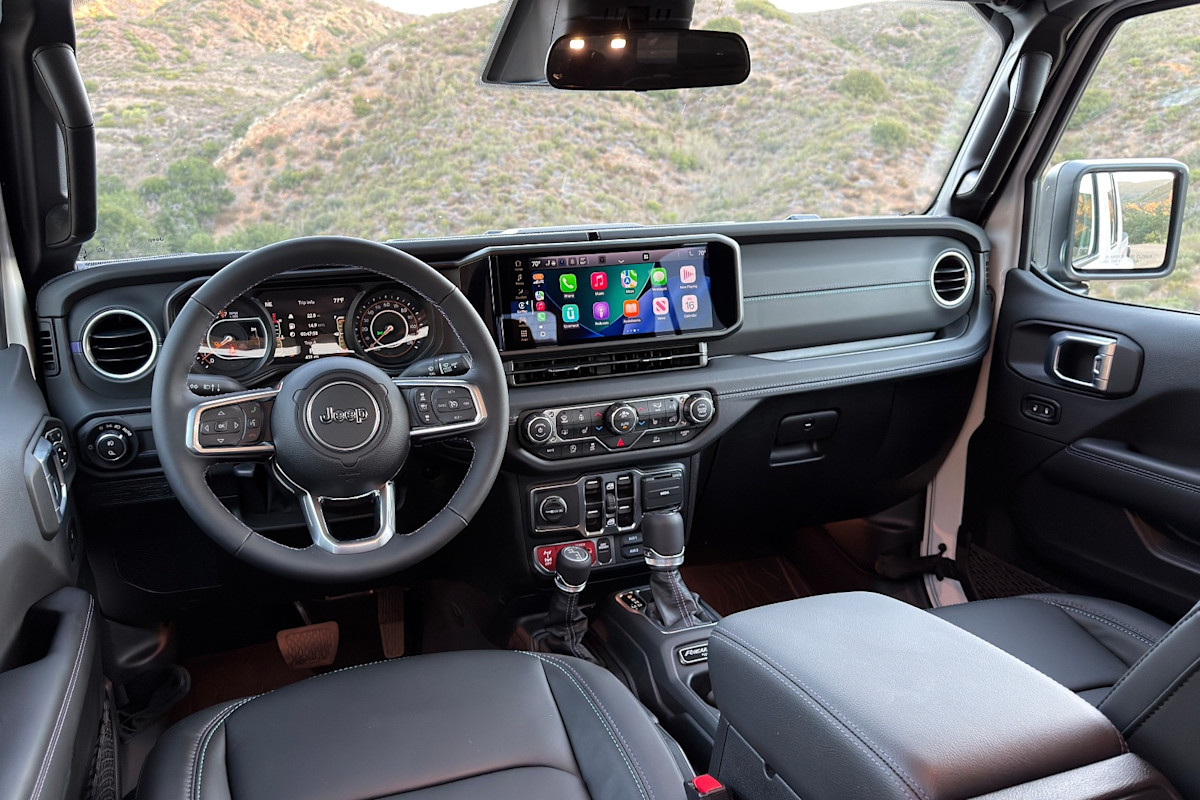
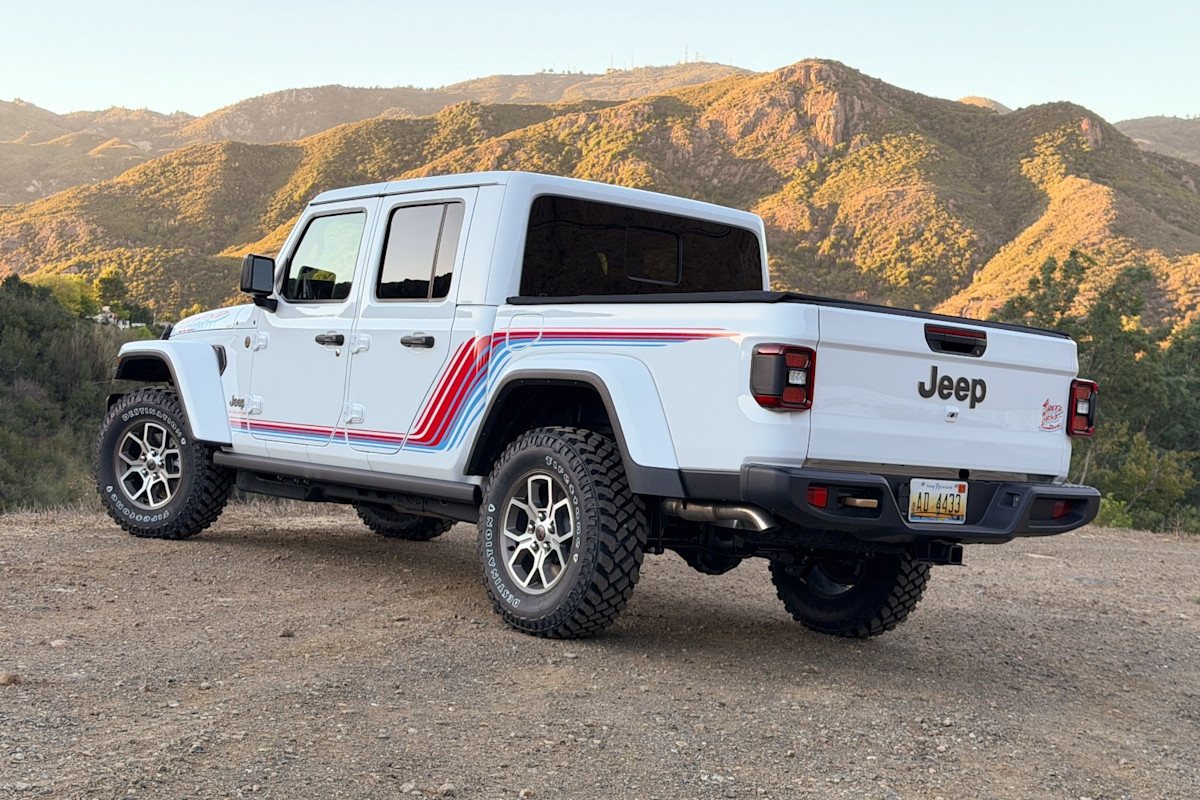
Outside, the highlights include colorful graphics on the hood and body sides, gold-accent wheels wrapped in off-road tires, gold-accent badges and recovery hooks, painted fender flares, and steel rock rails. Inside, the Rewind features heated front seats wrapped in Nappa leather with embossing inspired by retro arcade video-game graphics, aqua and purple contrast stitching, a dot-matrix shifter knob cap, a Rewind plaque on the cupholder housing, and all-weather slush mats.
Putting aside how great we thought this truck would look without the garish graphics package (but with the wheels and gold accents), it certainly catches the eye. We put a ton of miles on this Jeep driving from the northwestern suburbs of Los Angeles to the University of California at San Diego for parents’ weekend festivities, and the student body took note of the Jeep. Whether that notice was positive or negative is open to debate. They were, after all, born in this millennium.
Like most Jeep Gladiators, the interior was relentlessly black except for the exposed white inner surface of the test truck’s hardtop. The 80s-style graphics added some levity and texture, and polished metallic accents helped to lighten the mood. For buyers who want something lighter, Jeep offers Heritage Tan in the Willys ’41, black and green in the Mojave, Jean Blue in the Rubicon, or a bold plaid pattern in the 85th Anniversary Edition.
Artificial leather on the dashboard, a softly wrapped steering wheel, padded upper door panels, and the premium-grade seat leather all made the test truck’s interior feel smarter than expected. Still, the exposed hardtop and painted door-frame surfaces, rubber all-weather floor mats, and drain holes in the floor are reminders that the Gladiator is designed to get dirty, inside and out.
Performance
We didn’t get our test truck dirty. We could have, of course, but since this truck’s debut for the 2020 model year, we’ve spent a lot of time mudding, rock-crawling, and desert-running various iterations of the Gladiator. Even so, it is incredibly capable off-road even though its cargo box can occasionally get hung up on the terrain.
Instead, we drove the Gladiator Rewind like most owners do most of the time by taking kids to school, running errands, sitting in traffic, and taking drives just for the fun of it. And it is fun to drive a Jeep Gladiator. Cruising with the roof panels off and the windows down can put a smile on a driver's face.
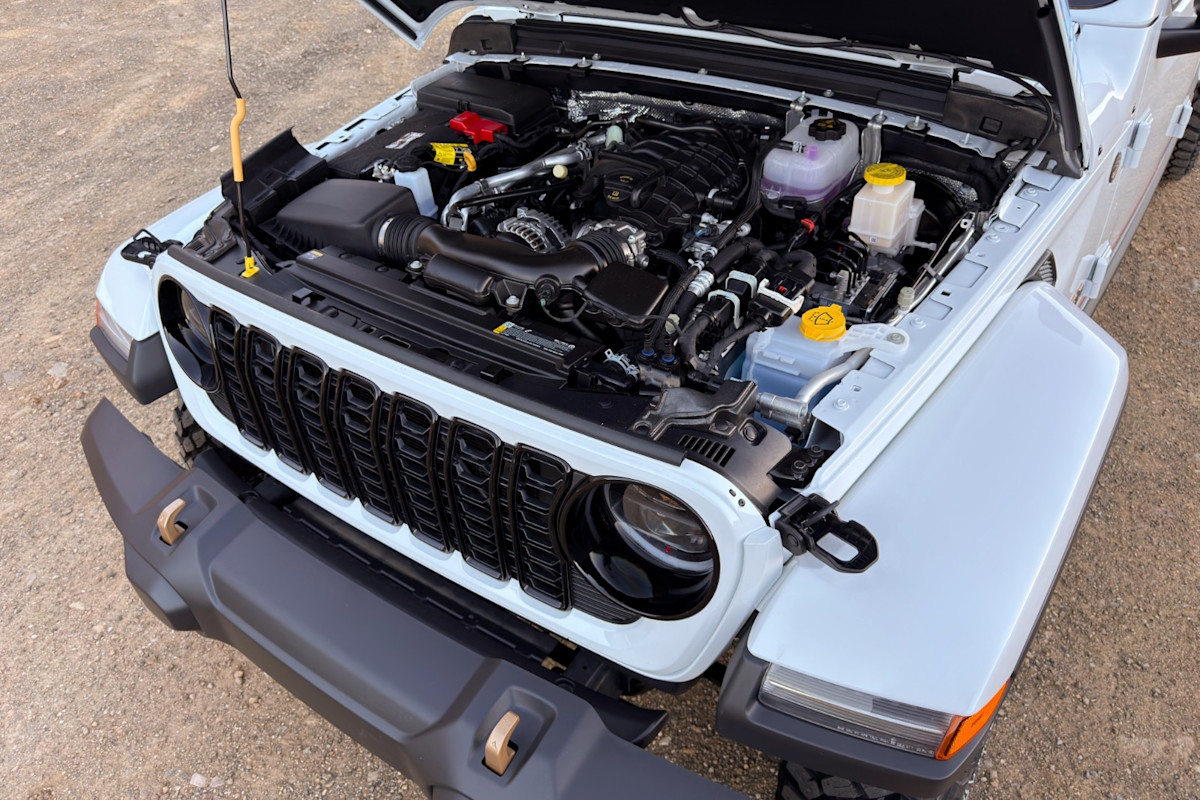
Under the latched clamshell hood is the same 3.6-liter V6 this truck has had since 2020, paired with the same eight-speed automatic transmission and one of four different part-time or full-time four-wheel-drive (4WD) systems. The V6 cranks out 285 horsepower and 260 pound-feet of torque, the same as it did when the Gladiator debuted.
In Sport or Sport S trim with the Max Tow Package, the Gladiator’s maximum payload rating is 1,720 pounds and its towing capacity is 7,700 pounds. Across the lineup, the baseline numbers are 1,025–1,200 pounds of payload and 4,500–7,000 pounds of towing capacity, depending on the trim level and options.
The Gladiator also offers up to 11.6 inches of ground clearance and 31.5 inches of water-fording capability. The approach angle measures 44.7 degrees, the departure angle is 26 degrees, and the breakover angle is 20.9 degrees.
At 19 mpg combined, the Jeep Gladiator isn’t particularly fuel-efficient, but neither are its rivals. Only the Toyota Tacoma consistently rates over 20 mpg combined, thanks to an available hybrid powertrain. In our testing, the Gladiator Rewind averaged 18.5 mpg on our Southern California fuel economy loop and 17.7 mpg on the mountainous dynamic evaluation loop.
The Gladiator’s drivetrain feels urgent and responsive from a standing start. Punch the accelerator to pass or to drop a gear for a hill climb, and the transmission obeys while the V6 summons additional thrust. Drivers will never think this Jeep is fast, but it’s quick enough to limit any complaints.
We spent a lot of time driving this truck on freeways. That’s not where the Gladiator is most at home, but from the perspective of preserving our driver's license, we appreciate that it feels like it's going much faster than it is. Between the wind noise and tire whir, cruising at 70 mph in any lane but the far left one was perfectly agreeable. Also, the steering didn’t feel as disconnected on-center as we expected, making the truck less tiring to drive over long distances.
In urban areas, the Gladiator feels stout and structurally robust as it pounds lousy pavement into submission, and drivers are never concerned about curbing a wheel or crunching an air dam when parking. Rear parking sensors are available, but our test truck didn’t have them. That was OK, because the rearview camera works well enough to avoid bumping into objects behind the truck. The Gladiator’s sheer length requires extra care in narrow drive-thrus and in cramped parking garages. Fortunately, it's easy to gauge where the truck’s front corners are.
No matter where they go, drivers should not expect a soft ride. Depending on the situation, the Gladiator Rewind can bounce a bit, especially over speed humps or through drainage dips. Typically, though, it feels stiff and, in lumpy corners and curves, skittish. Slow steering, low grip, and a jittery ride mean drivers need to take it easy. Over one mid-curve patched section of pavement on a good driving road, the rear end stepped out, the front end canted toward the road’s shoulder, and the stability control engaged to correct the behavior.
Form & function
Thanks to a detour that turned what should have been a relatively short drive into a long slog, we learned that the driver’s seat is not comfortable after six hours in the saddle, feeling as hard and flat as a park bench. Our test truck had power-adjustable front seats with lumbar adjustment—an improvement over most Gladiators—and the seats are fine on shorter journeys.
But after so much time on the road, we couldn’t wait to reach our destination and get out of this truck. Entry and exit are not a problem for those with long legs, but shorter folks will have a harder time. Irrespective of height, it is easy for drivers and passengers to get whatever might be on the outside of the truck on their clothes.
Roof options include a fabric convertible top, a sectioned hardtop, or both via the Dual-Top Group. The hardtop allows buyers to replace the two panels over the front seats with a fabric Sunrider option that makes it a lot easier to open the cabin to the sun.
Since the Sunrider upgrade necessitates the addition of a tonneau cover for the bed, it’s an expensive proposition. The hardtop’s dual front panels are easy enough to remove, and they're stored in a padded bag. However, unlike with a Jeep Wrangler, which has a secure cargo area to stow the roof panels, the only secure area in the Gladiator is the back seat.
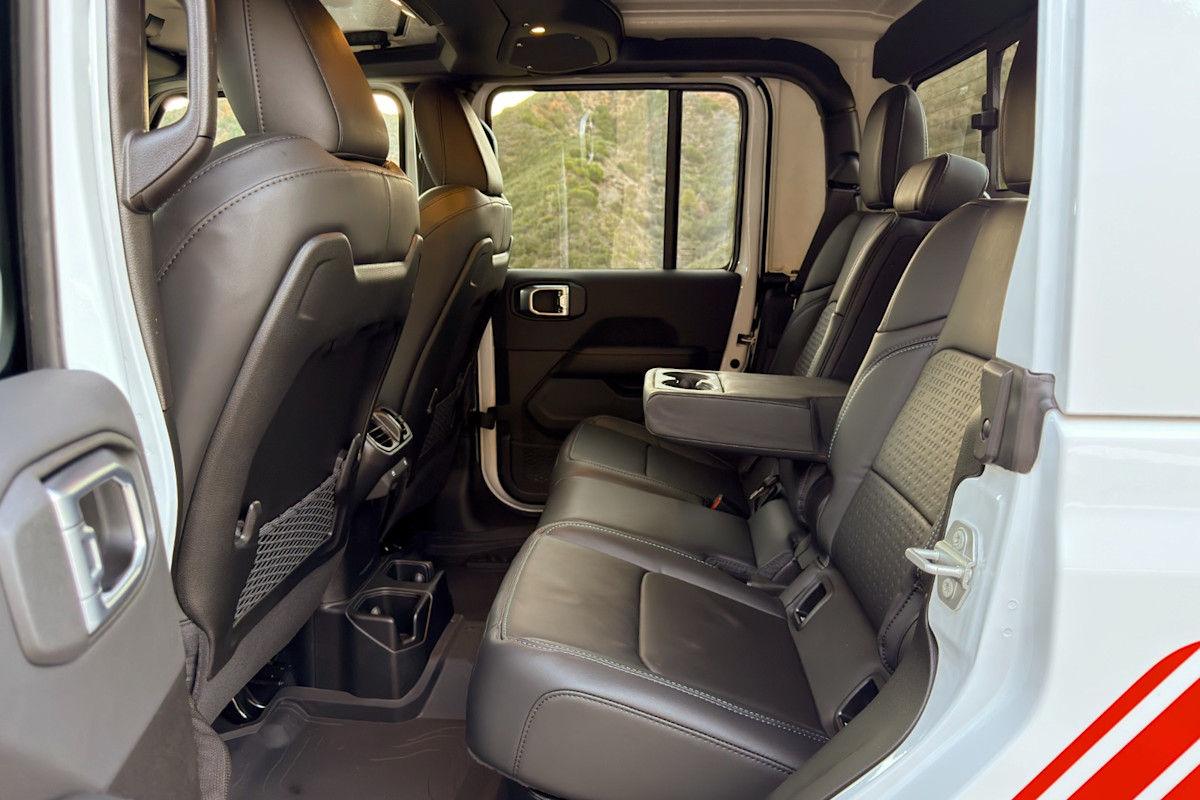
Use the back seat for passengers, and they’ll likely find it roomy in comparison to other midsize pickup trucks. The bottom cushion and backrest angles provide a good seating position, with proper leg support and a commanding seating height. There is plenty of storage space and two air conditioning vents, but the test truck did not have rear USB ports. The 60/40-split bottom seat cushion flips up to reveal an under-seat storage bin. Storage space up front is more limited.
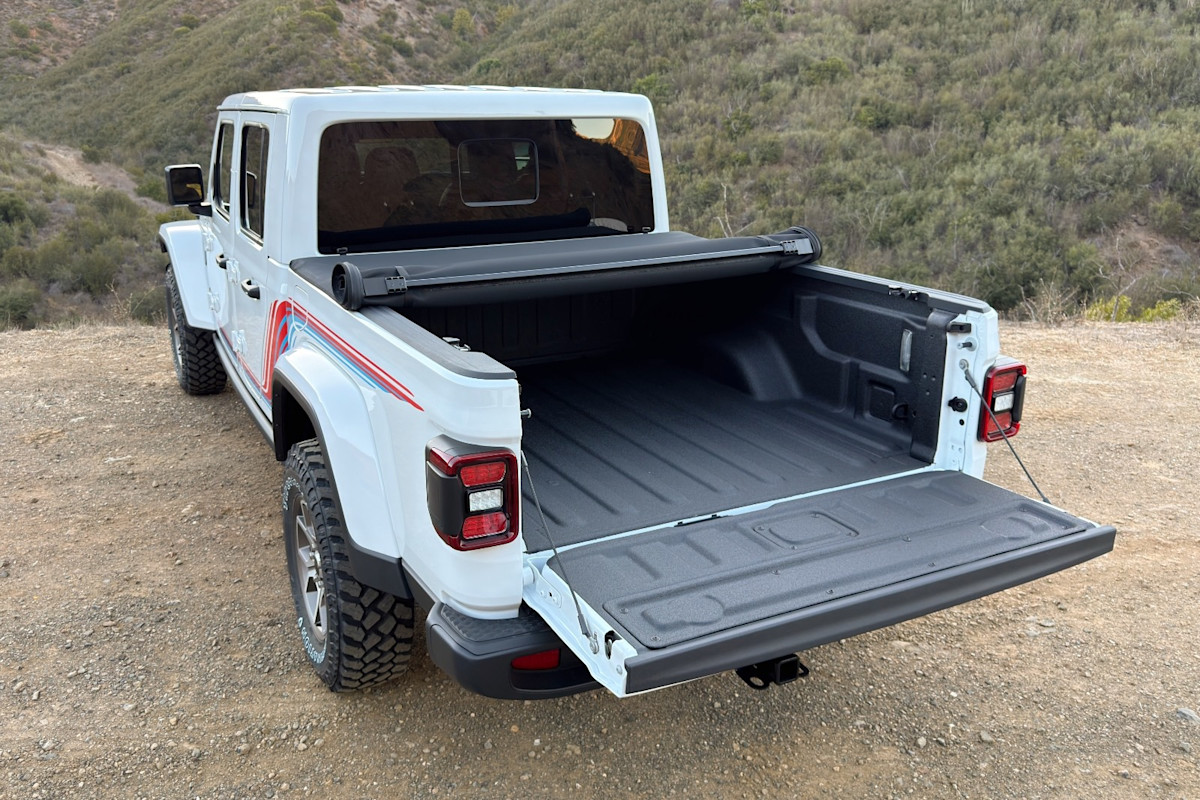
The optional roll-up tonneau cover for the cargo bed is easy enough to use. Our Gladiator Rewind tester also had the optional spray-in bed liner, lighting on each side of the bed, fixed tie-down loops, and a damped lightweight tailgate. Climbing up and into the bed is a challenge, especially when the tailgate is down.
Technology
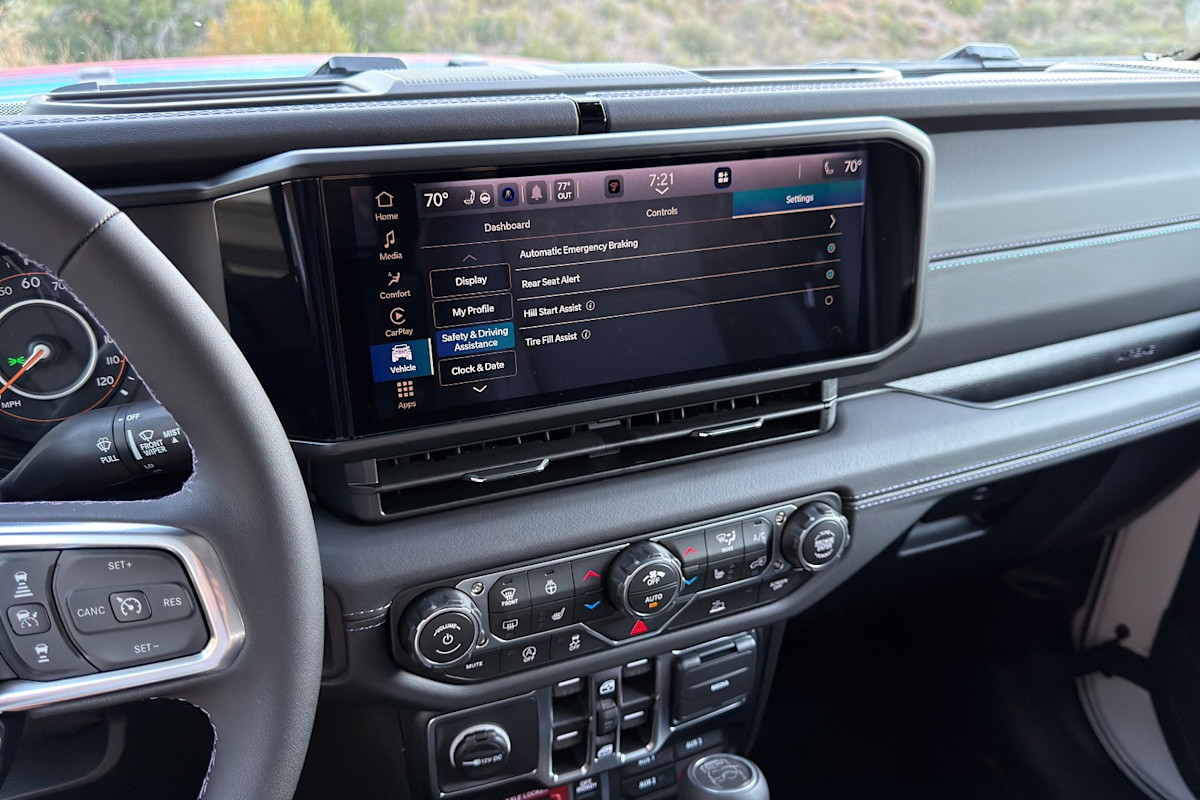
The Jeep Gladiator is not a technologically advanced vehicle, which is a part of its charm. Except for the small configurable display nestled between the analog gauges, the 12.3-inch touchscreen infotainment system, and a rearview camera, buyers will feel like it’s 1999.
That didn’t bother us one bit, especially when the Uconnect 5 infotainment screen glitched out on a truck with only 408 miles. It started loading the radio screen but then got stuck in a weird loop that intermittently magnified and shrank the displayed contents like a flashing billboard. We turned off the screen for the rest of that drive, and the problem never recurred.
Our Gladiator Rewind had Bluetooth connectivity, wireless Apple CarPlay, wireless Android Auto, and SiriusXM 360L satellite radio. It did not have a native navigation system or voice recognition, but we didn’t miss either of those features because CarPlay worked great, including Siri. The Gladiator’s standard eight-speaker stereo sounded impressive, too. So impressive that we initially thought it was the Alpine premium sound-system upgrade.
The standard Off-Road Pages display conveys a wealth of data pertinent to off-roading. Highlights include exact coordinates and elevation, vehicle pitch and roll, gauges related to fluid and component status, and more. Some of this data is also available through the digital driver display.
To unlock more tech, buyers must upgrade to the Uconnect 5 Nav system, which adds navigation, voice recognition, and Jeep Connect connected services with a smartphone app offering remote access to vehicle information and settings. It also includes Off-Road Trail Guides, which is helpful when exploring parts unknown. Other optional features include Alexa Built-In, a removable Bluetooth speaker, and a TrailCam off-road camera system.
Safety
As with the in-cab tech stack, the list of standard driver-assistance features is short. Forward-collision warning, automatic emergency braking, and adaptive cruise control are available only starting with the Sport S trim level, not the base Sport trim.
High-beam assist, blind-spot monitors, rear cross-traffic alert, and rear parking sensors are optional. Buyers can also get improved LED headlights that rate higher in safety testing, but the paucity of standard features is not great. Even our nearly $55,000 test truck didn’t have blind-spot monitors, which we definitely missed.
The Jeep’s adaptive cruise control performance was mixed. At higher speeds when another vehicle cut into the gap ahead, it sometimes braked too suddenly and too much, creating problems for vehicles behind. At slower speeds in thicker traffic, it was more agreeable, offering natural braking and gap maintenance.
The National Highway Traffic Safety Administration had not given the 2026 Gladiator an overall safety rating at the time of rating. It gave the Jeep a four-star frontal-crash rating and three-star rollover rating but had not published the side-impact ratings.
The Insurance Institute for Highway Safety gave the Gladiator a mix of Good and Acceptable ratings in crash tests, but lower ratings for crash avoidance and mitigation tech and headlights. The standard headlights received a Poor rating, and even the optional headlights were only rated Marginal.
Cost-effectiveness
If buyers want the open-air driving experience the Gladiator offers, or they regularly travel far off the beaten path, then this Jeep is extremely cost-effective. While it lacks the turbocharged four-cylinder engines of rivals that post better EPA fuel-economy numbers, the Gladiator’s real-world efficiency is in the same ballpark as its official ratings. We can’t say the same for the turbo-fours in some competitors, or even the optional hybrid powertrain in a Toyota Tacoma.
What’s frustrating about buying a Gladiator is how Jeep packages it. For example, if shoppers want the maximum towing and payload capacity, they must live with a basic trim level. If they want a body-color hardtop for a Willys, tough luck. If they want an interior color other than black, they’re restricted to special editions that also include things they might not want. And every paint color except for Bright White and Hydro Blue costs extra.
Not only that, but if buyers want certain upgrades, they often have to select other extra-cost features that they don’t want. That’s how opting for a Sunrider roof panel winds up adding almost $1,600 to the bottom line (at a minimum), because it must be inexplicably paired with a bed tonneau cover.
When shoppers do find an acceptable compromise, they’re typically spending at least $50,000—and usually more. Given the brand’s basement-dwelling status with organizations that rate reliability, Jeep needs to add more value and make it a lot less frustrating to find a Gladiator that checks all the boxes.
After all, there are other off-road-capable midsize trucks on the market. And while driving around exposed to the elements is fun, it isn’t necessarily healthy. Don’t forget the sunblock.
What owners say
Trims & specs
Base MSRP $56,995 | Seating 5 |
Engine N/A | Cargo Capacity N/A |
Combined MPG N/A | Drivetrain N/A |
Base MSRP $52,695 | Seating 5 |
Engine 3.6L 285 hp V6 | Cargo Capacity N/A |
Combined MPG 19 | Drivetrain 4X4 |
Base MSRP $52,000 | Seating 5 |
Engine 3.6L 285 hp V6 | Cargo Capacity N/A |
Combined MPG 19 | Drivetrain 4X4 |
Base MSRP $47,840 | Seating 5 |
Engine N/A | Cargo Capacity N/A |
Combined MPG N/A | Drivetrain N/A |
Base MSRP $47,595 | Seating 5 |
Engine N/A | Cargo Capacity N/A |
Combined MPG N/A | Drivetrain N/A |
Base MSRP N/A | Seating N/A |
Engine N/A | Cargo Capacity N/A |
Combined MPG N/A | Drivetrain N/A |
Base MSRP $60,690 | Seating 5 |
Engine 3.6L 285 hp V6 | Cargo Capacity N/A |
Combined MPG 19 | Drivetrain 4X4 |
Base MSRP $46,290 | Seating 5 |
Engine N/A | Cargo Capacity N/A |
Combined MPG N/A | Drivetrain N/A |
Base MSRP $59,995 | Seating 5 |
Engine 3.6L 285 hp V6 | Cargo Capacity N/A |
Combined MPG 19 | Drivetrain 4X4 |
Base MSRP $45,230 | Seating 5 |
Engine 3.6L 285 hp V6 | Cargo Capacity N/A |
Combined MPG 19 | Drivetrain 4X4 |
Base MSRP $39,300 | Seating 5 |
Engine 3.6L 285 hp V6 | Cargo Capacity N/A |
Combined MPG 19 | Drivetrain 4X4 |
Base MSRP $49,245 | Seating 5 |
Engine N/A | Cargo Capacity N/A |
Combined MPG N/A | Drivetrain N/A |
Base MSRP $42,495 | Seating 5 |
Engine 3.6L 285 hp V6 | Cargo Capacity N/A |
Combined MPG 19 | Drivetrain 4X4 |
Base MSRP $45,300 | Seating 5 |
Engine 3.6L 285 hp V6 | Cargo Capacity N/A |
Combined MPG 19 | Drivetrain 4X4 |


Pricing trends
MSRP range
$39,300 - $60,690
Current avg. market price
$42,780
Trending down by 1.7% this month
May 2026 - November 2026


