2026 Cadillac LYRIQ-V Reviews, Pricing & Specs


Pros & cons
What we like
Stylish design
Well-tuned chassis
Easy-to-use technology
What to consider
Not that much quicker than other EVs
Irritating safety chimes
Mediocre DC fast-charging
The CarGurus verdict
Cadillac’s first all-electric vehicle gets the V-Series performance treatment.
The Lyriq was the first Cadillac EV to reach showrooms, so it’s fitting that it’s also the first electric Cadillac to get a V-Series performance variant. The 2026 Cadillac Lyriq-V gains more power, sportier chassis tuning, and subtle styling changes to differentiate it from the standard Lyriq, which has been on sale since the 2023 model year and carries into 2026 with updated tech features, including a 23-speaker AKG audio system with Dolby Atmos and an augmented reality head-up display that are also available on the V-Series model.
Verdict: The first Cadillac V-Series EV succeeds in making the Lyriq a lot more exciting, without compromising the luxurious feel that makes it one of the best electric SUVs.
out of 10 expert review
Look & feel
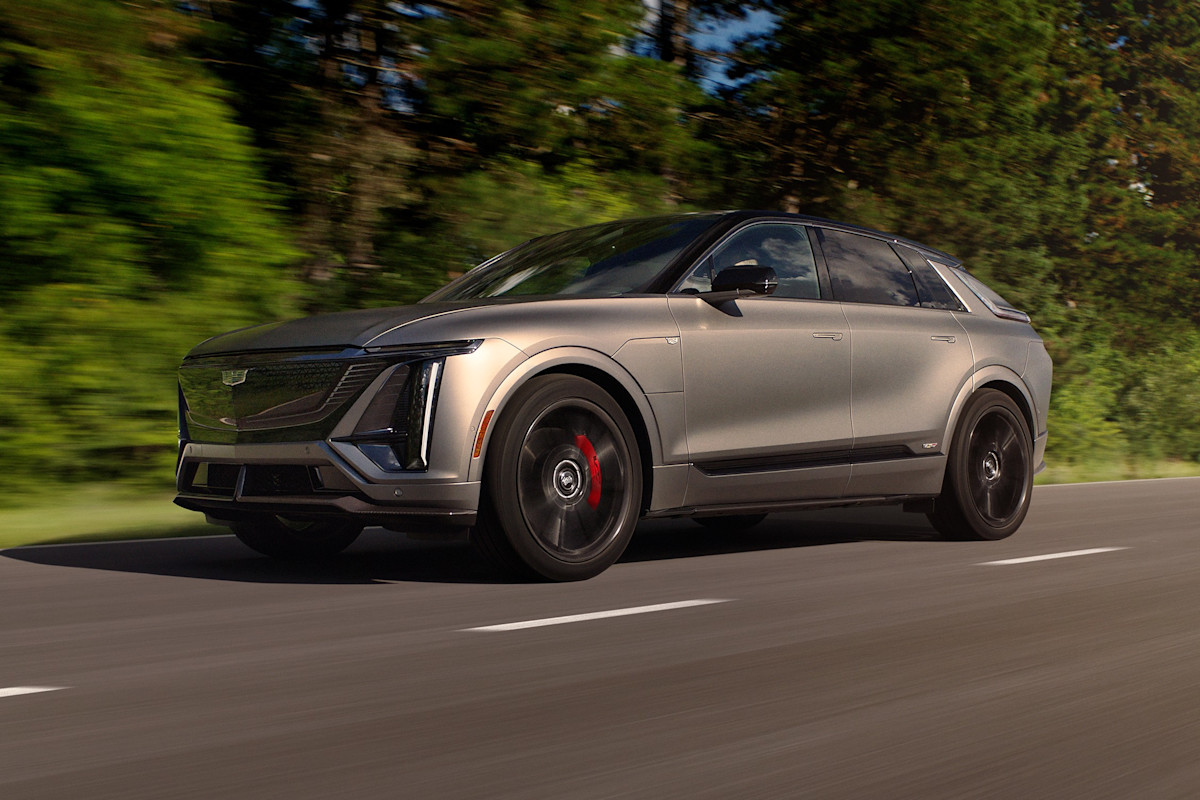
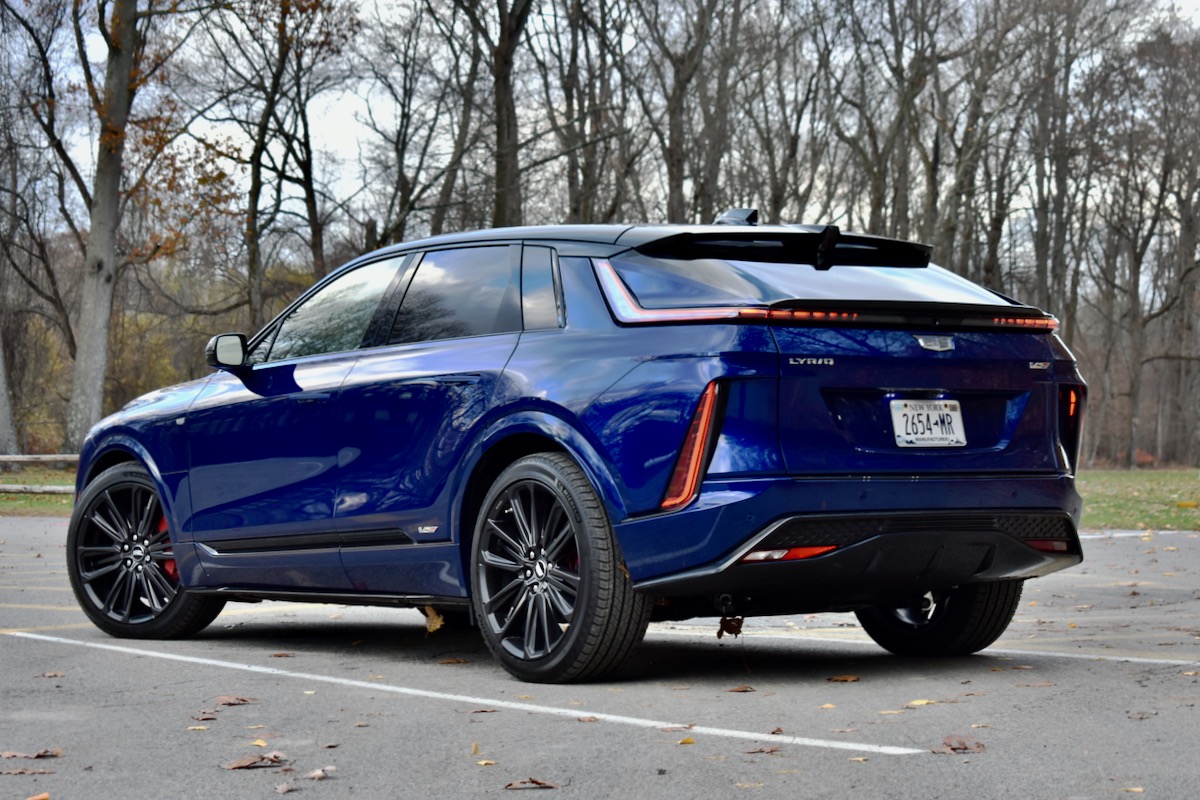
The V-Series is fast but subtle. Minor styling changes like a new lower front fascia, rocker panels, and body-color lower trim, and a standard black-painted roof are the only callouts, along with the obligatory “V” badging. It’s perfect for those who don’t want constant attention from the police or stoplight drag racers, and doesn’t interfere with the already-dramatic styling of the base car. With its light-up grille flanked by pillar-like LED headlights, fastback profile, and futuristic rear lighting signature, the Lyriq takes Cadillac styling in a different direction, but one that’s still faithful to the General Motors luxury brand’s character.
Like other Cadillac EVs, the Lyriq is based on GM’s flexible EV component set, formerly known as Ultium. That means a unibody architecture with the chassis dimensions determined by the battery pack, in this case a 102-kilowatt-hour unit that gives the Lyriq a 121.8-inch wheelbase. That’s nearly identical to the three-row Cadillac Vistiq, as that model uses the same pack, but in a vehicle with only two rows of seats.
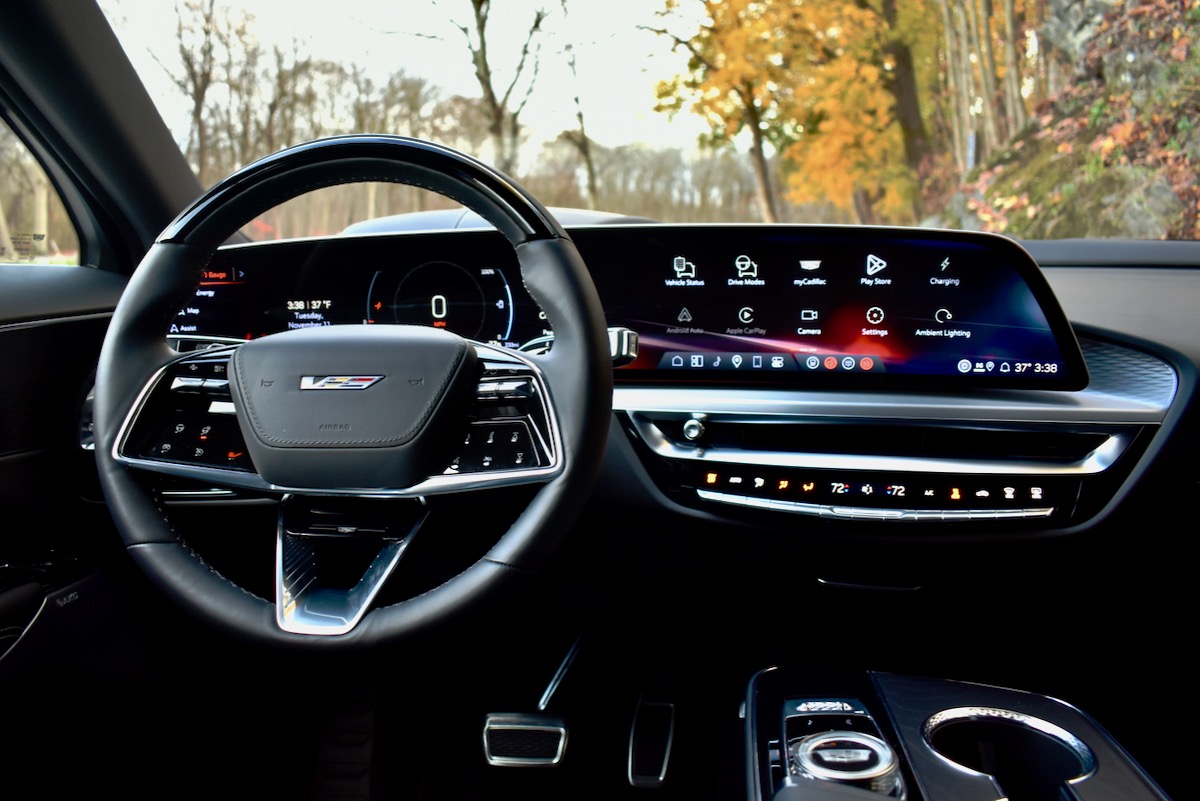
There isn’t much differentiation for the V-Series model inside, either. The steering wheel’s Cadillac crest is replaced by a V-Series logo, the paddle shifter used for controlling regenerative braking is now aluminum instead of plastic, and an additional button activates the V-Mode drive mode. The front seats have power-adjustable bolsters, but they still felt inadequate for a performance vehicle where the driver and front passenger will experience higher-than-average lateral G.
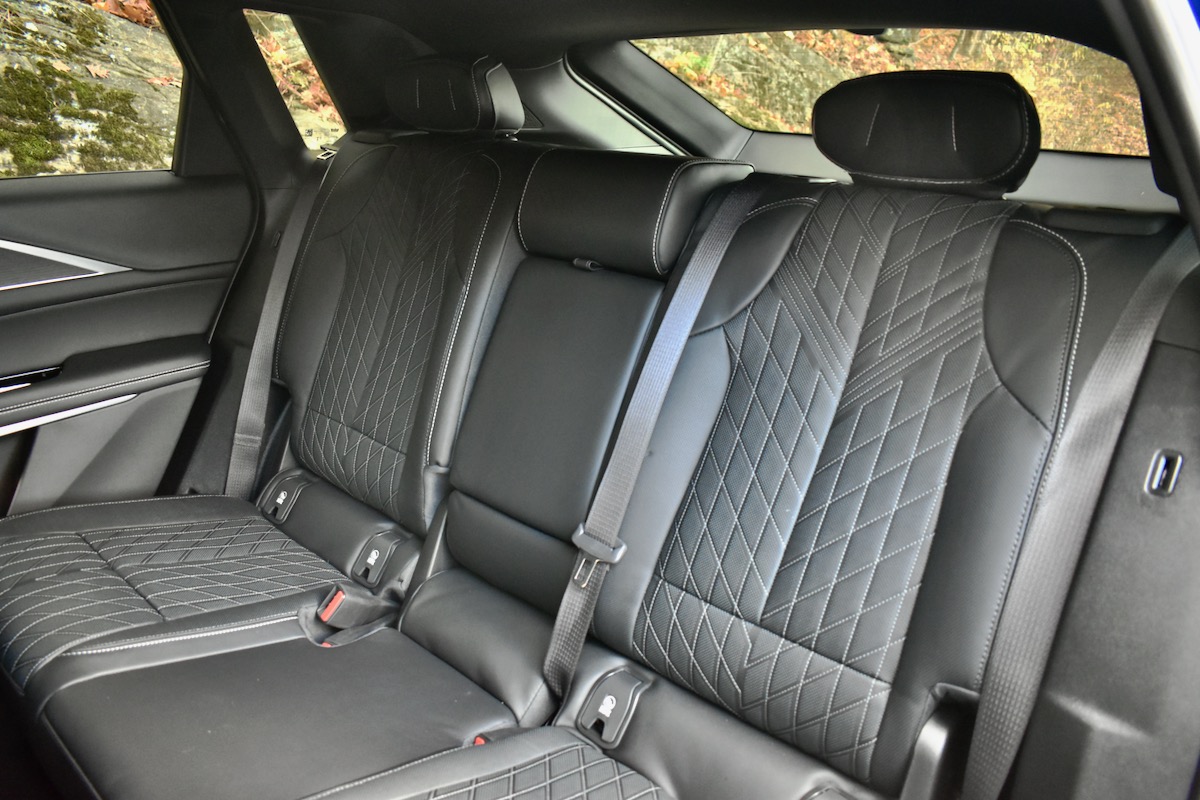
Still, Cadillac deserves credit for not descending into caricature. The steering wheel has nice added hand grips, but without the bratwurst thickness of BMW M or Mercedes-AMG wheels. The standard Paperwood trim is a nice alternative to traditional wood and the carbon-fiber trim that can look a little pretentious in other luxury SUVs. The Lyriq-V also comes very well equipped, with standard heated, ventilated, and massaging front seats, heated outboard rear seats, tri-zone climate control, and a panoramic glass roof with a power sunshade. Premium models add Nappa leather upholstery.
Performance
The Lyriq-V gets the same uprated dual-motor all-wheel drive (AWD) powertrain as the Vistiq and the Chevrolet Blazer EV SS. That means 615 horsepower and 650 pound-feet of torque—increases of 100 hp and 200 lb-ft over the standard dual-motor Lyriq and 250 hp and 325 lb-ft more than the single-motor rear-wheel drive (RWD) base model.
With that extra power, Cadillac says the Lyriq-V will do zero to 60 mph in 3.3 seconds, making it the quickest-accelerating production car in brand history. However, that’s by a small margin, as even the Vistiq will do zero to 60 mph in 3.7 seconds. The Lyriq-V is also just 0.1 second quicker than its Blazer EV SS platform-mate. It does beat the much pricier BMW iX M70 xDrive and Mercedes-AMG EQE SUV as well, but by similarly small margins.
The quickest acceleration is accessed with the Velocity Max launch mode. There’s also a Competition Mode intended for track driving, and V-Mode, which lets drivers customize performance settings for things like steering, damping, regenerative braking, and accelerator-pedal response. Tour, Sport, and Snow/Ice drive modes are included as well.
Those drive modes give the Lyriq-V an impressive breadth of capability. The default Tour mode provides good body control and a comfortable ride, although perhaps a degree or two less refined than the standard Lyriq. That’s likely down to the V-Series model’s 22-inch wheels, which come standard with summer performance tires. Our car had optional all-season tires, which were needed due to the colder weather at our test drive location. They weren’t an impediment, though, as in the sportier driving modes the suspension damping and traction-control intervention were well-judged.
It may not have the purest driving experience, and the artificial soundtrack is no substitute for a CT5-V Blackwing’s supercharged V8, but the Lyriq-V was impressively lithe for a 5,980-pound SUV. The response of the chassis and steering also felt smooth and natural; the software that makes the cornering heroics possible was kept well in the background.
The Lyriq-V is also equipped with Brembo front brake calipers, strong regenerative braking meant we didn’t need to use them much. We were even able to bring the car to a stop without the brake pedal in some cases. As with other GM EVs, the steering-wheel paddle calls up an extra burst of regen, a bit like downshifting in a gasoline car. And regen levels can be lowered via the touchscreen, depending on your preferences.
Form & function
While it’s considered an SUV, the Lyriq has a sleek profile that limits rear headroom compared to the similar-size BMW iX and Mercedes-Benz EQE SUV. The iX has 3.4 inches of additional front-seat headroom as well. However, the Lyriq’s limo-like wheelbase—nine inches longer than the BMW’s—affords superior legroom in both rows. A tall seating position also affords the easy ingress and egress expected of an SUV, but a long hood and tilted rear window limit visibility. The standard rearview camera mirror and surround-view camera system were definitely appreciated.
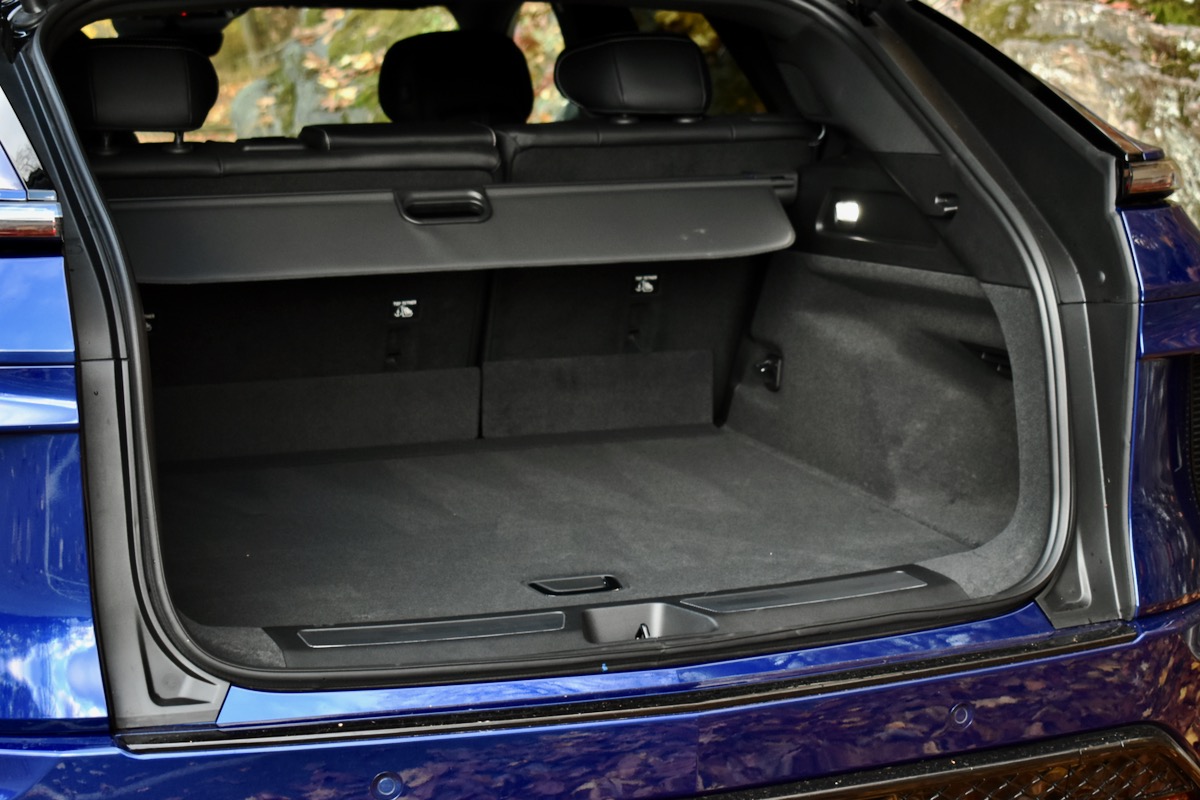
Cadillac quotes 28 cubic feet of cargo space behind the second row. That’s twice what you get in a Mercedes EQE SUV. Fold the back seats and you’ll find 60.8 cubic feet of cargo space, about five cubic feet more than in the Mercedes. The BMW iX has even more cargo room, though. The Lyriq lacks a frunk, but so do its German rivals. The Lyriq-V spec sheet also shows the same 3,500-pound towing capacity as the standard dual-motor Lyriq.
Up front, the cabin prioritizes form over function. The elevated center console serves as a great platform for the rotary infotainment controller and audio-volume toggle, but the design doesn’t leave much storage space. The Lyriq-V may be marketed as an SUV, but the cockpit layout is interchangeable with that of a luxury sedan.
Technology
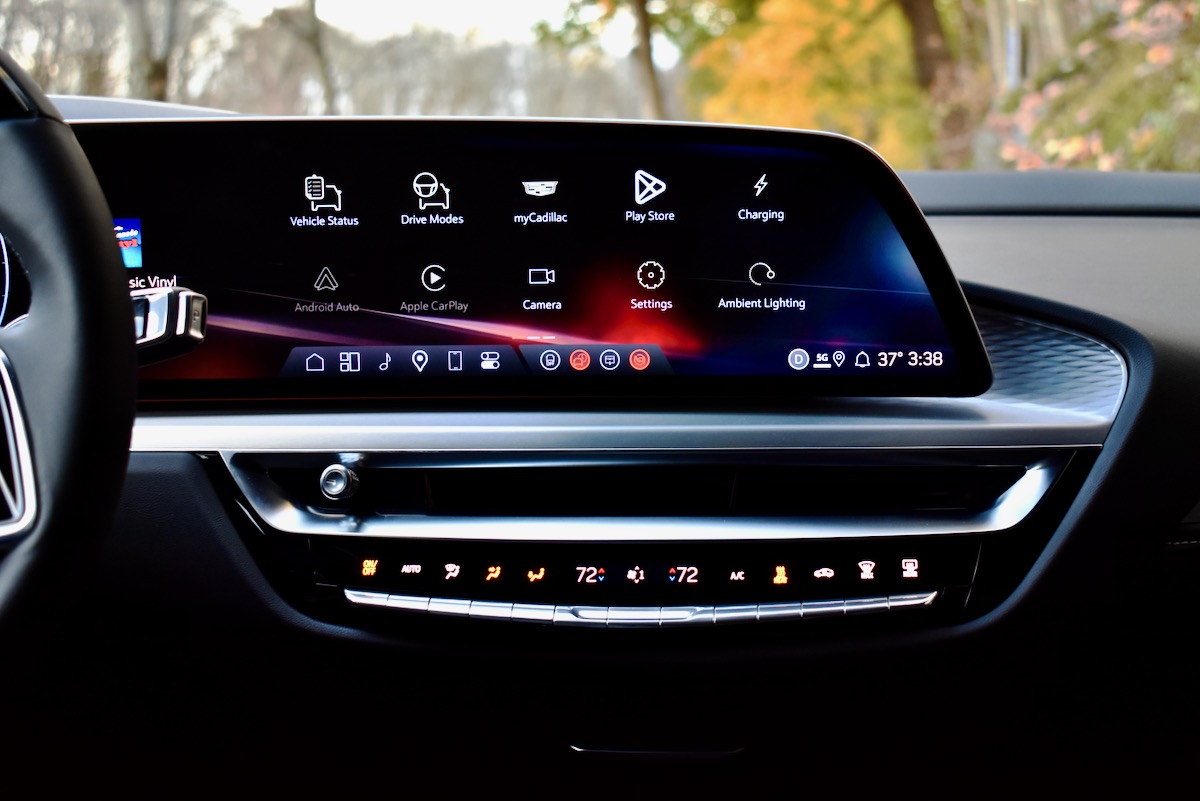
A 33-inch dashboard display carries over from other Lyriq models, with some V-specific graphics. The curved LED display encompasses the instrument cluster and infotainment touchscreen, along with a smaller panel to the left of the driver for secondary functions, like accessing the trip computer and changing the display’s layout. All Lyriq models retain standard wireless Apple CarPlay and Android Auto for 2026, which isn’t the case with other GM EVs.
The 2026 Lyriq-V does have the same Google Built-in apps as those other GM EVs, though. Google Maps serves as the default navigation system, Google Assistant provides voice recognition, and additional apps can be downloaded from the Google Play Store. This works well, even if the GM version of Google Assistant isn’t as good as the native voice recognition in a new Audi, BMW, or Mercedes. Cadillac’s simpler interface more than makes up for that.
Lyriq-V models also come standard with a 23-speaker AKG audio system with Dolby Atmos and an augmented-reality head-up display. Both are new to the Lyriq lineup for 2026, and are optional extras on non-V trim levels. When listening to SiriusXM satellite radio or Spotify, the sound system lived up to its premium billing. Dolby Atmos adds more depth and texture, but it’s only available through certain music streaming services. The head-up display shows navigation directions, speed, and driver-assistance warnings with added clarity thanks to a new dual-pane design.
Safety
Standard driver-assist features carry over from other Lyriq models. The list includes: forward collision warning, forward and reverse automatic emergency braking, blind-spot monitoring with steering assist and side bicyclist detection, rear cross traffic alert, and adaptive cruise control.
Super Cruise hands-free driving is standard as well. This system handles acceleration, braking, and steering on pre-mapped roadways, but still requires drivers to keep their eyes on the road. For the 2026 model year, Super Cruise gets updates including improved integration with Google Maps. However, that connectivity requires an active OnStar data-service subscription.
Other GM-standard features include a teen-driver system that limits certain vehicle functions when a teenager is behind the wheel, and a vibrating driver’s seat that helps communicate safety warnings alongside the normal audio and visual cues. These warnings became a bit overwhelming. The blind-spot monitoring system was a bit oversensitive and, because the Lyriq starts up automatically when you sit down, you’re always greeted with seatbelt chimes.
Full safety ratings from the Insurance Institute for Highway Safety (IIHS) were not available at the time of publication. The IIHS gave 2025 Lyriq models its highest “Good” rating in small overlap front, updated moderate overlap front, and updated side-impact crash tests. The headlights used on all Lyriq models received the lowest “Poor” rating, however.
The National Highway Traffic Safety Administration (NHTSA) also hadn’t published ratings for 2026 Lyriq models at press time. The federal safety agency gave the 2025 Lyriq a five-star overall safety rating, with five-stars in all crash-test categories.
Cost-effectiveness
An EPA-range rating of 285 miles is 34 miles less than the 319 miles a non-V AWD Lyriq achieves with the standard 11.5-kilowatt onboard charger (models with the 19.2-kW charger are rated at 303 miles). And our observed efficiency of 2.4 miles per kWh shows that achieving even that might be difficult in the real world.
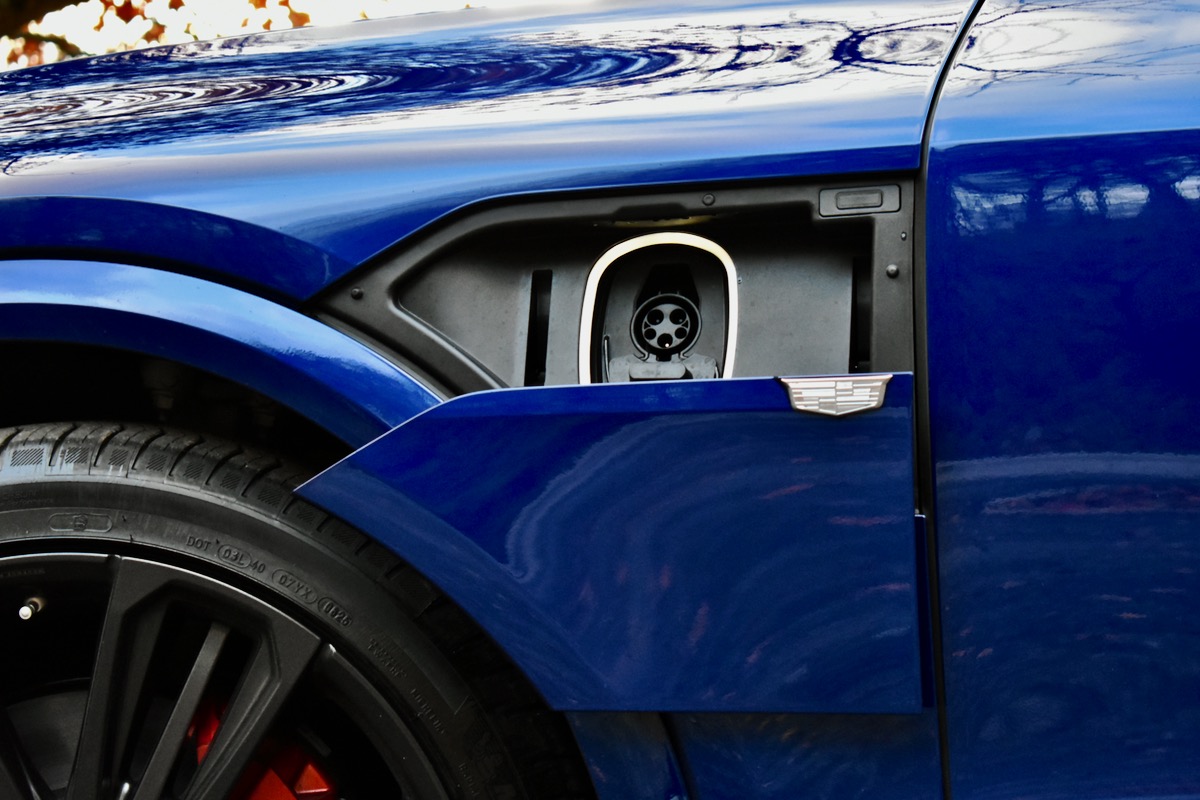
The Lyriq-V is also available with both 11.5-kW and 19.2-kW chargers, but there’s no range difference. The less-powerful charger can recover 27 miles of range per hour of AC charging at 240 volts, according to Cadillac. Available on the Lyriq-V Premium trim level, the 19.2-kW boosts that to 44 miles per hour. Cadillac says a 10%-80% DC fast charge takes 40 minutes, which is pretty slow by current standards.
Warranty coverage includes a four-year/50,000-mile bumper-to-bumper limited warranty and an eight-year/100,000-mile warranty that covers the battery pack and powertrain.
Pricing starts at $80,090 with the mandatory $1,495 destination charge. The Premium trim level costs $5,200 more, but doesn’t add many features. That’s because the base model is already so well equipped, with almost every feature available on the non-V trim levels. Considering that the Lyriq-V costs $6,795 more than the most-expensive non-V model, that’s as it should be. With its extra power, sportier driving dynamics, and luxurious cabin, the Lyriq-V is a very complete vehicle for its price.
Cadillac also offers this combination of performance and luxury at a lower price than the BMW iX M70 xDrive and Mercedes-AMG EQE SUV. An Audi SQ6 e-tron is cheaper still, but it’s smaller and not as satisfying to drive. For a left-field choice, the Rivian R1S Dual is nearly as quick from zero to 60 mph, but has 410 miles of range and greater utility for only a few grand more. The Chevy Blazer EV SS is essentially a blue-collar version of the Lyriq-V for $62,095 with destination. But for luxury-car shoppers who spend more time on pavement than dirt, the Lyriq-V is a sensible choice.
What owners say
After 1 yr with this vehicle I have a lot of really good things to say. 1: install a charger in the garage or on the house to charge. In our city; Medicine Hat we have electrical rate of $0.15 per kw. With a 102kw battery it costs $15.00 to fill from dead empty which never happens as we plug in every few days. 2: range is dependant on outdoor temp. According to manual the battery is best at 26 degrees Celsius. Above freezing it gets at easy 400km below freezing you have to divide the total km listed on the screen by 3. It says at full charge 494km. Average highway is 3.1km per kw. In town it’s 4.6km per kw. 3: comfort of the ride is exceptional and it glides along rather than bounces like 90% of most vehicles nowadays. Remixes me of the old grand marquis in ride. 4: power is exceptional. No shifting of gears so it’s fluid with power at every point. The AWD version which I have has over 500hp so it makes highway driving a dream. 4: cabin comfort is also amazing. It is quiet inside. Barely any wind noise and the tires that come with the unit are also quiet. The sound system seems a little quiet for my liking and could use a tweak. Controls are easy to find and the map feature tells you of charge locations and range till empty and it does it on the fly so every km driven will tell you a percentage you will have till you hit your destination. 5: charging is easy and it has the CCS port just in front of the drivers door. I would suggest buying a nacs adapter so you have access to all the charging spots available. Also the software is updated regularly. It’s over the air and only takes about 10-15 min to update. So it’s easy to do anytime you plug in. The vehicle comes with a 240 and a 120volt charging cable and has a brilliant option when plugged in to your house. If there is a power outage your car will reverse power and keep your house powered till the power comes back online. 6: insurance and registration is more!!! In Alberta we are charged $100 per yr more because we are not paying tax on gas. Insurance companies are worried about battery fires so they charge more. 7: it’s a Cadillac through and through. It is top of the line and as a 50 yr old with teenagers and older kids with grand kids this vehicle is by far one of the best I have ever purchased. I would give this suv a 9/10 just because of the highway range only. Thanks for reading
March 30, 2026Trims & specs
Base MSRP $78,700 | Seating 5 |
Engine N/A | Cargo Capacity 28.0 cu ft |
Combined MPG N/A | Drivetrain N/A |
Base MSRP $83,900 | Seating 5 |
Engine N/A | Cargo Capacity 28.0 cu ft |
Combined MPG N/A | Drivetrain N/A |