2025 Volkswagen Golf R Reviews, Pricing & Specs

Pros & cons
What we like
Great handling
Powerful engine
Standard all-wheel drive
What to consider
Potentially polarizing design
Poor ergonomic design
The CarGurus verdict
It may be a hot hatchback, but the VW Golf R never loses its cool.
The 2025 Volkswagen Golf R is the hotter of VW’s two hot hatchbacks, boasting more power than its Golf GTI platform mate, plus a standard all-wheel-drive system (AWD), known as 4Motion, and a commensurately higher base price that puts it in the same competitive set as the Honda Civic Type R and Toyota GR Corolla. The current-generation Golf R was launched as a 2022 model but gains a handful of small updates for 2025, including a new touchscreen infotainment system and two new styling packages.
Verdict: It’s hard to fault the Golf R’s performance capabilities and everyday usability, but the same can be said of its GTI sibling.
out of 10 expert review
Look & feel
The Golf R is the sportiest version of the Volkswagen Golf hatchback, tracing its lineage back to the limited-edition R32 of the early 2000s. The standard Golf remains a bestselling economy car in Europe, but because of Americans’ aversion to hatchbacks, VW opted not to bring the base Golf to the U.S. when the current generation arrived, so this market only gets the amped-up Golf R and Golf GTI.
While it looks completely different inside and out, the current-generation Golf (which arrived in Golf R form as a 2022 model) shares VW’s MQB platform with the previous-generation model. That highly flexibility platform also underpins the Volkswagen Jetta sedan and the Taos, Tiguan, Atlas, and Atlas Cross Sport crossovers—everything VW currently sells in the U.S. that isn’t electric.
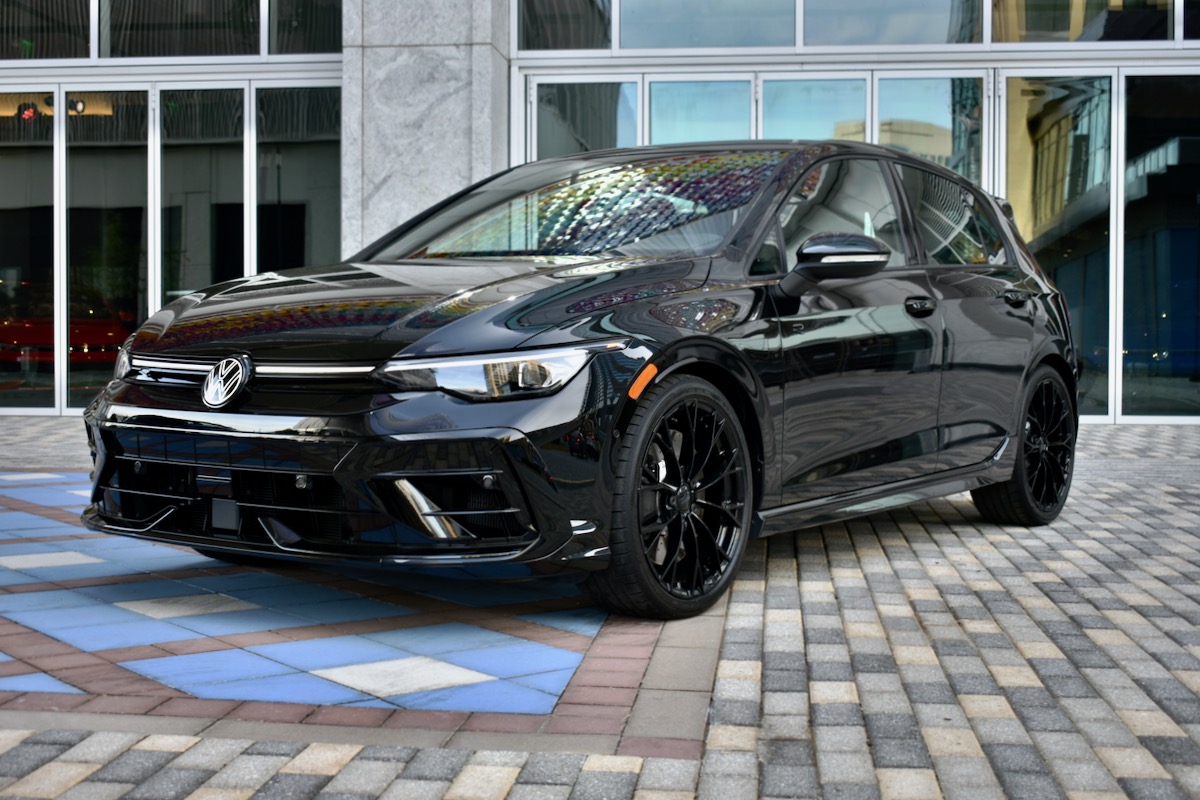
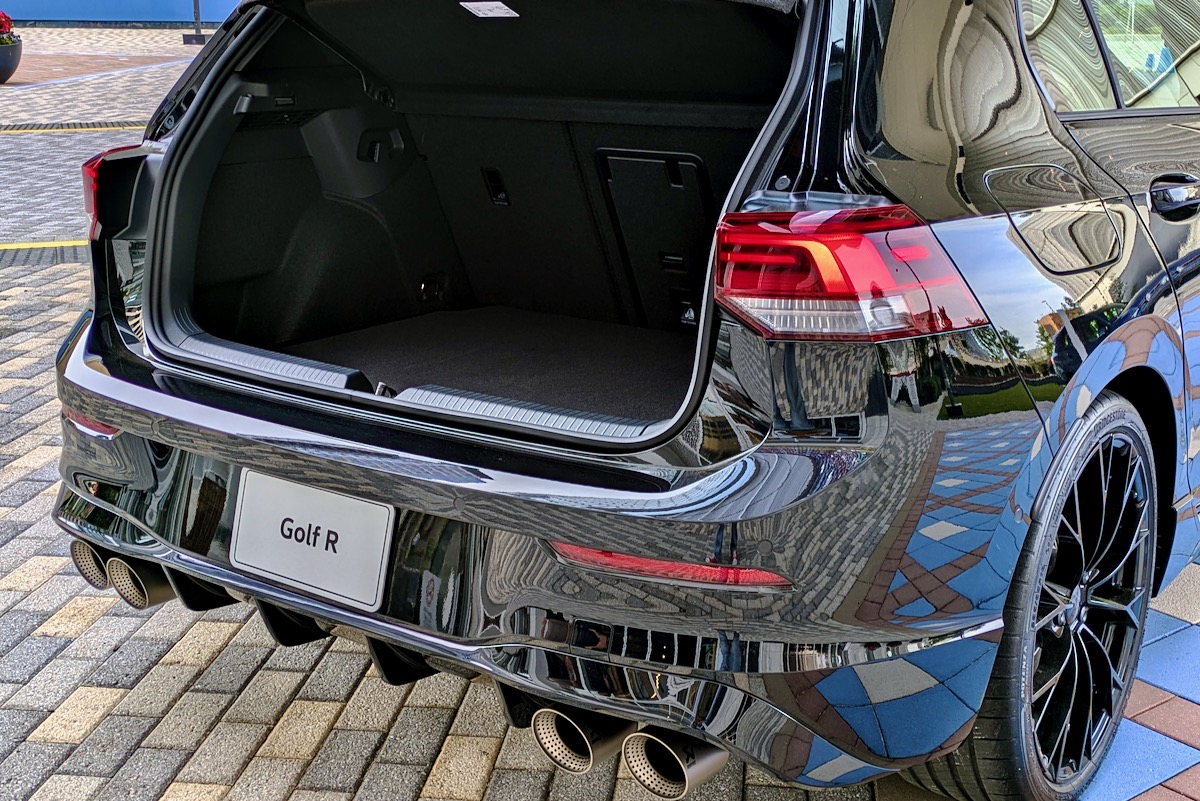
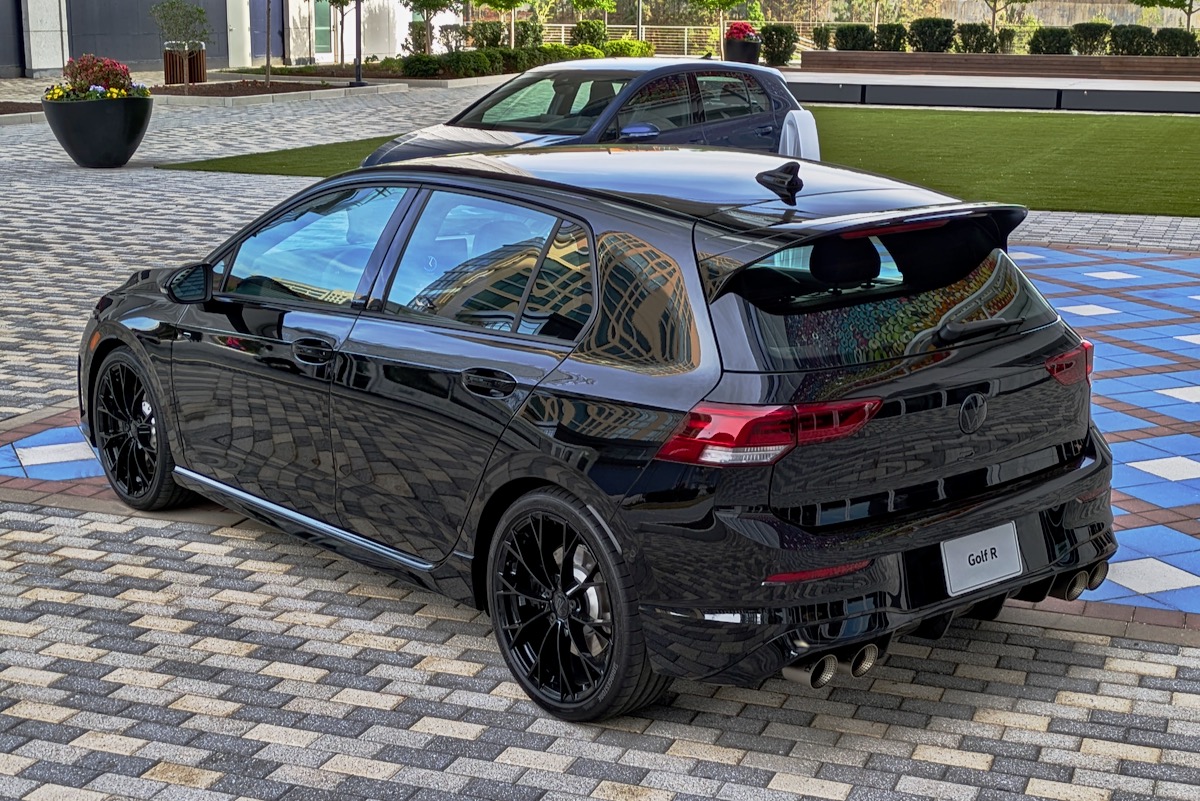
The Golf twins may be the most expressive looking of their many platform mates, though. The stretched hood, steeply raked windshield, and low-mounted grille and headlights create a sleeker look than the average VW, although they don’t blend well with the car’s upright rear hatch and side glass. The Golf R is further distinguished from the GTI by larger front air intakes (which also aid brake cooling, according to VW) and quad exhaust tips. But the Golf R still shares a light-up VW logo with the GTI and other models in the automaker’s lineup.
VW claims to have introduced a minor facelift for 2025, but it’s hard to spot. More substantial changes are new 19-inch wheels that are 20% lighter than the previous Golf R wheels, according to VW, with standard summer tires. A new Golf R Black Edition features gloss-black versions of these, along with blacked-out exhaust tips, badging, and exterior trim. Also new for a 2025 is a Euro Style Package that includes an Akrapovič titanium exhaust system and sunroof delete for maximum street cred.
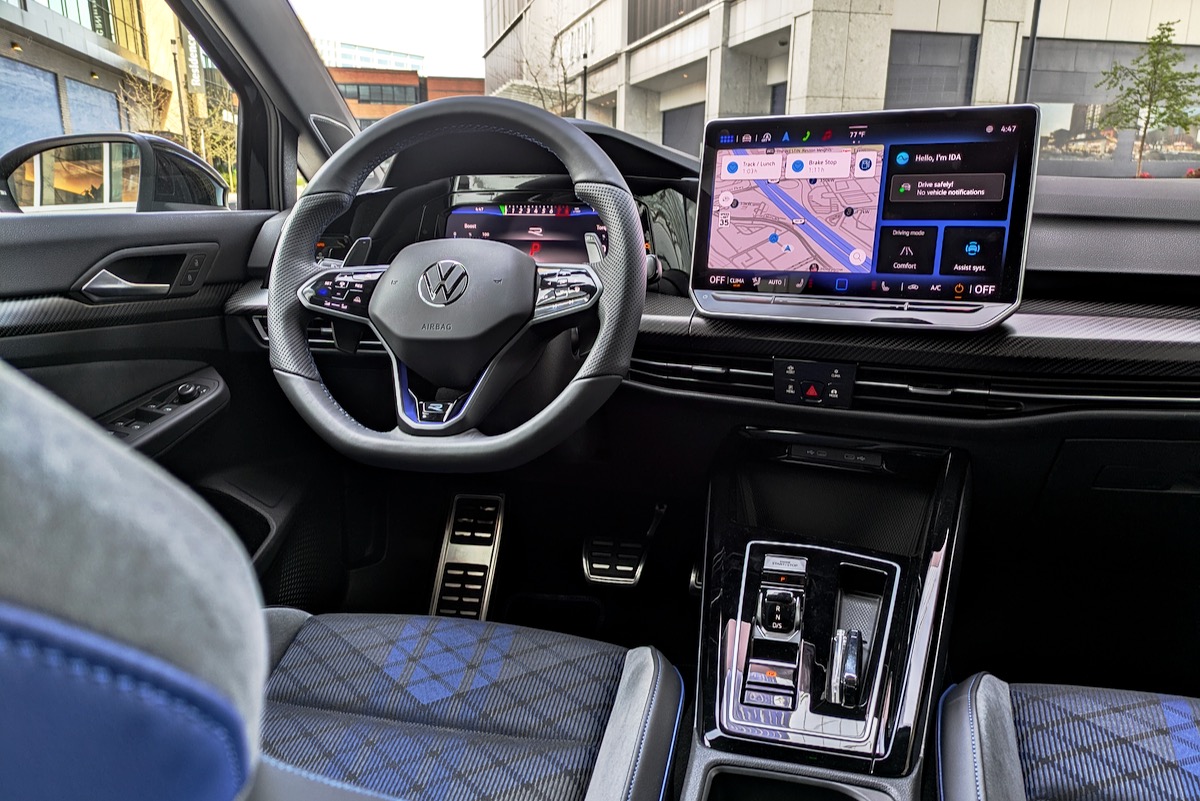
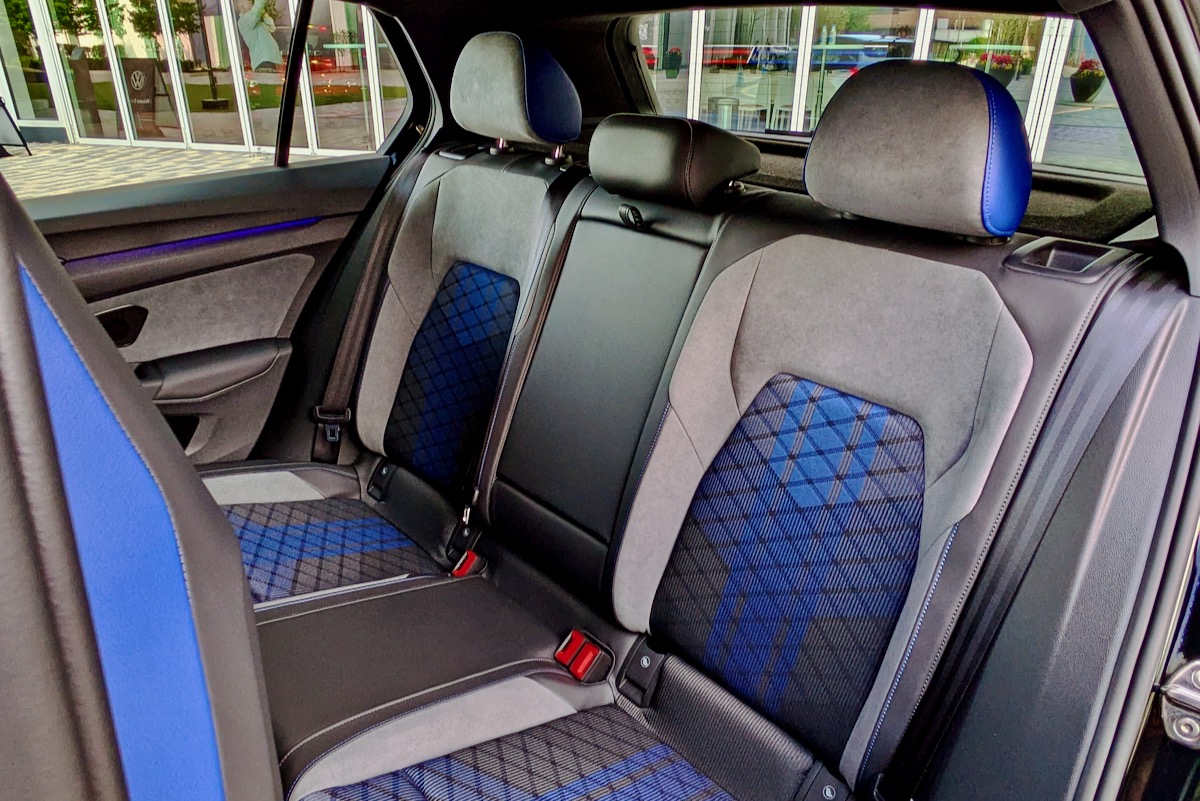
While the Golf started out as the replacement for the Beetle, and thus the center of gravity around which the rest of the VW lineup orbited, the modern version’s interior follows rather than leads. The steering wheel and prominently placed touchscreen recall VW’s all-electric ID models, while the copious shiny black plastic is just plain unimaginative. The saving graces are programmable ambient lighting and comfortable-yet-supportive sport seats available in a distinctive blue-and-gray ArtVelours upholstery (as part of the Euro Style Package, Nappa leather seats are standard).
Performance
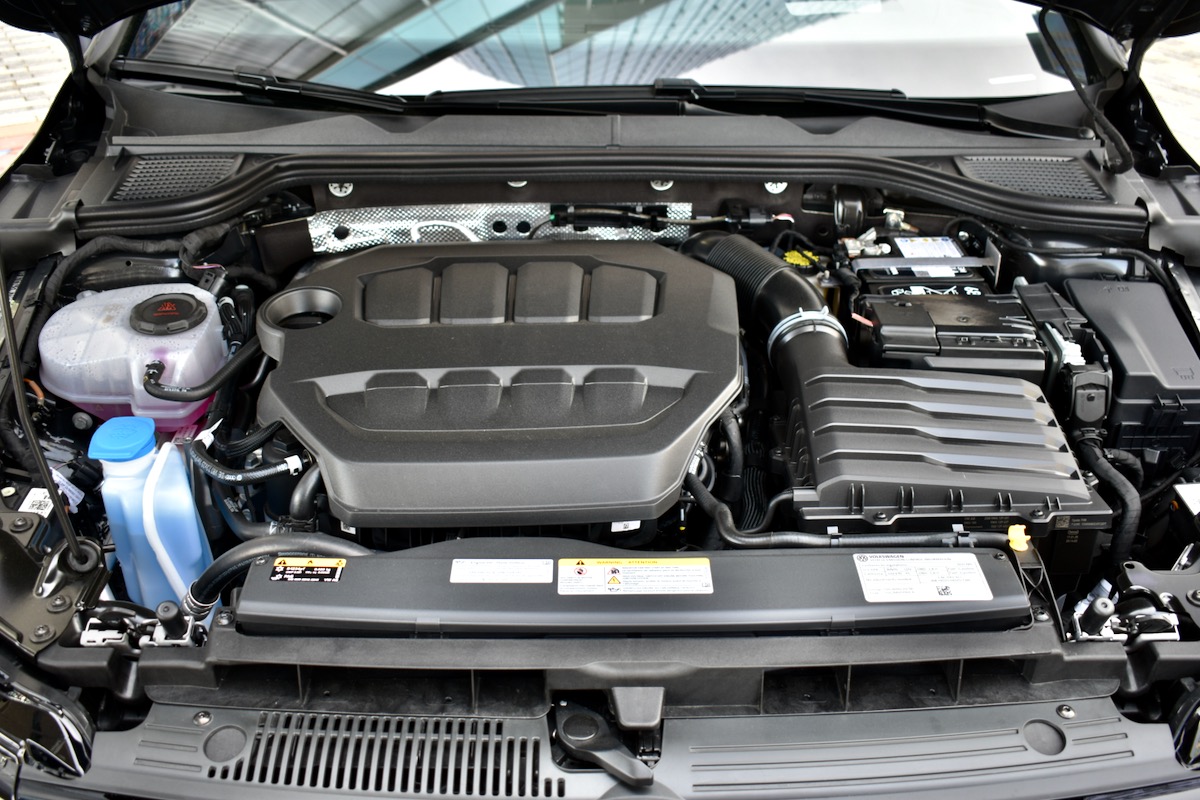
The Golf R uses the same version of VW’s common EA888 2.0-liter turbocharged four-cylinder engine as the Volkswagen Golf GTI, known as the Evo 4. But in the Golf R, the turbo-four produces 328 horsepower (13 hp more than the 2024 model) and 295 pound-feet of torque, compared to 241 hp and 273 lb-ft of torque for the GTI.
Both hatches were previously available with a six-speed manual transmission, but that option was discontinued after the 2024 model year. VW noted that the manual was offered primarily for the North American market, a fairly small one for the Golf, and that sales weren’t high enough to justify keeping it. A hot hatchback without a manual transmission may not seem right to driving enthusiasts, but the seven-speed dual-clutch Direct Shift Gearbox (DSG) automatic transmission that’s now mandatory in both the Golf R and GTI is hard to fault. It shifts quickly and smoothly in automatic mode, has a full manual mode with paddle shifters, and generally feels more in line with the character of the high-tech Golf R of today.
The Golf R also gets standard AWD to further distinguish it from the front-wheel drive (FWD) GTI. The drivetrain can send up to 50% of torque to the rear wheels, and up to 100% of that portion to an individual rear wheel via torque vectoring. This enables a Drift mode, one of seven drive modes available, along with Eco, Comfort, Sport, Race, Custom, and Special, which VW claims is configured for Germany’s famed Nürburgring Nordschleife racetrack. The stability control—which includes fully on, Sport, and off settings—can also brake individual wheels on both axles to help simulate a limited-slip diff.
VW’s PR budget couldn’t accommodate a trip to the Nürburgring, but for this first drive, the automaker set us loose at West Virginia’s Summit Point Motorsports Park, where the Golf R’s electronically-enhanced chassis really came into its own. This is a car that needs a proper slap in the face to really wake it up. The amount of grip and the faultless application of power from the turbo-four engine give the Golf R high limits, but that also makes for a somewhat disconnected driving experience unless you’re really going for it.
At slower speeds, on public roads, the Golf R still performed flawlessly. Its precise steering and endless grip inspired the confidence to charge corners just that little bit faster, but it wasn’t the most involving experience. It was clear that the Golf R wasn’t even breaking a sweat—and it almost felt like the car wanted us to know that.
This was also partly down to the Golf R’s high level of refinement. Standard adaptive damping and a quiet cabin—the Akrapovič exhaust system sounded pleasant but not harsh—meant there wasn’t much of a comfort penalty for R’s sporty handling. That’s a good indication that the Golf R will be easy to live with as a daily driver, more so than its main rivals. But that can also be said of its Golf GTI sibling; the main thing separating the two is on-track performance limits.
Form & function
The Golf R’s everyday usability isn’t just down to civilized driving dynamics. The five-door hatchback body also provides a more practical alternative to traditional sports cars. Usable back seats (with standard heating) and cargo space that’s more than even most similar-sized sedans are definite pluses.
This VW isn’t the only performance hatch in its price range, but the 19.9 cubic feet of cargo space behind the rear seats splits the difference between the 24.5 cubic feet of the Honda Civic Type R and 17.8 cubic feet of the Toyota GR Corolla. And while the Honda and Toyota aim for a no-nonsense aesthetic, the Golf R doesn’t skimp on creature comforts.
Standard sport seats—with reasonable bolstering that doesn’t feel as constricting as the Type R or GR Corolla seats—come standard with the aforementioned Nappa leather upholstery, plus 12-way power adjustment for the driver (the passenger gets a power backrest only) and three memory presets, with heating and ventilation for both. The ArtVelours seats included with the Euro Style Package are manually adjusted, but they’re lighter, VW notes, and have nifty diamond-patterned fabric.
Ditching the manual transmission means every Golf R now has a space-efficient center console layout. Small rectangular engine-start and parking-brake buttons and a small toggle-like shiter leave room for a large wireless device charging pad (with ventilation for 2025) fore and large cupholders aft. Large door pockets provide additional storage space, and a thin slot can hold a second phone on its edge, helping make the most of the space up front.
However, Volkswagen also continues to use frustrating haptic touch sliders for audio volume and temperature (three-zone automatic climate control is standard). And while the GTI gets conventional buttons on its steering wheel for 2025, the Golf R continues with haptic versions of those controls as well. These are the worst of both worlds. They’re difficult to use precisely when you actually want to adjust something, but still sensitive enough to be triggered by an accidental brush of the hand.
Technology
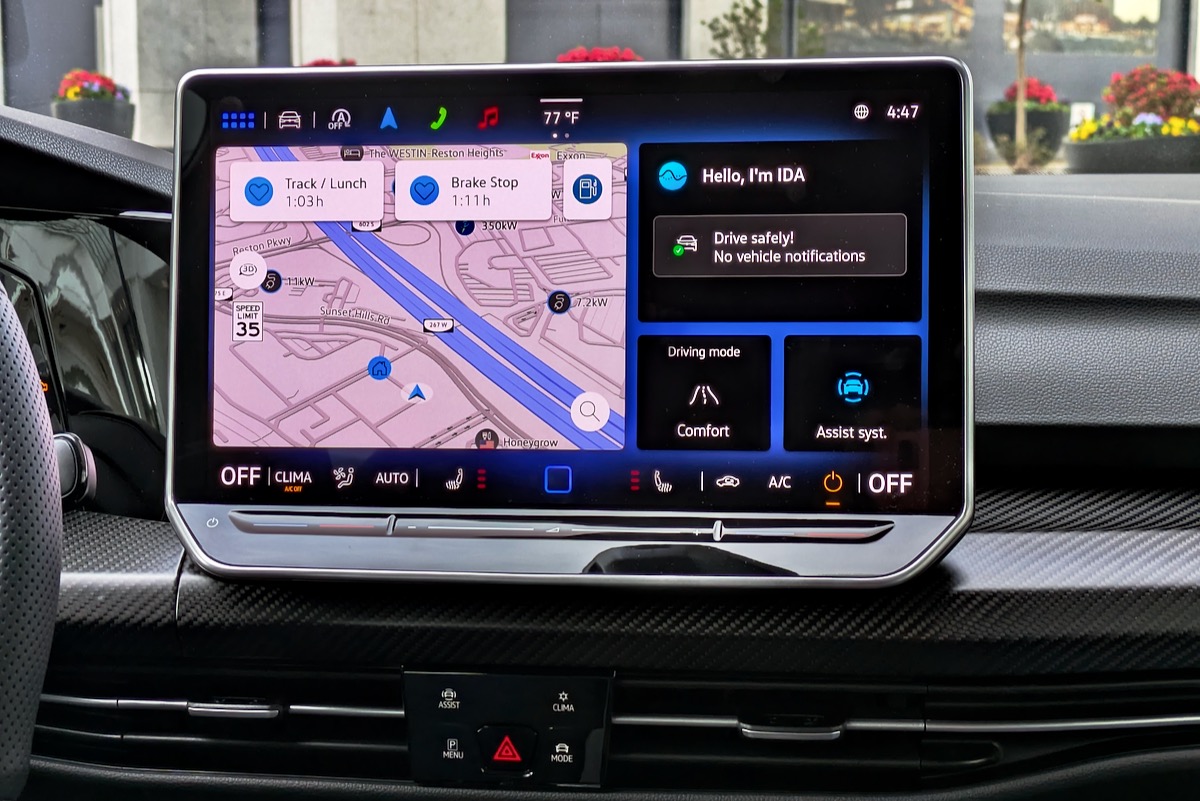
The Golf R receives a larger standard touchscreen for 2025. A 12.9-inch screen replaces the previous 10-inch unit, with software changes aimed at improving responsiveness and new menu layouts. Wireless Apple CarPlay and Android Auto remain standard, with multiple device pairing, along with four USB-C ports (two in front, two charge-only in the rear), while ChatGPT-backed voice recognition is now available via a subscription.
The bigger touchscreen’s new home screen layout puts more information up front without having to select individual menus. The previous desktop-style collection of icons has been replaced with large widgets showing a map, vehicle status, drive mode, and driver-assist info by default. Climate controls live below, with smaller icons for individual menus above. It’s a big improvement over the previous layout, although we had trouble finding the home button once we’d navigated away from the main menu.
The 10.25-inch Digital Cockpit Pro digital instrument cluster carries over from the 2024 model year. As before, it includes four configurations that emphasize driver-assist features, vehicle information, or connectivity, as well as a full map view. The graphics are sharp, and a performance view that includes a large boost gauge and g-meter, is perfect for the track.
On other hand, the tiny fuel gauge doesn’t seem as well thought-out, as do some of the options. Is it really necessary to have the boost gauge and g-meter within traditional dials or as standalone items, for example? It’s clear that software-based features offer a lot of possibilities, but it seems VW hasn’t quite figured out which ones are really worth pursuing.
Safety
The Golf R comes standard with the full VW IQ.Drive suite of driver aids, including forward collision warning, automatic emergency braking, blind spot monitoring, rear cross traffic alert, lane keep assist, adaptive cruise control, and Travel Assist, which combines lane centering and adaptive cruise for highway driving.
These are fairly common features on most new cars, but VW also includes its Intelligent Crash Response system, which automatically shuts off the fuel pump, unlocks the doors, and switches on the hazard lights after a collision. Emergency Assist will also bring the car to a stop automatically if it detects that the driver is incapacitated.
Full crash-test ratings weren’t available at the time of publication. The Insurance Institute for Highway Safety (IIHS) had only published results for its original side, moderate overlap front, and small overlap tests, although the 2025 Golf R received top “Good” scores in all three. The National Highway Traffic Safety Administration (NHTSA) hadn’t published any ratings at all.
Cost-effectiveness
Unlike so many performance cars, the Golf R doesn’t come with a huge fuel-economy penalty. Its EPA-estimated 25 mpg combined (22 mpg city, 31 mpg highway) is not bad for an AWD car with 328 hp.
Like other VW models, the Golf R includes a four-year/50,000-mile new vehicle warranty, as well as up to two years or 20,000 miles (whichever comes first) of free scheduled maintenance. Both can be transferred to a subsequent owner—not something you normally see with warranty or scheduled maintenance coverage.
Pricing starts at $48,325 after the mandatory $1,225 destination charge. There’s really only one core trim level, but for 2025 Volkswagen is also offering the Black Edition for an extra $1,315 or the Euro Style Package for an additional $3,795.
The base price is close to the $47,045 starting price of a Honda Civic Type R, but substantially more than the $39,995 point of entry for a Toyota GR Corolla. The Toyota also comes with AWD, as does the Subaru WRX, which can be had for $36,920, but is a bit down on power compared to the Golf R. All three Japanese alternatives still offer manual gearboxes, but only the Civic Type R can really match the Volkswagen’s level refinement, although its massive rear wing makes it harder to fly under the radar while driving one. There’s also in-house competition within the Volkswagen Group from the Audi S3, which starts at a near-identical $48,700 and features a similar mechanical package—quattro AWD and a seven-speed S Tronic dual-clutch automatic transmission.
However, the Golf R’s biggest rival might be its sibling. Even in top Autobahn spec, a Golf GTI can be had for less than a Golf R, while offering most of the same features and the same unflappable character. The Golf R is still the ultimate hot hatch for VW fans, and it’s probably faster around a track, but the GTI comes close enough that it’s seriously worth considering as an alternative.
What owners say
Trims & specs
Base MSRP $47,100 | Seating 5 |
Engine 2.0L 328 hp I4 | Cargo Capacity 19.9 cu ft |
Combined MPG 26 | Drivetrain AWD |
Base MSRP $48,415 | Seating 5 |
Engine 2.0L 328 hp I4 | Cargo Capacity 19.9 cu ft |
Combined MPG 26 | Drivetrain AWD |


Pricing trends
MSRP range
$47,100 - $48,415
Current avg. market price
$47,899
Trending up by 0.2% this month
May 2026 - September 2026


