2025 Kia Carnival Hybrid Reviews, Pricing & Specs
Write a reviewPros
Fuel-efficient
Great handling
Spacious
Cons
Awkward second-row seat arrangement
All-wheel drive not available
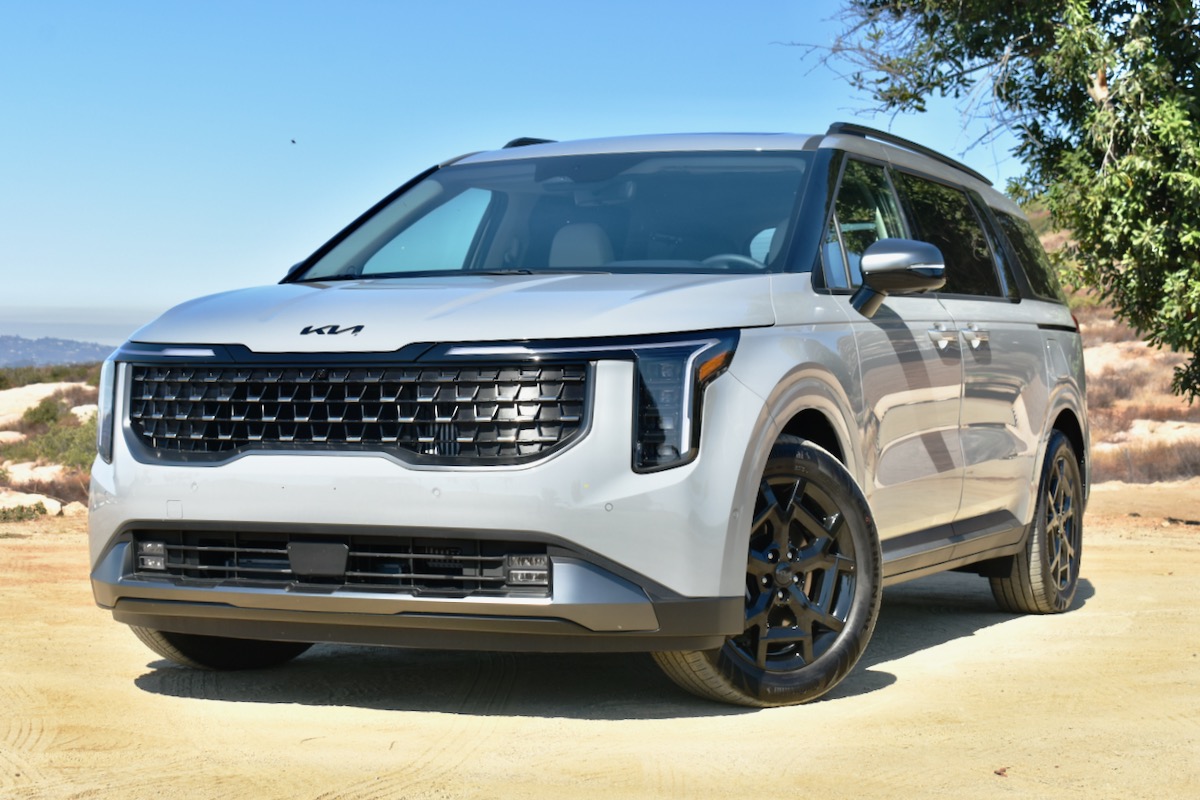
A hybrid powertrain headlines a number of updates for Kia’s minivan.
The 2025 Kia Carnival Hybrid is a new addition to the Kia Carnival minivan lineup, giving buyers the option of a hybrid powertrain for the first time. The Carnival gets a number of updates as well, including refreshed exterior styling and tech features, to help it remain competitive with the Chrysler Pacifica, Honda Odyssey, and Toyota Sienna in the small—but still significant—minivan segment.
Verdict: The Carnival's new hybrid powertrain enhances an already-impressive package.

All Kia Carnival models receive a dramatically different look for the 2025 model year. A new front fascia, similar to the one on the refreshed 2025 Kia Sorento midsize crossover SUV, eschews streamlining for toughness. The headlights are pushed aside to make room for a larger grille that Kia hopes will make the Carnival look more SUV-like. A big grille isn’t exactly distinctive, but daytime running lights that bleed off the corners of the front end onto the forward edge of the hood are an interesting touch.
Most of the styling changes are concentrated up front, although Kia also moved the license plate housing to the lower part of the tailgate to clean up the rear end. An available trim piece meant to look like a skid plate also adds to the SUV theme, and “Star Map” taillights are standard on the top SX Prestige trim level. Despite Kia’s efforts, though, the Carnival Hybrid still looks like a van—and one that’s not as handsome as the pre-refresh version.
The Carnival Hybrid skips the base LX trim level of the gasoline model, leaving LXS, EX, SX, and SX Prestige grades. That’s not as drastic as the trim strategy for the Chrysler Pacifica Hybrid—which is only available in two high-end trim levels that substantially raise the price of entry—but still means there’s not true base model to compete with the Toyota Sienna LE. The Carnival Hybrid LXS comes standard with 17-inch wheels, but 19-inch wheels are available on higher trim levels, as is a Carnival Dark Edition with darkened exterior trim.
The interior mostly carries over from the 2024 model, but that’s not a bad thing. We drove an SX Prestige hybrid, and its navy and gray interior looked legitimately premium in a way the top trims of competitor minivans can’t match. Small details like a distinctive cross-hatch pattern for the Bose audio system’s speaker grilles combine with high-quality materials for a pleasing experience. The cabin was also mostly free of shiny plastic trim that produces glare and attracts fingerprints and dust, but is still a staple of new car interiors.

The Carnival Hybrid’s powertrain is similar to the one used in the Kia Sorento Hybrid. A 1.6-liter turbocharged four-cylinder engine shares propulsion duties with a single electric motor that’s attached to the input shaft of a six-speed automatic transmission. For comparison, the non-Hybrid Carnival's V6 is coupled to an eight-speed automatic transmission.
Total system output is 242 horsepower and 271 pound-feet of torque, compared to the 287 horsepower and 260 lb-ft of torque of the 3.5-liter V6 engine that’s still available in non-hybrid models. Both hybrid and non-hybrid Carnivals are front-wheel drive (FWD). Only Toyota offers a hybrid minivan with all-wheel drive (AWD); the Chrysler Pacifica Hybrid is available only with FWD, and the Honda Odyssey doesn’t offer AWD or hybrid options.
We weren’t able to compare zero to 60 mph times on this test drive, but merging onto highways and accelerating up hills in and around San Diego, we subjectively felt similar thrust to the V6 model, albeit delivered in a less-linear fashion. You can really feel the electric motor’s torque coming off the line, but acceleration seems to dip a bit after that initial push before getting a second wind as turbocharger boost builds. The little turbo-four engine also seemed to be working pretty hard on steeper inclines, so we wouldn’t want to test the Carnival Hybrid’s 2,500-pound maximum towing capacity (1,000 pounds less than the V6 model).
Kia included three levels of regenerative braking (plus an “off” setting) selectable via steering-wheel paddles that can also be used to change gears in Sport mode. The highest regeneration level was pretty strong for a hybrid, enough that we were able to fully recharge the battery pack on long downhills. Old school driving enthusiasts can also switch to Sport mode and get engine braking by downshifting, but without the energy-recovery benefit. We preferred the default Smart mode and Eco mode to Sport mode, which didn’t do much to enhance the driving experience.
Everything else about the Carnival Hybrid matched the impressive V6 version. Excellent steering makes this fairly large vehicle feel smaller than it is, and the suspension allowed minimal body roll on twisty roads without compromising ride quality. Potholes and cattle guards were not a problem, even with our test car’s larger 20-inch wheels. The Carnival Hybrid was also impressively quiet at all speeds, although the exhaust note of the four-cylinder engine isn’t as pleasant as that of the V6.

Like the non-hybrid Carnival, hybrid models come standard with eight-passenger seating, including sliding and removable second-row seats. Fold-flat third-row seats are standard as well, while optional VIP Lounge Seats replace the second-row bench with reclining captain’s chairs that sport airline business-class-style leg rests. Power sliding doors are standard on all models, while a power liftgate is standard on EX and higher trim levels.
Kia isn’t the only minivan maker to offer fancy second-row seats, but the VIP Lounge Seats in our SX Prestige test car seemed like an odd choice for a family vehicle. The recline function is nice, as is the power adjustment, heating, and ventilation, but the seats aren’t removable and we found it difficult to get them out of the way to access the third row. Removable second-row seats are available, and might be the better option unless you plan on being chauffeured around in your own minivan.
Interior dimensions are the same as the non-hybrid Carnival, which carry over for 2025. That keeps the Kia fairly close to other minivans in measurements of headroom and legroom across all three rows. Kia lists 40.2 feet of cargo space behind the third row and 145.1 cubic feet with both the second and third rows folded, but does not quote a number with just the third row folded. The other two cargo-space numbers are segment-leading, though.
Inside, hybrids models have a rotary shifter instead of the gear lever of non-hybrids, but Kia otherwise retained the highly functional center console and dashboard layout. Buttons for drive modes and front-seat heating and ventilation are easy to find, and don’t interfere with the large cupholders and wireless charging pad. Both the console and touchscreen are also easy to reach from the driver’s seat, and unlike the Chrysler Pacifica, the dashboard can be used as a place to rest your wrist while tapping and swiping.

A 12.3-inch touchscreen infotainment system replaces the 8-inch screen that was standard on 2024 Carnival models, and it incorporates wireless Apple CarPlay and Android Auto connectivity (only wired versions were previously available with this screen). The touchscreen itself is easy to navigate, but like other recent Kia models the Carnival’s switchgear changes function depending on what menu is selected, and that can be confusing.
SX and SX Prestige models also come standard with a 12.3-inch digital instrument cluster. Bluetooth connectivity is also standard, and the infotainment system can receive over-the-air updates. A voice-recognition system that can recognize the occupants of individual seats is also available, although it doesn’t activate by default, which led to some confusion when we tried to use it.
As with 2024 Carnival models, a Wi-Fi hotspot is standard on the 2025 Carnival Hybrid. The hybrid also receives standard first-row USB ports in the center console, second-row USB ports integrated with the front seatbacks, and third-row USB ports located in the arm rests for that row. SX and SX Prestige models also have two power outlets and two 115-volt inverters.
Notable tech options include an 11-inch head-up display, digital key functionality, digital rearview mirror, and a 12-speaker Bose audio system. EX and higher trim levels also come with an in-cabin camera and intercom, as well as a quiet mode. Like other minivans, it’s also possible to spec a rear-seat entertainment system, in this case with dual 14.6-inch HD monitors and native Netflix and YouTube streaming.

With the 2025 Kia Carnival going on sale at the time of publication, updated safety ratings were not available. The 2024 model received mixed crash-test ratings from the Insurance Institute for Highway Safety (IIHS), and was not rated by the National Highway Traffic Safety Administration (NHTSA).
Kia did not introduce any new safety features with this update, but added capability to the Carnival’s already-complete array of driver aids. Forward-collision warning and automatic emergency braking are still standard, but SX and SX Prestige models add junction crossing and lane-change assist functions. Blind-spot monitoring, lane-keep assist, a driver attention monitor, automatic high beams, safe exit assist, and adaptive cruise control with stop-and-go functionality are standard as well.
SX and SX Prestige models also come standard with Highway Driving Assist 2, which allows the car to follow highway lane markings while maintaining speed and distance from other vehicles. The two higher trim levels also feature a standard 360-degree camera system and blind-spot camera system, which shows a camera view in the digital instrument cluster. The blind-spot view camera system remains an excellent feature, and proved especially helpful considering the oversensitivity of the blind-spot monitoring system, which seemed to be calibrated for an even bigger vehicle.

The Carnival Hybrid boasts EPA-rated fuel economy of 33 mpg combined (34 mpg city, 31 mpg highway). That’s a big improvement over the non-hybrid Carnival’s 21 mpg combined (18 mpg city, 26 mpg highway), and beats the 22 mpg combined (19 mpg city, 28 mpg highway) of both the Honda Odyssey and Chrysler Pacifica.
However, the Toyota Sienna manages 36 mpg combined (36 mpg city, 36 mpg highway) with its standard hybrid powertrain and FWD. And while the standard Pacifica isn’t very fuel efficient, the Chrysler Pacifica Hybrid boasts a plug-in hybrid powertrain capable of 32 miles of all-electric range (or 30 mpg combined when using its gasoline engine).
Kia continues to offer the best warranty among minivan makers. The Carnival boasts a five-year/60,000-mile new car warranty and 10-year/100,000-mile powertrain warranty.
Pricing starts at $41,895 for the base Carnival Hybrid LXS, once the mandatory $1,395 destination charge is added. EX and SX models start at $44,095 and $48,995 with destination, respectively, while the range-topping Carnival Hybrid SX Prestige starts at $53,995. Hybrid models cost $2,000 more than equivalent non-hybrid models, but the standard Carnival is also available in an LX trim that costs $4,000 less than the LXS hybrid.
The Carnival Hybrid is also a bit dearer than a Toyota Sienna, which comes standard with a hybrid powertrain and starts at $39,135 in base LE guise. However, the Kia is a lot cheaper than a Chrysler Pacifica Hybrid, which starts at $52,945 in its base Select form. Honda still doesn’t make an Odyssey hybrid, so that’s not exactly an apples to apples comparison.
At the other and of the price spectrum, however, our Carnival SX Prestige test car’s $56,990 MSRP (including the $2,500 rear-seat entertainment system and $495 Ceramic Silver paint) was about the same as the top Sienna Platinum and a bit cheaper than a Chrysler Pacifica Hybrid Pinnacle. We’d also argue that the Carnival feels more worthy of its price tag in top-spec form thanks to a high-quality interior and refined driving dynamics. And now new car buyers don’t have to make a choice between those attributes and a fuel-efficient powertrain, making the Carnival minivan a compelling family-hauler alternative to the Kia Telluride SUV as well.

User reviews for 2025 Kia Carnival Hybrid
Write a review2025 Kia Carnival Hybrid Pricing
Trims & specs
Air Conditioning
Automatic climate control front air conditioning · Dual front air conditioning zones · Automatic climate control rear air conditioning · Single rear air conditioning zones
Airbags
Dual front airbags · Driver knee airbags · Passenger airbag deactivation: occupant sensing deactivation · Front side airbags · Rear side curtain airbags
Audio System
Antenna Type: mast · Voice recognition audio system · USB auxiliary audio input · AM/FM radio · Total Number of Speakers: 6
Brakes
ABS: 4-wheel · Braking assist: hill start assist · Electronic parking brake: auto off · Front brake diameter: 12.8 · Front brakes: ventilated disc · Rear brake diameter: 12.8 · Rear brakes: disc
Comfort Features
Armrests: third row center · Dash trim: metallic · Door sill trim: scuff plate · Floor Material: carpet · Shift knob trim: leather · Steering wheel trim: leather
Convenience Features
Adaptive stop and go cruise control: fully automated · Assist handle: rear · Autonomous lane guidance: lane centering · Cargo area power outlet: 12V · Center console: front console with armrest and storage · Cruise control: adaptive · Cupholders: rear · Easy entry: manual rear seat · Multi-function remote: keyless entry with panic alarm · One-touch windows: 1 · Power outlet(s): USB-C third row · Power steering: electric · Power windows: lockout button · Reading lights: third row · Rear power outlet: 12V · Steering wheel: power tilt and telescopic · Steering wheel mounted controls: cruise controls · Storage: front seatback · Vanity mirrors: dual illuminating
Driver Seat
Adjustable lumbar support: 4-way power · Power adjustments: 8
Drivetrain
Axle ratio: 3.65
Engine
Battery: maintenance-free · EV battery capacity: 1.5 kWh · Electric Motor Battery Type: lithium ion · Electric Motor HP: 75 · Electric Motor Power Output (Kilowatts): 54 · Electric Motor Torque: 224 · Hybrid Gas Engine HP: 180 · Hybrid Gas Engine HP@RPM: 5500 · Hybrid Gas Engine Torque: 195 · Hybrid gas Engine Torque@RPM: 1500
Exterior Features
Door handle color: body-color with chrome accents · Fender lip moldings: body-color · Front bumper color: body-color · Grille color: black chrome · Mirror color: body-color · Rear bumper color: body-color · Rear spoiler: roofline spoiler · Rear spoiler color: body-color · Rear trunk/liftgate: liftgate · Rocker panel color: black · Side door type: dual power sliding · Window trim: black
Headrests
Front headrests: adjustable · Number of front headrests: 2 · Number of rear headrests: 3 · Number of third row headrests: 3
In Car Entertainment
Connected in-car apps: Google search · Infotainment: Kia Connect · Infotainment screen size: 12.3 in. · Smartphone integration: wireless Android Auto
Instrumentation
Fuel economy display: range · Instrument cluster screen size: 4.2 in. · Warnings and reminders: coolant temperature warning
Lights
Daytime running lights: LED · Exterior entry lights: puddle lamps · Headlights: auto delay off
Mirrors
Exterior mirrors: integrated turn signals · Inside rearview mirror: manual day/night
Passenger Seat
Manual Adjustments: 4
Rear Seats
Type: folding removable center seat
Roof
OEM roof height: undefined
Safety
Automatic emergency braking: front · Camera system: rearview · Child seat anchors: LATCH system · Cross Traffic Alert: rear · Crumple zones: rear · Impact sensor: door unlock · Parking sensors: rear · Pre-Collision Warning System: visual warning · Pre-collision warning system: intersection/junction turn · Rearview monitor: in dash
Seatbelts
Emergency locking retractors: front, rear, third, and fourth row · Front seatbelts: 3-point · Seatbelt pretensioners: front · Seatbelt warning sensor: driver and passenger · Second row seatbelts: 3-point · Third row seatbelts: 3-point
Seats
Driver seat power adjustments: reclining · Front seat type: bucket · Passenger seat manual adjustments: reclining · Rear headrests: adjustable · Rear seat folding: fold flat into floor · Third row headrests: adjustable · Third row manual adjustments: reclining · Third row seat folding: split · Upholstery: leatherette
Security
Power door locks: anti-lockout
Spare Tire
Mount Location: inside · Size: temporary
Spare Wheel
Rim Type: steel
Steering
Steering ratio: 14.2 · Turns lock-to-lock: 3.0
Suspension
Front Arm Type: lower control arms · Front Shock Type: gas shock absorbers · Front Spring Type: coil springs · Front Suspension Classification: independent · Front Suspension Type: MacPherson struts · Rear Shock Type: gas shock absorbers · Rear Spring Type: coil springs · Rear Suspension Classification: independent · Rear Suspension Type: multi-link · Stabilizer bar(s): front
Telematics
Driver assistance app: roadside assistance · Electronic messaging assistance: with read function · Navigation system: hard drive navigation system · Phone: voice activated · Phone wireless data link: Bluetooth · Smart device app compatibility: Kia Access · Smart device app function: lock operation · Wifi: hotspot
Third Row Seat
Type: 40-60 split bench
Tires
Type: all season
Tires and Rims
Wheels: aluminum with painted accents
Windows
Front wipers: variable intermittent · Laminated glass: acoustic · Liftgate window: fixed · Power windows: with safety reverse · Rear wiper: with washer · Solar-tinted glass: front
Air Conditioning
Automatic climate control front air conditioning · Dual front air conditioning zones · Automatic climate control rear air conditioning · Single rear air conditioning zones
Airbags
Dual front airbags · Driver knee airbags · Passenger airbag deactivation: occupant sensing deactivation · Front side airbags · Rear side curtain airbags
Audio System
Antenna Type: mast · Voice recognition audio system · USB auxiliary audio input · HD radio · Satellite Radio: SiriusXM · Total Number of Speakers: 8
Brakes
ABS: 4-wheel · Braking assist: hill start assist · Electronic parking brake: auto off · Front brake diameter: 12.8 · Front brakes: ventilated disc · Rear brake diameter: 12.8 · Rear brakes: disc
Comfort Features
Armrests: third row center · Dash trim: simulated wood · Door sill trim: scuff plate · Floor Material: carpet · Shift knob trim: leather · Steering wheel trim: leather
Convenience Features
Adaptive stop and go cruise control: fully automated · Assist handle: rear · Autonomous lane guidance: lane centering · Cargo area power outlet: 12V · Center console: front console with armrest and storage · Cruise control: adaptive · Cupholders: front · Easy entry: manual rear seat · Multi-function remote: proximity entry system · One-touch windows: 4 · Power outlet(s): USB-C front · Power steering: electric · Power windows: lockout button · Reading lights: third row · Rear power outlet: 12V · Steering wheel: power tilt and telescopic · Steering wheel mounted controls: audio · Storage: accessory hook · Sunshade: side window · Vanity mirrors: dual illuminating
Driver Seat
Adjustable lumbar support: 4-way power · Power adjustments: 8
Drivetrain
Axle ratio: 3.65
Engine
Battery: maintenance-free · EV battery capacity: 1.5 kWh · Electric Motor Battery Type: lithium ion · Electric Motor HP: 75 · Electric Motor Power Output (Kilowatts): 54 · Electric Motor Torque: 224 · Hybrid Gas Engine HP: 180 · Hybrid Gas Engine HP@RPM: 5500 · Hybrid Gas Engine Torque: 195 · Hybrid gas Engine Torque@RPM: 1500
Exterior Features
Door handle color: body-color with chrome accents · Fender lip moldings: body-color · Front bumper color: body-color · Grille color: black chrome · Mirror color: body-color · Rear bumper color: body-color · Rear spoiler: roofline spoiler · Rear spoiler color: body-color · Rear trunk/liftgate: power operated · Rocker panel color: black · Side door type: dual power sliding · Window trim: black
Headrests
Front headrests: adjustable · Number of front headrests: 2 · Number of rear headrests: 3 · Number of third row headrests: 3
In Car Entertainment
Connected in-car apps: Google POIs · Infotainment: Kia Connect · Infotainment screen size: 12.3 in. · Smartphone integration: wireless Android Auto
Instrumentation
Fuel economy display: range · Instrument cluster screen size: 4.2 in. · Warnings and reminders: lamp failure
Lights
Daytime running lights: LED · Exterior entry lights: puddle lamps · Headlights: auto delay off
Mirrors
Exterior mirrors: integrated turn signals · Inside rearview mirror: manual day/night
Passenger Seat
Power adjustments: 8
Rear Seats
Type: folding removable center seat
Roof
OEM roof height: undefined · Roof rails: silver
Safety
Automatic emergency braking: front pedestrian · Camera system: in-vehicle passenger · Child seat anchors: LATCH system · Cross Traffic Alert: rear · Crumple zones: rear · Impact sensor: door unlock · Parking sensors: rear · Pre-Collision Warning System: audible warning · Pre-collision warning system: pedestrian detection · Rearview monitor: in dash · Traffic sign recognition: adaptive speed limiting
Seatbelts
Emergency locking retractors: front and rear · Front seatbelts: 3-point · Seatbelt pretensioners: front · Seatbelt warning sensor: driver and passenger · Second row seatbelts: 3-point · Third row seatbelts: 3-point
Seats
Driver seat power adjustments: reclining · Front seat type: bucket · Passenger seat power adjustments: height · Rear headrests: adjustable · Rear seat folding: fold flat into floor · Third row headrests: adjustable · Third row manual adjustments: reclining · Third row seat folding: fold flat into floor · Upholstery: perforated
Security
Power door locks: anti-lockout
Spare Tire
Mount Location: inside · Size: temporary
Spare Wheel
Rim Type: steel
Steering
Steering ratio: 14.2 · Turns lock-to-lock: 3.0
Suspension
Front Arm Type: lower control arms · Front Shock Type: gas shock absorbers · Front Spring Type: coil springs · Front Suspension Classification: independent · Front Suspension Type: MacPherson struts · Rear Shock Type: gas shock absorbers · Rear Spring Type: coil springs · Rear Suspension Classification: independent · Rear Suspension Type: multi-link · Stabilizer bar(s): front
Telematics
Driver assistance app: roadside assistance · Electronic messaging assistance: with read function · Navigation system: with voice recognition · Phone: voice activated · Phone wireless data link: Bluetooth · Smart device app compatibility: Kia Access · Smart device app function: maintenance status · Wifi: hotspot
Third Row Seat
Type: 40-60 split bench
Tires
Type: all season
Tires and Rims
Wheels: painted aluminum
Windows
Front wipers: variable intermittent · Laminated glass: acoustic · Liftgate window: fixed · Power windows: with safety reverse · Rear wiper: with washer · Solar-tinted glass: front
Air Conditioning
Automatic climate control front air conditioning · Dual front air conditioning zones · Automatic climate control rear air conditioning · Single rear air conditioning zones
Airbags
Dual front airbags · Driver knee airbags · Passenger airbag deactivation: occupant sensing deactivation · Front side airbags · Rear side curtain airbags
Audio System
Antenna Type: mast · Voice recognition audio system · USB auxiliary audio input · AM/FM radio · Satellite Radio: SiriusXM · Total Number of Speakers: 8
Brakes
ABS: 4-wheel · Braking assist: hill start assist · Electronic parking brake: auto off · Front brake diameter: 12.8 · Front brakes: ventilated disc · Rear brake diameter: 12.8 · Rear brakes: disc
Comfort Features
Armrests: third row center · Dash trim: simulated wood · Door sill trim: scuff plate · Floor Material: carpet · Shift knob trim: leather · Steering wheel trim: leather
Convenience Features
Adaptive stop and go cruise control: fully automated · Assist handle: front · Autonomous lane guidance: navigation integration · Cargo area power outlet: 115V · Center console: front console with armrest and storage · Cruise control: adaptive · Cupholders: front · Easy entry: manual rear seat · Memorized settings: 2 driver · Multi-function remote: trunk release · One-touch windows: 4 · Power outlet(s): USB-C rear · Power steering: speed-proportional · Power windows: lockout button · Reading lights: front · Rear power outlet: 115V · Steering wheel: power tilt and telescopic · Steering wheel mounted controls: cruise controls · Storage: door pockets · Sunshade: side window · Vanity mirrors: dual illuminating
Driver Seat
Adjustable lumbar support: 4-way power · Power adjustments: 8
Drivetrain
Axle ratio: 3.65
Engine
Battery: maintenance-free · EV battery capacity: 1.5 kWh · Electric Motor Battery Type: lithium ion · Electric Motor HP: 75 · Electric Motor Power Output (Kilowatts): 54 · Electric Motor Torque: 224 · Hybrid Gas Engine HP: 180 · Hybrid Gas Engine HP@RPM: 5500 · Hybrid Gas Engine Torque: 195 · Hybrid gas Engine Torque@RPM: 1500
Exterior Features
Door handle color: body-color with chrome accents · Fender lip moldings: body-color · Front bumper color: body-color · Grille color: black chrome · Mirror color: body-color · Rear bumper color: body-color · Rear spoiler: roofline spoiler · Rear spoiler color: body-color · Rear trunk/liftgate: liftgate · Side door type: dual power sliding · Skid plate(s): front · Window trim: black
Headrests
Front headrests: adjustable · Number of front headrests: 2 · Number of rear headrests: 3 · Number of third row headrests: 3
In Car Entertainment
Connected in-car apps: Google POIs · Infotainment: Kia Connect · Infotainment screen size: 12.3 in. · Smartphone integration: wireless Apple CarPlay
Instrumentation
Fuel economy display: range · Instrument cluster screen size: 12.3 in. · Warnings and reminders: low fuel level
Lights
Daytime running lights: LED · Exterior entry lights: puddle lamps · Front fog lights: LED · Headlights: automatic high beam dimmer
Mirrors
Exterior mirrors: power · Inside rearview mirror: manual day/night
Passenger Seat
Power adjustments: 8
Rear Seats
Type: folding removable center seat
Roof
Moonroof: power glass · Moonroof / Sunroof: power sunshade · OEM roof height: undefined · Rear sunroof: power glass · Roof rails: silver
Safety
Automatic emergency braking: intersection/junction cross · Blind spot safety: passenger side camera · Camera system: in-vehicle passenger · Child seat anchors: LATCH system · Cross Traffic Alert: rear · Crumple zones: front · Impact sensor: door unlock · Parking sensors: rear · Pre-Collision Warning System: visual warning · Pre-collision warning system: intersection/junction turn · Rearview monitor: in dash · Traffic sign recognition: adaptive speed limiting
Seatbelts
Emergency locking retractors: front, rear, third, and fourth row · Front seatbelts: 3-point · Seatbelt pretensioners: front · Seatbelt warning sensor: driver and passenger · Second row seatbelts: 3-point · Third row seatbelts: 3-point
Seats
Driver seat power adjustments: height · Front seat type: bucket · Passenger seat power adjustments: height · Rear headrests: adjustable · Rear seat folding: fold flat into floor · Third row headrests: adjustable · Third row manual adjustments: reclining · Third row seat folding: split · Upholstery: perforated
Security
Power door locks: anti-lockout
Spare Tire
Mount Location: inside · Size: temporary
Spare Wheel
Rim Type: steel
Steering
Steering ratio: 14.2 · Turns lock-to-lock: 3.0
Suspension
Front Arm Type: lower control arms · Front Shock Type: gas shock absorbers · Front Spring Type: coil springs · Front Suspension Classification: independent · Front Suspension Type: MacPherson struts · Rear Shock Type: gas shock absorbers · Rear Spring Type: coil springs · Rear Suspension Classification: independent · Rear Suspension Type: multi-link · Stabilizer bar(s): front
Telematics
Driver assistance app: roadside assistance · Electronic messaging assistance: with voice recognition · Navigation system: hard drive navigation system · Phone: voice activated · Phone wireless data link: Bluetooth · Smart device app compatibility: Kia Access · Smart device app function: security event/collision alert · Wifi: hotspot
Third Row Seat
Type: 40-60 split bench
Tires
Type: all season
Tires and Rims
Wheels: painted aluminum
Windows
Front wipers: variable intermittent · Laminated glass: acoustic front side · Liftgate window: fixed · Power windows: with safety reverse · Rear wiper: intermittent · Solar-tinted glass: front
Air Conditioning
Automatic climate control front air conditioning · Dual front air conditioning zones · Automatic climate control rear air conditioning · Single rear air conditioning zones
Airbags
Dual front airbags · Driver knee airbags · Passenger airbag deactivation: occupant sensing deactivation · Front side airbags · Front side curtain airbags
Audio System
Antenna Type: mast · Voice recognition audio system · USB auxiliary audio input · Premium Brand: Bose · AM/FM radio · Satellite Radio: SiriusXM · 1 subwoofer · Surround audio: 5.1 · Total Number of Speakers: 11
Brakes
ABS: 4-wheel · Braking assist: hill start assist · Electronic parking brake: auto off · Front brake diameter: 12.8 · Front brakes: ventilated disc · Rear brake diameter: 12.8 · Rear brakes: disc
Comfort Features
Armrests: third row center · Dash trim: satin chrome · Door sill trim: scuff plate · Floor Material: carpet · Shift knob trim: leather · Steering wheel trim: leather
Convenience Features
Adaptive stop and go cruise control: fully automated · Assist handle: rear · Autonomous lane guidance: navigation integration · Cargo area power outlet: 115V · Center console: front console with armrest and storage · Cruise control: adaptive · Cupholders: front, rear and third row · Dimming rearview mirror: auto-dimming · Easy entry: manual rear seat · Memorized settings: 2 driver · Multi-function remote: keyless entry with panic alarm · One-touch windows: 4 · Power outlet(s): USB-C third row · Power steering: electric · Power windows: lockout button · Reading lights: third row · Rear power outlet: 115V · Rearview mirror: camera-based · Steering wheel: power tilt and telescopic · Steering wheel mounted controls: voice recognition controls · Storage: front seatback · Sunshade: side window · Universal garage door opener: Homelink · Vanity mirrors: dual illuminating
Driver Seat
Adjustable lumbar support: 4-way power · Power adjustments: 8
Drivetrain
Axle ratio: 3.65
Engine
Battery: maintenance-free · EV battery capacity: 1.5 kWh · Electric Motor Battery Type: lithium ion · Electric Motor HP: 75 · Electric Motor Power Output (Kilowatts): 54 · Electric Motor Torque: 224 · Hybrid Gas Engine HP: 180 · Hybrid Gas Engine HP@RPM: 5500 · Hybrid Gas Engine Torque: 195 · Hybrid gas Engine Torque@RPM: 1500
Exterior Features
Door handle color: body-color with chrome accents · Fender lip moldings: body-color · Front bumper color: body-color · Grille color: black chrome · Mirror color: body-color · Rear bumper color: body-color · Rear spoiler: roofline spoiler · Rear spoiler color: body-color · Rear trunk/liftgate: sensor-activated · Side door type: dual power sliding · Skid plate(s): front · Window trim: black
Headrests
Front headrests: adjustable · Number of front headrests: 2 · Number of rear headrests: 3 · Number of third row headrests: 3
In Car Entertainment
Connected in-car apps: Google POIs · Infotainment: Kia Connect · Infotainment screen size: 12.3 in. · Smartphone integration: wireless Android Auto
Instrumentation
Fuel economy display: MPG · Instrument cluster screen size: 12.3 in. · Warnings and reminders: lamp failure
Lights
Daytime running lights: LED · Exterior entry lights: puddle lamps · Front fog lights: LED · Headlights: automatic high beam dimmer · Tail and brake lights: LED
Mirrors
Exterior mirrors: power folding
Passenger Seat
Power adjustments: 8
Rear Seats
Type: folding removable center seat
Roof
Moonroof: anti-trapping feature · Moonroof / Sunroof: power sunshade · OEM roof height: undefined · Rear sunroof: power glass · Roof rails: black
Safety
Automatic emergency braking: front · Blind spot safety: passenger side camera · Camera system: surround view · Child seat anchors: LATCH system · Cross Traffic Alert: rear · Crumple zones: front · Impact sensor: door unlock · Parking sensors: front · Pre-Collision Warning System: audible warning · Pre-collision warning system: intersection/junction turn · Rearview monitor: in dash · Traffic sign recognition: adaptive speed limiting
Seatbelts
Emergency locking retractors: front, rear, third, and fourth row · Front seatbelts: 3-point · Seatbelt pretensioners: front · Seatbelt warning sensor: driver and passenger · Second row seatbelts: 3-point · Third row seatbelts: 3-point
Seats
Driver seat power adjustments: height · Front seat type: bucket · Passenger seat power adjustments: height · Rear extending leg rest: dual manual · Rear headrests: adjustable · Rear seat folding: fold flat into floor · Third row headrests: adjustable · Third row manual adjustments: reclining · Third row seat folding: split · Upholstery: leather
Security
Power door locks: anti-lockout
Spare Tire
Mount Location: inside · Size: temporary
Spare Wheel
Rim Type: steel
Steering
Steering ratio: 14.2 · Turns lock-to-lock: 3.0
Suspension
Front Arm Type: lower control arms · Front Shock Type: gas shock absorbers · Front Spring Type: coil springs · Front Suspension Classification: independent · Front Suspension Type: MacPherson struts · Rear Shock Type: gas shock absorbers · Rear Spring Type: coil springs · Rear Suspension Classification: independent · Rear Suspension Type: multi-link · Stabilizer bar(s): front
Telematics
Driver assistance app: roadside assistance · Electronic messaging assistance: with voice recognition · Navigation system: over-the-air map updates (OTA) · Phone: voice activated · Phone wireless data link: Bluetooth · Smart device app compatibility: Kia Access · Smart device app function: engine start · Wifi: hotspot
Third Row Seat
Type: 40-60 split bench
Tires
Type: all season
Tires and Rims
Wheels: painted aluminum
Windows
Front wipers: variable intermittent · Laminated glass: acoustic front side · Liftgate window: fixed · Power windows: with safety reverse · Rear wiper: auto-on in reverse · Solar-tinted glass: front

