2024 Toyota Grand Highlander Reviews, Pricing & Specs


Pros & cons
What we like
Plenty of cargo space
Standard advanced safety features
Multiple powertrain options
What to consider
Poor handling
Too many subscription-dependent tech features
The CarGurus verdict
Can’t find a Kia Telluride? The 2024 Toyota Grand Highlander is a bigger and more fuel-efficient option.
If you have more than a couple of kids, chances are good that a regular Toyota Highlander won’t be big enough for all your needs. For many shoppers like you, the Kia Telluride and its corporate cousin, the Hyundai Palisade, have become the obvious choices. Those three-row crossovers are newer, bigger, and incredibly nice to drive.
But now there’s a new Highlander. A bigger Highlander. A Grand Highlander. This all-new model takes a popular nameplate (which, don't worry, isn’t going anywhere) and adds a little extra space. But what separates the Grand Highlander from the field is the availability of not one, but two different hybrid powertrains. This all-new model offers plenty of space, good fuel efficiency, and Toyota’s sterling reputation for reliability. So, is the 2024 Grand Highlander an immediate threat to the hot-selling Kia Telluride?
out of 10 expert review
Look & feel
First, let’s sort out Toyota’s current line-up of crossovers and SUVs. You have plenty of options. Moving up from smallest to largest, Toyota sells the Corolla Cross, RAV4, Venza, Highlander, Grand Highlander, and Sequoia. Amazingly, you’ll be able to choose from an all-gas or hybrid-powered option for almost all of them (only the Venza is offered only as a hybrid).
Built on the TNGA-K platform, the new Grand Highlander is a true crossover. Unlike the Sequoia, which is built on the Tundra and the new Tacoma’s TNGA-F truck platform, the Grand Highlander shares its underpinnings with the regular Highlander, the RAV4, the Toyota Sienna, and the Toyota Camry. Although it’s plenty big, the Grand Highlander is not a body-on-frame vehicle, and as such its towing capacity is capped at 5,000 pounds.
And “big” isn’t an understatement; the Grand Highlander stretches 201.4 inches in length and sits atop a 116.1-inch wheelbase. Both of those figures are larger than what you’ll get from a Kia Telluride, and the Grand Highlander’s spacious interior reaps the benefit.
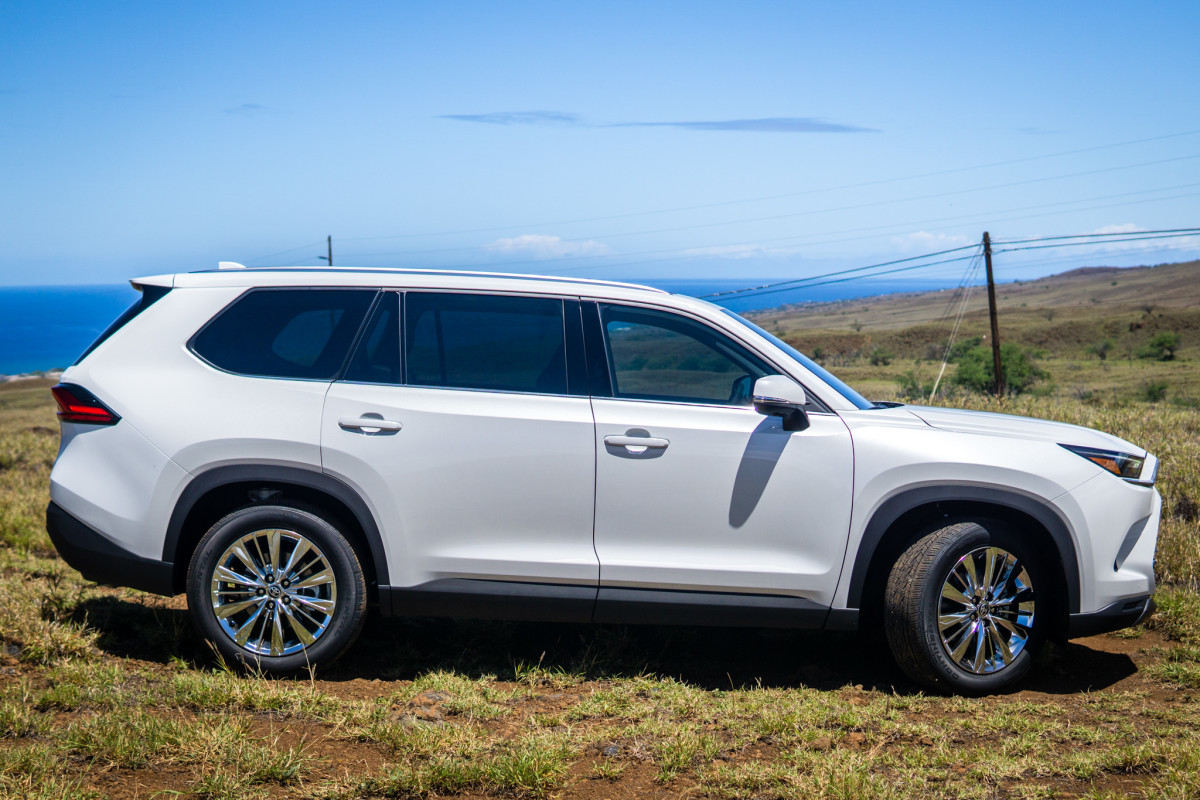
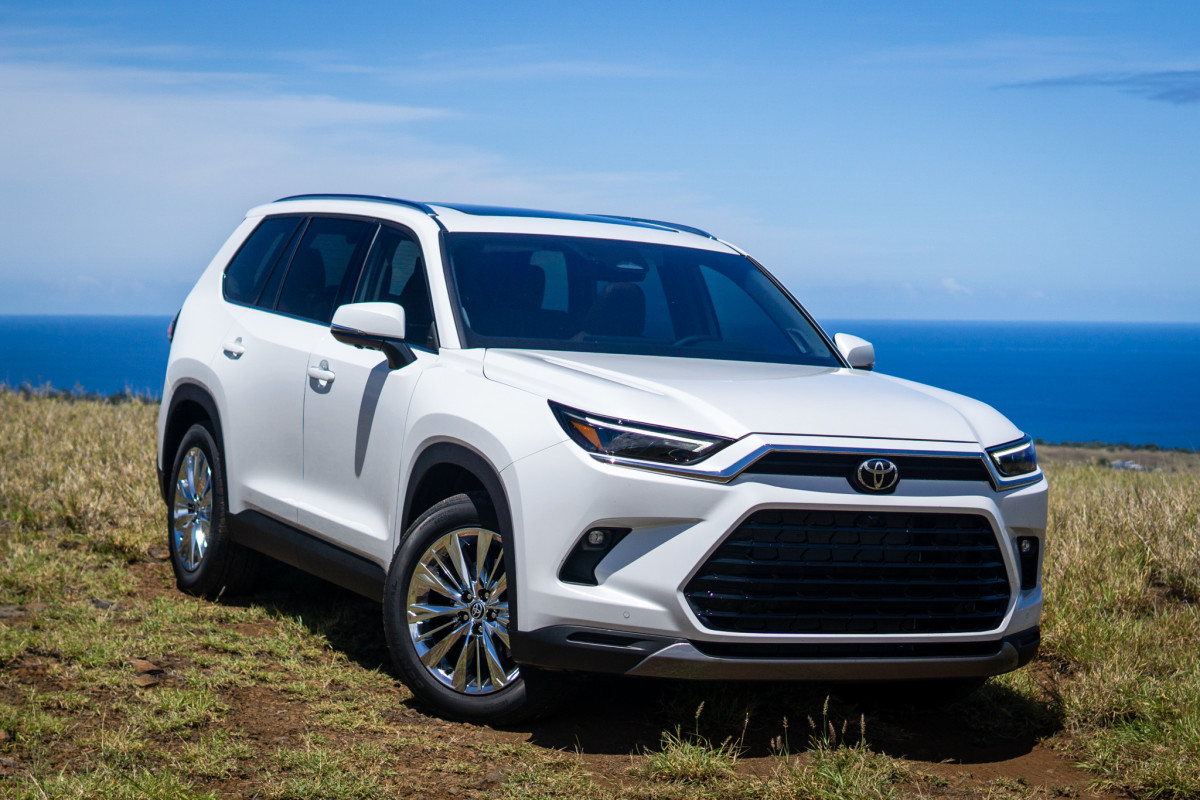
Ground clearance measures 8 inches, which will keep you out of harm's way on a dirt road, but we wouldn’t drive this three-row crossover too far off the beaten path. However, despite being designed for the tarmac, the Grand Highlander’s styling draws inspiration from more rugged vehicles. While its design is a bit more conservative, it’s also a bit blockier than the smaller Highlander. Whereas that smaller SUV showcases more swoops and curves, the Grand Highlander falls more in line, stylistically, with the Ford Explorer, Kia Telluride, and the new 2023 Honda Pilot. Above its trapezoidal grille, a smaller horizontal slit stretches between two narrow headlights. With the Toyota emblem smack in the middle, this design feature lends a startling resemblance to Toyota’s genuine off-roading SUV, the 4Runner.
Toyota sells the 2024 Grand Highlander in three trims: XLE, Limited, and Platinum. Inside, you’ll find either light gray or black Softex synthetic leather on the XLE trim level (there is no cloth-seat option for the Grand Highlander). Move up to the Limited or Platinum trims, and that Softex gets swapped out for real leather. At the top of the range, the Platinum trim can be equipped with Portobello (brown) upholstery, assuming you also opt for the top-spec engine.
A 10-way power-adjustable driver seat (with adjustable lumbar support) comes standard on the XLE trim; the front passenger seat has eight-way adjustability (with no adjustable lumbar support). Heated front seats are also standard, and the Limited and Platinum trim levels add ventilation and a heated steering wheel. A large center console between the front seats can fit a tablet, plus one of the three cupholders ahead of the console is big enough to handle a large water bottle.
In the back, you’ll find standard second-row sunshades and a removable center console on Grand Highlanders equipped with second-row captain’s chairs. There’s also a plastic built-in step stretching inboard from the rear doorsills, making ingress and egress to the third row significantly easier than what we’ve dealt with in smaller three-row crossovers.
Beyond the counting stats (13 cupholders, seven USB-C ports, etc.), the Grand Highlander excels as a comfortable and well-built road-trip vehicle. We’re impressed with the quality of its materials, and all pieces look to fit together seamlessly. Toyota has developed a reputation for mechanical reliability, but the Grand Highlander’s interior looks like it will hold up well over time, too.

Performance
You’ll be able to purchase a Grand Highlander with one of three available engine options. Starting things off, Toyota’s 2.4-liter turbocharged four-cylinder engine will produce 265 horsepower and 310 pound-feet of torque. For folks willing to sacrifice power for fuel efficiency, a 2.5-liter four-cylinder hybrid option will develop 245 combined net horsepower and 177 lb-ft of torque (no combined net figure has been provided). At the top of the price range lives the Hybrid Max powertrain. This 2.4-liter turbocharged four-cylinder hybrid mill turns out 362 combined net horsepower and 400 combined net lb-ft of torque.
Both the gas and hybrid engines will be available with front-wheel drive (FWD) and all-wheel drive (AWD), while the Hybrid Max will be offered with only an AWD drivetrain. You shouldn’t head to the dealership expecting sports car performance from any of these SUVs, but the Hybrid Max will at least deliver impressive acceleration, thanks to a zero-to-60 time of 6.3 seconds.
Toyota expects the standard turbo gas-engine Grand Highlander to account for roughly 85% of sales, so that’s the one we tested for this review.
There’s no getting around the Grand Highlander’s size. We’ve always appreciated the tidy road manners of the smaller Highlander; this larger model is a bit tougher to maneuver through tight roads and parking lots. Likewise, although the Grand Highlander doesn’t demonstrate horrible body roll when cornering, it doesn’t feel quite as tight as some of its competitors. Finally, we found the steering feel a bit numb and disconnected. We’d prefer it if a bit more road feedback was transmitted through the steering wheel. As is, the Grand Highlander can sometimes feel like you’re piloting a very well-sorted boat.
On the positive side, the Grand Highlander’s brakes feel solid, with a linear pedal feel and very little sponginess. We also found acceleration to be more than adequate. The 2.4-liter turbocharged four-cylinder might be more sedate than the Hybrid Max, but it didn’t leave us wanting for power when we pulled away from stoplights. Certainly, we expect it to be more rewarding than the efficiency-conscious 2.5-liter hybrid.
Toyota offers three drive modes–Sport, Eco, and Normal–on all Grand Highlander models. AWD-equipped gas and Hybrid Max models gain an extra three: Mud & Sand, Rock & Dirt, and Snow. We didn’t have ample opportunity to test these additional modes, but we did spend plenty of time sifting through the Sport, Eco, and Normal modes. As one might expect, Sport mode marginally tightened up the steering and throttle response, and Eco mode dulled things down a bit. Ultimately, we’d be inclined to leave the Grand Highlander in Normal mode.

Form & function
The 2024 Toyota Grand Highlander isn’t just bigger than the standard Highlander, it’s bigger than essentially all of its primary rivals. At 201.4 inches long, stretching across a 116.1-inch wheelbase, the Grand Highlander is longer and more spacious than the Ford Explorer, Honda Pilot, Hyundai Palisade, and Kia Telluride.
That extra length translates to extra storage space. Total cargo capacity measures 97.5 cubic feet–roughly 10 more than you’d get from a Telluride–and the figures with seats in position aren’t bad, either. Behind the second-row seats, Toyota provides 57.9 cubic feet, and with all three rows up, there are still 20.6 cubic feet available. Considering the 2023 Toyota Sienna maxes out at 101 cubic feet of cargo space, the Grand Highlander gives minivan-averse shoppers a reasonable alternative.
Even better than just being spacious, the 2024 Toyota Grand Highlander is very comfortable. Its big greenhouse offers good outward visibility, and there’s plenty of head- leg- and shoulder room in every row of seats. Truthfully, a six-foot adult wouldn’t have any trouble sitting in the third row.

Technology
Every 2024 Toyota Grand Highlander comes equipped with a 12.3-inch touchscreen infotainment system. While it’s visually stunning and a massive improvement over Toyota’s old infotainment interface, the new system requires some extra financial outlay to maximize its usefulness.
An intelligent assistant (just say “Hey Toyota” to wake it up) is available via a connected-services subscription. This tech responds to voice commands to handle tasks like adjusting the temperature or changing radio stations. The same connected-services subscription also includes cloud-based navigation software and 24/7 live agent assistance.
Standard features packaged within Toyota's audio multimedia software include dual-device Bluetooth connectivity, and standard wireless Apple CarPlay and Android Auto. Our test vehicle came with Toyota’s 11-speaker JBL stereo. It’s standard on the Limited and Platinum trims, and it sounds good, with a good balance between the bass and treble.
Streaming audio integration is available. Sirius XM satellite radio comes with a three-month trial (subscription required afterward), and if you pay for the company’s Wi-Fi Connect package, you’ll also be able to connect your Apple Music and Amazon Music accounts (assuming you pay for those, too).
Although Toyota’s tech offering has made a significant leap forward in recent years, we do recommend that all shoppers give the brochure a careful read when selecting from the various subscription options.

Safety
Being a brand-new model, the 2024 Toyota Grand Highlander has yet to be crash-tested or rated by either the National Highway Traffic Safety Administration (NHTSA) or the Insurance Institute for Highway Safety (IIHS). However, Toyota is including an impressive list of advanced driver assistance systems (ADAS) as standard equipment on every model.
Labeled Toyota Safety Sense 3.0 (TSS 3.0), the suite of features includes automatic emergency braking, lane-departure alert with steering assist, lane-tracing assist, road-sign recognition, and blind-spot monitoring with rear cross-traffic alert. The updated lane-departure alert can now identify three-dimensional objects like guard rails, making it a bit less likely to throw false warnings.
Toyota also includes adaptive cruise control as standard equipment. For the 2024 Grand Highlander, the adaptive cruise now offers four following-distance settings, as opposed to the usual three.

Cost-effectiveness
When considering a vehicle as large and as powerful as the 2024 Toyota Grand Highlander, fuel economy needs to be top of mind. We’re pleasantly surprised to report that all trims of the Grand Highlander deliver better-than-expected fuel efficiency.
Gas-powered models with FWD will return 21 mpg city, 28 highway, and 24 combined while adding AWD will bring those numbers to 21/27/23 for the XLE trim and 20/26/22 for the Limited and Platinum trims.
The hybrid powertrain is predictably better. XLE trims deliver 36 mpg city, 32 highway, and 34 combined, and the Hybrid Limited with AWD delivers 35/21/33. Despite producing significantly more power, the Hybrid Max also manages to provide better fuel economy than the standard gas model, coming in at 26/27/27.
Assembled alongside the Sienna at Toyota’s Indiana plant, the 2024 Toyota Grand Highlander should arrive at dealerships in July 2023 with a base MSRP of $44,405 including a $1,335 destination fee. While certainly not cheap, remember that the Grand Highlander also starts at the XLE trim level, rather than the less-expensive LE trim available on other Toyota models.
Compared with a Toyota Sienna, the Grand Highlander will run three or four thousand dollars more–to start–but prices do climb much higher. The Hybrid XLE with FWD, for instance, starts at $46,005, and the Grand Highlander Platinum with the Hybrid Max engine starts at $59,460.
Those aren’t inexpensive price tags, but it’s worth noting that they keep the Grand Highlander priced comfortably below the Sequoia, and pricing for the gas model is very much in line with other vehicles of the Grand Highlander’s class. Tack on the availability of more fuel-efficient powertrains (plus more space for cargo and passengers), and the Grand Highlander looks like a compelling option for any family toting around a handful of kids.

What owners say
Great suv with lots of space and safety features.
June 20, 2024The car is amazing. Not much of a discount though.
August 14, 2024Trims & specs
Base MSRP $51,660 | Seating 8 |
Engine N/A | Cargo Capacity 20.6 cu ft |
Combined MPG N/A | Drivetrain N/A |
Base MSRP $55,745 | Seating 7 |
Engine N/A | Cargo Capacity 20.6 cu ft |
Combined MPG N/A | Drivetrain N/A |
Base MSRP $50,060 | Seating 8 |
Engine N/A | Cargo Capacity 20.6 cu ft |
Combined MPG N/A | Drivetrain N/A |
Base MSRP $45,430 | Seating 8 |
Engine N/A | Cargo Capacity 20.6 cu ft |
Combined MPG N/A | Drivetrain N/A |
Base MSRP $47,030 | Seating 8 |
Engine N/A | Cargo Capacity 20.6 cu ft |
Combined MPG N/A | Drivetrain N/A |


Pricing trends
MSRP range
$43,320 - $53,795
Current avg. market price
$43,349
Trending down by 1.4% this month
May 2026 - November 2026


