2024 Hyundai Kona Reviews, Pricing & Specs




Pros & cons
What we like
Multiple powertrain options
Impressive technology
Standard advanced safety features
What to consider
Fairly pedestrian performance
Not enough covered storage in the cabin
The CarGurus verdict
Subcompact but not subpar, the Hyundai Kona is all-new for 2024.
The previous-generation Hyundai Kona debuted for 2018 and got an electric counterpart when the Kona EV hit the market the following year. Hyundai's subcompact SUV got a refresh for 2022, which also saw the addition of the hot-hatch Kona N to the stable. Now, the Kona kicks off a whole new generation, with a new look, new tech, and, naturally, a new price tag to match. In a crowded segment, do the new features match—or perhaps even exceed—the added cost?
out of 10 expert review
Look & feel
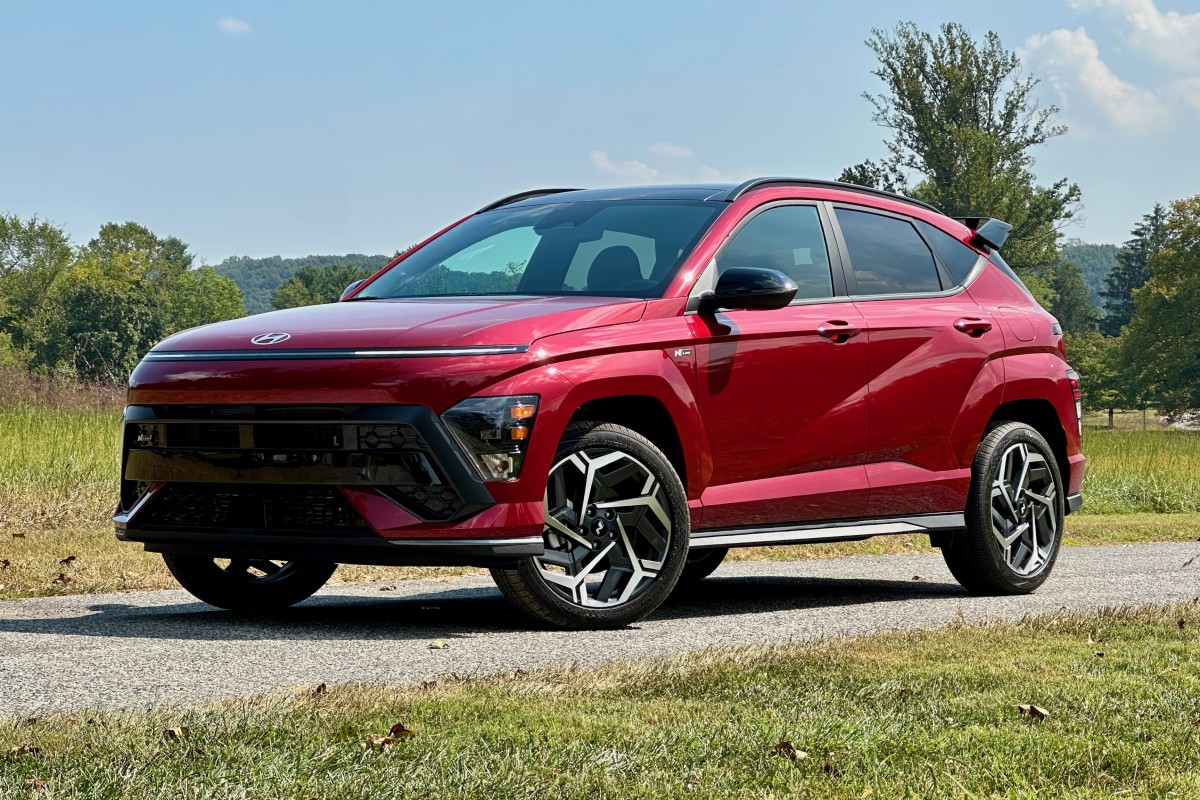
Hyundai designed the new Kona as an electric vehicle (EV) first, and it shows in the little SUV’s looks. The grille certainly more closely resembles the Ioniq 5’s than that of the first-gen Kona, with the single-piece appearance that’s become a telltale sign of an electric powertrain in recent years. The new Kona gets the same “seamless horizon” styling treatment seen on the new Sonata, with a single skinny LED headlight dominating the front end.
Despite its larger size—it has nearly 6 inches of additional length over the old one—the new Kona retains a recognizable silhouette. It’s when you get into the visual foreground that the changes become obvious: The creased “parametric surface” of the doors is new to the Kona, though not to Hyundai, and the black body cladding on the base SE, next-up SEL, and top Limited trims is now more substantial and angular. (The sporty N-Line, which sits second from the top in the trim lineup, gets body-colored wheel arches.)
The new Kona lineup comes standard with LED headlights, taillights, and daytime running lights across the board. The seamless horizon appears again at the rear, with a single taillight spanning the width of the vehicle and even wrapping around the sides a bit. 17-inch wheels are now standard, with 18-inch wheels assigned to SEL and 19-inch to N-Line and Limited trim levels.
Inside, the Kona’s cabin is quite noticeably updated. The center stack is now driver-oriented, and the gear shift has moved to a stalk on the steering column, opening up the space between driver and passenger for storage. The most obvious update is the curved display, which houses both the driver-information and infotainment screens, but the vents, climate controls, and dash have all been revised and refined.

Performance
The 2024 Kona retains the engine lineup of its predecessor, with a naturally aspirated 2.0-liter four-cylinder powering the SE and SEL trims and a turbocharged 1.6-liter four-cylinder under the hood of the N-Line and Limited trims. The base engine makes 147 horsepower and 132 lb-ft of torque and comes with a continuously variable transmission (CVT), while the turbo makes 190 horsepower and 195 lb-ft of torque. The seven-speed dual-clutch transmission (DCT) of the old Kona has been replaced for 2024 with an eight-speed automatic transmission. Paddle shifters come with the N-Line and Limited trims, and for anyone who really wants the shifting experience with their CVT, the SEL Convenience Package adds paddles as well.
Because we joined Hyundai for the Kona launch, we drove the Kona Limited from Baltimore out to the rolling Maryland countryside on a hot August day, and we returned to the city in the Kona N-Line. (We have not yet experienced the naturally aspirated 2024 Kona.) We found pickup to be a tad slow even with the turbo, but we appreciated the intuitive steering and nimble handling on the narrow city streets.
Front-wheel drive (FWD) is standard on the Kona lineup, and all-wheel drive (AWD) is available on any trim for an added fee of $1,500. Opting for AWD reduces EPA fuel economy estimates from 26 city, 32 highway, and 28 mpg combined to 24 city, 29 highway, and 26 mpg combined.

Form & function
It’s in the rear seat and the cargo area that the extra length of the new Kona really makes itself felt. Rear-seat legroom sits at 38.2 inches, three inches longer than the 2023 Kona and six more than the 2023 Toyota Corolla Cross’s back seat, and the new narrower, molded front seats create a more comfortable and roomier space for passengers in that second row. Headroom has also increased, to 38.3 inches front and rear with the sunroof, but the real news is cargo capacity: It’s gone from 19.2 to 25.5 cubic feet of storage space with the rear seats up and 63.7 with them folded down. That’s nearly 20 cubic feet of additional space over the first-gen Kona. To help you access all that room, the Kona Limited now comes with a power hands-free liftgate.
Storage inside the cabin is enhanced by a handy shelf on the passenger’s side of the dash. On our test drive, this proved to be a perfect spot for a phone or a pair of sunglasses, and the rubber surface helped those items to stay put. Hyundai has also added a “guardrail” to keep a phone in place on the wireless charging pad (standard for N-Line and Limited, available with the Convenience Package for SEL). We wish the center console had a larger covered area, though: It’s a very short and shallow tray which is really only suitable for a small wallet or a coiled-up charging cable.
For 2024, the Kona gets cloth seats on SE and SEL trims and a leather/suede combination for N-Line, and Hyundai’s H-Tex leatherette replaces the leather-trimmed seating surfaces of 2023 for Limited. In a noteworthy move, Hyundai has made ventilated front seats and a heated steering wheel standard for the Limited trim—neither feature has previously been available even as an option for the Kona. Heated front seats are standard starting with the N-Line trim, or available as an option for SEL with the Convenience Package.

Technology
The Kona gets several notable technological value-adds for 2024. A 12.3-inch infotainment system touchscreen display is now standard across the lineup, where the 2023 Kona had a standard 8-inch display that was replaced with a 10.25-inch screen for higher trims. Wireless Apple CarPlay and Android Auto still come on only the two lower trims, but that’s now temporary: Hyundai promises an over-the-air (OTA) update coming soon that will add wireless connectivity to the top two trims as well. For now, N-Line and Limited (and SEL Convenience Package) Kona buyers will have to make do with wired connections, but they’ll also enjoy wireless device charging and a new Wi-Fi hotspot. Six speakers are standard, and the upgraded stereo system is now provided by Bose rather than Harman Kardon. Every 2024 Kona comes with two USB-C ports in the front and two at the back of the center console for rear-seat passengers.
SE and SEL trims get a 4.2-inch driver-information display, just like last year, but dual 12.3-inch screens create a panoramic view in that curved housing that’s optional with the Convenience Package and included with N-Line and Limited trims. OTA update capability is now standard on the Kona lineup. Finally, Hyundai’s Bluelink connected services now come standard on all 2024 Konas, and a subscription is now included for the life of the vehicle.

Safety
Some automakers reserve advanced driver-assistance safety features for their pricier models, but as many such features grow increasingly expected by shoppers, manufacturers are finding they need to be more generous to stay competitive. Hyundai is one that will not need to adapt: The company is known for packaging its high-quality safety tech into vehicles across its portfolio. The Kona was just endowed with standard Safe Exit Warning, blind-spot collision avoidance, and rear cross-traffic collision avoidance for 2023, and for 2024, it gets even more capable. High-beam assist is now standard, adaptive cruise control is now standard on N-Line and Limited trims, and the Limited trim now comes with Surround View Monitor and blind-spot view monitor to boot.
We’ve sampled Hyundai’s Highway Driving Assist suite of Level 2 semi-autonomous driving features before, but we couldn’t help but be impressed when we experienced lane-keep assist from behind the wheel of the Kona on our first drive. The system steered us neatly around curves in the highway with smooth inputs—no jerky over-corrections here—and seemed to have a good understanding of our intentions. It may have been a little resistant to cancellation when we hit backroads, but we could just as easily blame user error (and the multi-function steering-wheel buttons). Next time, we’ll go into the screen, which has a clear inventory of driver-assistance features ready to be managed a la carte.

Cost-effectiveness
Even with all these updates, Hyundai has kept the Kona’s base price below the $25,000 mark—but it’s perilously close. The Kona SE trim with FWD now starts at $24,100, while N-Line and Limited now top $30,000. This is not surprising or unreasonable in the circumstances; in fact, that $24,100 starting point is a precise match for the 2024 Honda HR-V’s advertised base MSRP. Both subcompact SUVs have just entered their second generation (the HR-V for 2023) and are enjoying the right to a price increase that comes with the position of newly updated kid on the block.
As of this writing, many manufacturers have yet to announce pricing for the 2024 model year. But we can recommend the Kona on the basis of its features. Factoring in the $2,200 for the Convenience Package upgrade, a shopper can get a modern SUV with key comfort and convenience features like heated seats, adaptive cruise control, navigation, a Wi-Fi hotspot, and wireless charging for less than $28,000 (before destination). And those who are satisfied with OTA updates, connected services, and of course Hyundai’s famous warranty don’t need to go even that high. New-car bargains may seem fewer and further between in the automotive world than ever before, but for the right person looking for the right combination of features, the 2024 Kona is one.

What owners say
Nice safety features, modern look and great price point.
January 12, 2024Trims & specs
Base MSRP $27,100 | Seating 5 |
Engine 2.0L 147 hp I4 | Cargo Capacity 25.5 cu ft |
Combined MPG 28 | Drivetrain AWD |
Base MSRP $25,600 | Seating 5 |
Engine 2.0L 147 hp I4 | Cargo Capacity 25.5 cu ft |
Combined MPG 31 | Drivetrain FWD |
Base MSRP $25,750 | Seating 5 |
Engine 2.0L 147 hp I4 | Cargo Capacity 25.5 cu ft |
Combined MPG 28 | Drivetrain AWD |
Base MSRP $24,250 | Seating 5 |
Engine 2.0L 147 hp I4 | Cargo Capacity 25.5 cu ft |
Combined MPG 31 | Drivetrain FWD |
Base MSRP $30,800 | Seating 5 |
Engine 1.6L 190 hp I4 | Cargo Capacity 25.5 cu ft |
Combined MPG 29 | Drivetrain FWD |
Base MSRP N/A | Seating N/A |
Engine N/A | Cargo Capacity N/A |
Combined MPG N/A | Drivetrain N/A |
Base MSRP N/A | Seating N/A |
Engine N/A | Cargo Capacity N/A |
Combined MPG N/A | Drivetrain N/A |
Base MSRP N/A | Seating N/A |
Engine N/A | Cargo Capacity N/A |
Combined MPG N/A | Drivetrain N/A |
Base MSRP N/A | Seating N/A |
Engine N/A | Cargo Capacity N/A |
Combined MPG N/A | Drivetrain N/A |
Base MSRP N/A | Seating N/A |
Engine N/A | Cargo Capacity N/A |
Combined MPG N/A | Drivetrain N/A |
Base MSRP N/A | Seating N/A |
Engine N/A | Cargo Capacity N/A |
Combined MPG N/A | Drivetrain N/A |
Base MSRP $32,300 | Seating 5 |
Engine 1.6L 190 hp I4 | Cargo Capacity 25.5 cu ft |
Combined MPG 26 | Drivetrain AWD |
Base MSRP $33,300 | Seating 5 |
Engine 1.6L 190 hp I4 | Cargo Capacity 25.5 cu ft |
Combined MPG 26 | Drivetrain AWD |
Base MSRP $31,800 | Seating 5 |
Engine 1.6L 190 hp I4 | Cargo Capacity 25.5 cu ft |
Combined MPG 29 | Drivetrain FWD |


Pricing trends
MSRP range
$24,250 - $33,300
Current avg. market price
$21,557
Trending up by 0.5% this month
May 2026 - November 2026