2024 GMC Hummer EV SUV Reviews, Pricing & Specs



Pros & cons
What we like
Hummer design
Hummer capability
Impressive technology
What to consider
Inefficient
Poor visibility
Lots of tire and wind noise
The CarGurus verdict
The 2024 GMC Hummer EV is an image vehicle to showcase technology with a side helping of practicality.
Available in crew-cab pickup truck and five-passenger SUV body styles, the 2024 GMC Hummer EV is an impressive example of what’s possible with electric drive systems and modern technology. Specifically, the SUV we reviewed carries five people and up to 81.8 cubic feet of cargo, travels up to 314 miles on a battery charge, goes farther off-road than most vehicles can, and costs about the same as a loaded Cadillac Escalade.
Verdict: Similar to other purpose-built image vehicles, owning a Hummer EV requires inherent compromises. Knowing what those are and accepting them before driving one home is critical to your satisfaction with your decision. Regardless, there is no denying that the Hummer EV is an impressive showcase for electric vehicles.
out of 10 expert review
Look & feel
Arnold Schwarzenegger is a serious man who doesn’t take himself too seriously. The famed bodybuilder, actor, and politician has a sense of humor, lately depicted in a series of State Farm commercials that poke fun at his accent. And that lighthearted side of his personality makes the man who portrayed The Terminator seem friendly and approachable.
Reportedly, Schwarzenegger loved the AM General High Mobility Multipurpose Wheeled Vehicle (HMMWV), a military vehicle also known as the Humvee (and ultimately the Hummer). As the story goes, he convinced the company to sell the military-grade vehicle to civilians, and the cigar-chomping celebrity took to the streets of Los Angeles driving numerous variations.
General Motors bought the rights to the Hummer name and partnered with AM General to launch the Hummer H1, based on the Humvee. The more affordable H2 and H3 followed, based on GM truck platforms. Briefly, there was a Hummer H3T crew-cab pickup truck before GM shut Hummer down during the Great Recession.
If the original Humvees reflected the Schwarzenegger’s lean and muscular iron-pumping days, and the Hummer H2/H3 his aging action-star persona, the electric 2024 GMC Hummer EV aligns with the funnier, kinder, and “neigh-bahly” side of Arnold. After all, it’s hard not to crack a smile at a vehicle that can crab walk with both sets of wheels pointed in the same direction.
Like the Humvees and Hummers that came before it, the Hummer EV is a vanity vehicle with an underlying purpose. You buy this pickup truck or SUV for its look and how it makes you feel when you’re sitting behind the steering wheel, but now that we’ve lived with one for a week, we know it also works as a daily driver, making it better than any civilian Hummer before it.
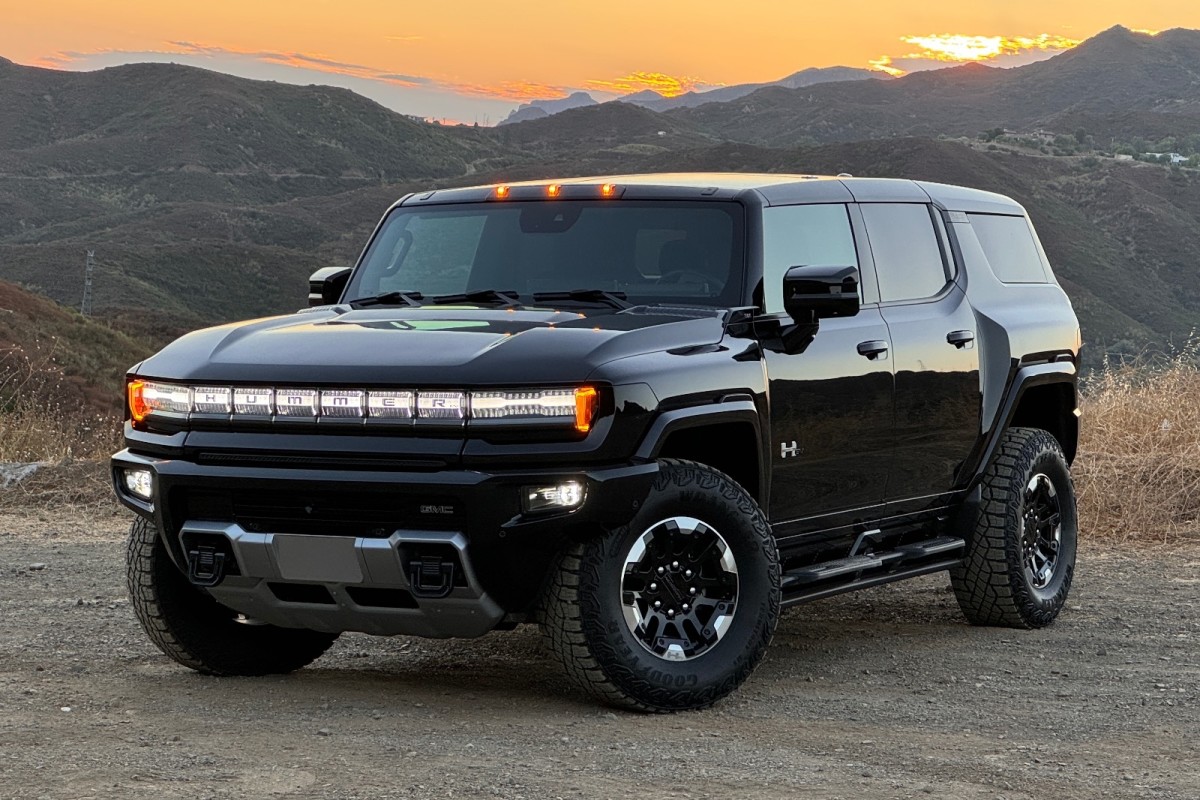
We tested the Hummer EV SUV, which comes in 2X, 3X, and 3X Omega Limited Edition trim levels. Prices range from $96,550 to $140,295, including the $2,295 destination charge. Our 3X test vehicle arrived with the Extreme Off-Road Package, Void Black paint, and a front license plate bracket, bringing the manufacturer’s suggested retail price (MSRP) to $117,475 with destination.
Some of the same compromises inherent in previous Hummers remain. For example, the vertical, mail-slot windshield still makes it hard to see out, and from the driver’s seat, the Hummer EV feels wider than the Mississippi River. In addition, climbing into and out of the cabin requires strong legs and knees, and the liftover height into the cargo area is so high that you’ll need Schwarzenegger-sized biceps to load heavy items. Lastly, if you’re not an extrovert who loves talking to strangers, pick something else to drive.
While the Hummer EV’s styling has evolved in a futuristic direction, it remains instantly identifiable as a descendant of that original Humvee. The huge gray front skid plate and oversized recovery hooks are a little over the top (if that’s even possible), but the electric Hummer nevertheless looks good and, appropriately, capable and aggressive.
We can’t say the same for the Lego-block interior design, where acres of plastic and gaudy bronze accents belie the Hummer’s price tag. The interior is functional and nicely laid out, with exclusive graphics on the dual displays and some switchgear that’s not shared with other General Motors vehicles. The topographic map pattern on the metal speaker grilles is cool, too. Still, the cabin makes it clear that you’re paying for this vehicle’s image, engineering, and technology, not the quality common to luxury marques.

Performance
Weighing a reported 8,660 pounds, the Hummer EV SUV is a heavy beast. Due to its bulk, we didn’t park it on a paver driveway for fear it would create depressions under each of its four massive wheels. You constantly feel the heft when driving, too, as the adaptive air suspension works overtime to manage the wallow, lean, and rubbery ride quality. A teenager riding in the back seat even commented on it, sharing that she didn’t like the sensation.
Unsurprisingly, you need lots of power to move this amount of mass. The test vehicle’s three-motor powertrain takes care of that, supplying up to 860 horsepower and a truly astounding 11,500 pound-feet of torque when using the Watts to Freedom launch control. With that engaged, GMC claims its electric SUV can accelerate to 60 mph in an incomprehensible 3.5 seconds.
We didn’t use Watts to Freedom because even without it, the Hummer is squirrelly under a heavy right foot. Stomp on the accelerator from a stop, and the front end lifts high enough to block part of the view ahead while the electric motors figure out how to make the balloon-sized 35-inch tires spin as fast as possible without relinquishing their grip on the road. It feels like a situation that could get sketchy without much notice, especially on any surface but dry pavement.
Our test vehicle had the Extreme Off-Road Package, which, for about ten grand, adds the equipment you need for extreme off-roading. You get 35-inch mud-terrain tires (on 18-inch wheels), locking front and rear differentials, full underbody skid plates, underbody cameras, rocker panel protection with assist steps, a rear recovery hook, and exclusive wheel designs.
In the interest of full disclosure, our release form to test-drive the Hummer EV SUV prohibited off-roading without written permission from General Motors. We could have asked, but testing week fell during a triple-digit Southern California heat wave, and despite the standard Extract Mode technology, putting this EV’s capabilities to the test in a remote area simply would not be safe or smart.
So, we took it to the beach instead, where its four-wheel steering made quick work of tucking the Hummer into a free parallel space fronting Westward Beach in Malibu. Alternatively, we could have used the Enhanced Automatic Parking Assist, but it never would have identified as viable the space we found and squeezed into.
Unfortunately, after parking, we realized the tailgate design would make unloading impossible, so we nixed that plan and put the Hummer in the pay lot further down near Point Dume, where the rear-wheel steering worked equally well slipping into a perpendicular spot. Our test vehicle had numerous exterior cameras to assist with parking, and you’ll need them because the Hummer EV SUV is both wide and hard to see out of.
We also used the Hummer as a daily driver and took it on our usual SoCal test-driving loop. In all situations, the four-wheel steering is helpful, whether making U-turns on city streets or driving down a twisty mountain road. Crabwalk is less convincing, and it’s hard to conceive of a use case where it might be superior to the rear-steering system as far as maneuverability goes. Therefore, it strikes us as a flex and not a helpful feature.
The mud-terrain tires whir loudly at all times. Take the Hummer EV SUV on a freeway, and wind noise is a constant companion. The teenager who commented on the sensation of weight also chimed in about the road noise, claiming it reminded her of the sounds inside The Matterhorn ride at Disneyland.
Drive anywhere with the lane-keep assist system on, and you’ll find the heavy SUV behaving in ways you don’t expect due to the automated steering inputs. We found it much better to drive without that system active. We were also constantly aware of the Hummer EV SUV’s weight, width, and your personal responsibility for it. In a collision, this vehicle will demolish most other cars on the road, so you must take extra care to avoid one, whether it is your fault or the other driver’s.
GMC delivered the Hummer with 306 miles of indicated range and a nearly full battery. So, the maximum driving range is competitive. Also, the Hummer EV SUV is compatible with 300-kilowatt DC fast charging stations, and GMC claims you can get 100 miles of extra range in as few as 14 minutes if you can find one of those stations.
Opening our EVGo charging station app, we discovered some previously unknown 350-kW chargers in the next city over. The app indicated they were open, so we programmed the Hummer’s navigation system to take us there. When you do that, the Hummer EV automatically preconditions its battery pack to accept the maximum charging rate when you arrive.
By the time we got to the chargers, both of the 350-kW units were in use. More were available a couple of miles away, so we drove to the second EVGo location, plugged in, and soon, the Hummer was charging at 145 kW (apparently, the maximum available at that time). Our charging session went sideways shortly thereafter. Fourteen minutes in, a message popped up on the Hummer’s dashboard display: “DC Fast Charging Rate Limited. Your charge may take more time than expected to complete.” That’s when the charge rate dropped to 45 kW.
Then, after a total of 33 minutes on the charger, we got this message: “Charging Interrupted or Overridden. This may be due to an app stopping the charge or problems with the charge station /cord. Try reconnecting the charge cord.” By now, it had been well over an hour since we’d left home. From the time we plugged in, the Hummer’s battery charge had risen from 37% to 58%, adding 50 miles of indicated range at a cost of $25.10 including the session fee.
Our frustrating experience, a common one across test vehicles, is why many people are skeptical about electric vehicles. Despite Tesla showing everyone how it should be done with its Supercharger network, the public charging experience remains awful for EVs from other brands. So, if you get an EV, upgrade your home with a home charging station to avoid using public chargers.
And just as internal-combustion Hummers got terrible fuel economy, the electric Hummer isn’t efficient at all, consuming an EPA-estimated 67 kilowatt-hours of electricity for every 100 miles of driving. For comparison, the least efficient version of the three-row Kia EV9 rates 42 kWh/100 miles. On a hot testing day, we departed on our mountainous evaluation loop with 169 miles of range, drove 68.4 miles, and returned with 85 miles of remaining range. The Hummer consumed electricity at an indicated rate of 1.4 miles per kWh, or 71.4 kWh/100 miles, proving even less efficient than the EPA estimate.

Form & function
The new Hummer EV SUV is difficult to climb into and out of for several reasons. First, to provide more than 300 miles of range, it has a double-stacked 20-module battery pack under the cabin and between the front and rear wheels. Second, it sits on 35-inch tires. Third, it offers a minimum of 10.2 inches of ground clearance (and a maximum of 16 inches). Fourth, the exterior steps are mounted high to preserve the breakover angle.
Our test vehicle was black with black seats, turning it into a heat sink during the first week of August. GMC uses a “leather alternative” upholstery in the 3X trim, and when it’s been baking in the sun, such as at the beach, it feels like you’re sitting on a frying pan when you get in. An effective seat ventilation system, coupled with the Hummer’s traditionally excellent General Motors air conditioning system, resolves that quickly. Plan ahead, and you can remotely precondition the cabin temperature.
Seat comfort is great, front and rear. We found the driving position to be low-slung due to the low roof and high window sills, which contributed to the sensation that the Hummer’s outward visibility isn’t good. Storage space is plentiful for everyone aboard. Behind the rear seats, the Hummer EV SUV offers 35.9 cubic feet of cargo space, which is about what you’ll find in larger compact and smaller midsize crossover SUVs. The Hummer’s maximum volume of 81.8 cubic feet with the rear seat folded down aligns with a typical midsize SUV—i.e., a much smaller vehicle than the Hummer.
The Hummer offers an open-air driving experience. With the press of a single switch, you can lower all four side windows and the back window glass to create a flow-through effect. You can also remove the standard Infinity Roof’s four overhead roof panels and stack them in a protective bag in the 11.3 cubic-foot front trunk. The panels work similarly to those on Ford Broncos and Jeep Wranglers and are as awkward to remove and re-install, especially since the Hummer is so tall. But, by removing them, you can eliminate their tendency to creak.
As previously mentioned, the Hummer EV SUV’s tailgate powers open to the right, blocking curbside access when parallel parked. You can use a button on the vehicle itself or the remote keyless entry fob to operate it. Presumably to prevent damage and for safety, when you release either button, the tailgate stops moving, so keep pressing it to open it completely.

Technology
GMC equips the Hummer EV SUV with a configurable 12.3-inch digital driver display and a center 13.4-inch touchscreen infotainment system. Both feature underlying technology and exclusive graphics not shared with other General Motors vehicles.
Steering-wheel controls adjust the data shown on the driver display, while most infotainment functions are available by touching the screen, speaking voice commands, or using the few physical controls. Equipped with Google Built-in technology, the infotainment system’s digital voice assistant is better than what you’ll find in many modern vehicles, though it remains imperfect.
For example, when listening to SiriusXM satellite radio, it did not direct us to a reggae station when we asked to listen to reggae music, recommending one of the embedded apps instead. Also, in response to an urgent request for directions to a hospital, it offered some medical facilities that were not hospitals as potential destinations. But, overall, it performed just as well as what you’ve come to expect from your smartphone and proved helpful with regard to finding nearby charging stations.
Pairing to the system’s Bluetooth proved effortless, and it was easy to wirelessly run Apple CarPlay and switch between that smartphone mirroring tech and the native infotainment system environment. Also, the 14-speaker Bose Centerpoint premium sound system offered decent quality, but it had its work cut out for it when driving on the highway as it tried to overcome the tire whir and wind noise. Manufactured sound emanates from the speakers when the Hummer EV is in the Watts to Freedom, Terrain, or Off-Road driving modes to enhance the driving experience.
In addition to wireless Apple CarPlay (and Android Auto), the Hummer’s infotainment system offers access to connected services and a subscription-based WiFi hotspot. Numerous apps related to the electric drive system’s performance, battery charging, off-roading, and towing are included as well. Over-the-air updates keep the tech fresh while occasionally adding new features.

Safety
The Hummer EV SUV 2X, 3X, and 3X Omega Limited Edition all come with a comprehensive collection of driver assistance systems. The list is long, including: adaptive cruise control, forward-collision warning, automatic emergency braking, front and rear pedestrian detection, blind-spot monitoring (with trailer coverage), rear cross-traffic alert, rear automatic braking, lane-departure warning, lane-keep assist, and a surround-view camera system.
Super Cruise is also standard and comes with a three-year subscription to service. It pairs the adaptive cruise control and lane-centering assistance technology to offer hands-free driving on more than 200,000 miles of approved roads in North America. When active, it shows a green bar illuminated on the upper part of the steering wheel, clearly conveying to a driver when it is safe to remove their hands and let the Hummer do the driving.
Since we didn’t like how the lane-keeping technology felt, especially on the narrow lanes of Los Angeles freeways, we were skeptical of how effective Super Cruise might be in the Hummer. Surprisingly, it did an excellent job of managing the slicing and dicing common on L.A.’s multi-lane expressways and keeping the Hummer within a lane. The automated lane-change function worked well, too.
Unfortunately, during the separate evaluation drive, the driver aids stopped working. After running the SUV down the twisting and turning Mulholland Highway to examine its handling on pavement, we turned right on Pacific Coast Highway to begin driver-assist testing for the remainder of the driving loop. At first, we thought driving into the late afternoon sun was causing a problem or that the Hummer’s brakes needed to cool a bit following the mountain descent. But it didn’t take long to determine something else was amiss. It wasn’t until after testing was complete and we restarted the Hummer that night that the driver aids came back online.
As of this writing, no crash-test ratings from the Insurance Institute for Highway Safety (IIHS) and the National Highway Traffic Safety Administration (NHTSA) were available.

Cost-effectiveness
The 2024 GMC Hummer EV SUV is not a cost-effective vehicle. It is expensive to buy and inefficient to operate. While electric vehicles require less maintenance than those with internal combustion engines, they tend to wear out tires quickly, and the 35-inch mud-terrains on the test vehicle are not cheap.
But, you probably know and accept these facts going into Hummer ownership. The other points of criticism, from how hard it is to see out of and how high you need to lift things to put them in the cargo hold to the excessive tire roar and wind noise on the highway, might not be obvious. So know that Hummer EV SUV ownership requires your acceptance in those areas, too.
With that said, if you buy a Hummer SUV with a complete understanding of the compromises inherent in that decision, we bet you’ll be quite satisfied with your so-called “super truck.” Ultimately, it is a remarkable and impressive vehicle.
This is an emotional rather than practical purchase, and the reward in owning a Hummer EV is related to how it looks, the image it projects, what it can tackle off-road, and the sheer cool factor associated with features like the Watts to Freedom acceleration, Crabwalk capability, Infinity Roof Sky Panels, and Super Cruise.

What owners say
A great car to have! Lots of room and technology!
November 11, 2023Trims & specs
Base MSRP $104,000 | Seating 5 |
Engine 830 hp Electric | Cargo Capacity 35.9 cu ft |
Combined MPG 54 | Drivetrain AWD |
Base MSRP $98,300 | Seating 5 |
Engine N/A | Cargo Capacity 35.9 cu ft |
Combined MPG N/A | Drivetrain N/A |
Base MSRP $78,400 | Seating 5 |
Engine 625 hp Electric | Cargo Capacity 35.9 cu ft |
Combined MPG 54 | Drivetrain AWD |
Base MSRP $106,500 | Seating 5 |
Engine N/A | Cargo Capacity 35.9 cu ft |
Combined MPG N/A | Drivetrain N/A |


Pricing trends
MSRP range
$78,400 - $104,650
Current avg. market price
$66,614
Trending down by 1.8% this month
May 2026 - November 2026