2023 Subaru WRX Reviews, Pricing & Specs


Pros & cons
What we like
Stylish design
Great handling
Manual transmission available
What to consider
Unintuitive technology
Poor value for money
Less cargo space than rivals
Expert review
After two decades on sale in the United States, the rally-inspired WRX has grown up.
Subaru's image is centered around rugged station wagons, outdoor activities, and cute dogs, but the automaker also has a sporty side—exemplified by the 2023 Subaru WRX.
The WRX first appeared in the 1990s as a homologation special for the World Rally Championship (WRC), which at the time required cars to be closely related to production models. Subaru viewed rallying as the perfect way to show off its all-wheel drive (AWD) vehicles so, after a trial with the Legacy midsize sedan, it launched the Impreza-based WRX with the goal of becoming more competitive. It worked: Subaru has won multiple rally championships and the WRX has endeared it to car enthusiasts.
Subaru didn't begin selling the WRX in the United States until the 2002 model year, but it's remained a fixture of the automaker's U.S. lineup every since, competing against other sporty compact cars like the Honda Civic Si, Hyundai Elantra N, Volkswagen Golf GTI and Jetta GLI, and other derivatives of those models.
The current, fourth-generation WRX was introduced for the 2022 model year, so there are no changes to report for 2023. The lineup includes base, Premium, Limited, and GT trim levels. For this review, we drove the WRX GT, which sits at the top of the range.
out of 10 expert review
Look & feel
The WRX was once badged as the Impreza WRX, maintaining most of the sheetmetal of the base Impreza, but Subaru has moved away from that in more recent generations.
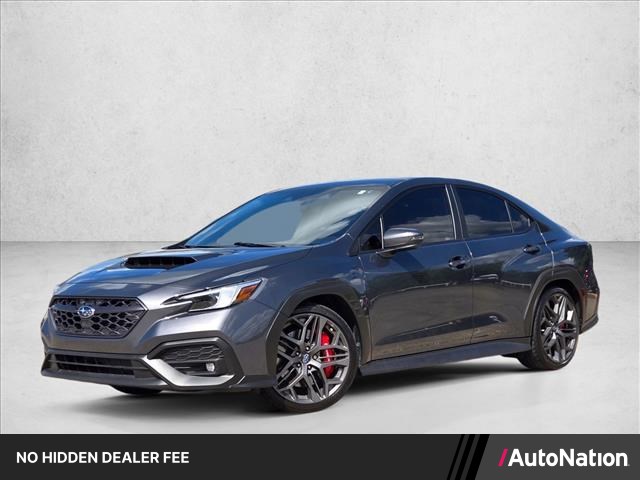
Aside from being a compact sedan riding on the Subaru Global Platform, the current-generation WRX will never be mistaken for an Impreza. The front- and rear-end styling is different, the sides feature a wide-body look with what seems like a new interpretation of the first-generation WRX's box fender flares, and revenge-of-Pontiac body cladding visually links the WRX to the Subaru Crosstrek and Outback. Subaru also kept the WRX's signature hood scoop, which is functional, feeding air to an intercooler mounted on top of engine. Base models get 17-inch wheels and other WRX trims get 18-inch wheels, with standard summer tires in all cases.
The WRX and Impreza will grow further apart for the 2024 model year. The 2024 Impreza will be available only as a hatchback, and while Subaru has sold WRX hatches in the past, it has no plans to offer the current WRX in anything other than a sedan body style.
It doesn’t fly under the radar like a Honda Civic Si or Volkswagen Jetta GLI, but the WRX's exterior styling clearly conveys that this is both a performance car and a Subaru. The various additions have the same tuner aesthetic long associated with the WRX and other Japanese performance cars, but still fit in with Subaru's current design theme.
The interior is typical of Subaru. It's basic, but looks like it will hold up to years of use. WRX GT models like our test car get Recaro Performance Design front seats, with eight-way power adjustment for the driver's seat. Comfortable and supportive, these buckets get red contrast stitching, which helps liven up the mostly black interior. GT models also get Ultrasuede upholstery for the front seats and dashboard cover.

Performance
The WRX is an in-betweener in its segment. With 271 horsepower and 258 pound-feet of torque generated by its 2.4-liter turbocharged four-cylinder boxer engine, the Subaru develops more horsepower (albeit less torque) than a Volkswagen Golf GTI, but less than a Golf R. It also sits between the Honda Civic Si and Honda Civic Type R in output (all of these cars also use turbocharged four-cylinder engines). With previous generations, a high-performance WRX STI from the Subaru Tecnica International tuning division competed against the likes of the Type R and Golf R, but Subaru has said there will be no STI version of the current WRX.
Unlike the mostly front-wheel-drive (FWD) competition (the more powerful Golf R and Toyota GR Corolla being the exceptions) the WRX features AWD. Power is routed from the engine to the wheels through a standard six-speed manual transmission, or an optional continuously variable transmission (CVT), branded as the Subaru Performance Transmission (SPT).
The SPT/CVT is optional on the base, Premium, and Limited trims, but standard on our GT test car. It shakes CVT stereotypes with quick responses to throttle inputs, feeling more like a conventional geared automatic transmission. Subaru may have gone too far in this regard however; we could do without the fake shift shock that jolts the car as it accelerates hard through simulated gears. Unlike the turbo engine/CVT combination used in the Subaru Outback and Legacy, the transmission and engine also seemed well-matched, producing smooth and predictable acceleration. Subaru also deserves credit for continuing to offer a manual gearbox for people who want it.
GT models also get electronically controlled dampers and a drive mode select system that also offers multiple settings for the steering, engine, AWD system, driver aids, and even the climate control. Subaru combines these into Comfort, Normal, Sport, and Sport+ drive modes, plus a custom Individual mode that lets drivers mix and match settings their own way. Differences were noticeable, but not dramatic. And we found the default Sport mode suitable for most conditions.
The current WRX's well-mannered character is both its greatest asset and its greatest drawback. While far from luxurious, it's quiet and comfortable enough to be a pleasant daily driver. It also inspired plenty of confidence on twisty roads, thanks to the generous supply for grip from its AWD system and standard summer tires. Yet the best way to describe the driving experience is “muted.” The exhaust is quiet, the CVT blunts the feeling of acceleration, and the aforementioned laid-back steering removes any sense of urgency. The WRX does everything you want with competence, but without exuberance.

Form & function
One of the main benefits of a WRX over a traditional sports car, like Subaru's BRZ, is that this is still a compact sedan and thus offers a modicum of practicality. Compared to other compact sedans, the WRX has a smidge more front headroom and legroom than a Honda Civic Si, but the Civic offers more space for rear-seat passengers.
The Subaru's 12.5 cubic feet of trunk space is less than the 14.1 cubic feet offered by the Civic Si and Volkswagen Jetta GLI, or the Hyundai Elantra N’s 14.2-cubic-foot trunk. A 60/40 split-folding rear seat is standard, but Subaru doesn't quote a cargo-space number with the seat folded. Roof-rack mounts are standard as well.
Unlike some other automakers, Subaru has managed to preserve the good outward visibility of previous generations of compact cars. The WRX's low window-sill lines, relatively thin forward roof pillars, and low dashboard provide a fantastic view of your favorite driving road—while making parking a bit easier.
However, another throwback is that there is no place to put a phone. The typical spot underneath the touchscreen is too small for a modern smartphone, as are the cupholders. That leaves the center console storage bin, but leaving a phone there means you can't charge or use Apple CarPlay or Android Auto, because that's not where the USB ports are. This is the only real ergonomic flaw in the WRX cabin, but it's a surprising one for a 2023 model that was recently redesigned.

Technology
The WRX's Subaru Starlink infotainment system includes standard Apple CarPlay and Android Auto integration and two display configurations. Base models get a pair of 7-inch touchscreens, with one screen for smartphone connectivity and audio functions, and another for climate control and vehicle settings. WRX Premium and higher trim levels get an 11.6-inch portrait-oriented touchscreen that puts all of that functionality into one display.
We appreciated the larger screen for its ability to display icons and text in an easily-legible size but, as in all interfaces like this, physical buttons and knobs would have been appreciated. Climate-control icons, a home button, and a shortcut to the drive-mode menu (this can also be accessed by pressing the "Mode" button on the steering wheel) take up space and don't provide the tactile feedback of physical controls.
The menus were mostly easy to figure out although, as with other car brands, the interface for SiriusXM satellite radio requires a few too many steps. Some brands have gotten around this with sophisticated voice recognition that allows you to, for example, simply call out a specific channel name, but that hasn't reached Subaru and other mainstream brands. In our test car, SiriusXM also took an unusually long time to load on startup. Each time we started the car, we ended up driving a significant distance before any music started playing.

Safety
The WRX gets Subaru's EyeSight safety system, which is notable for using stereo cameras mounted in a less-vulnerable position behind the windshield in place of the bumper- or grille-mounted radar units most other automakers use as sensors for their driver aids. Only available with the CVT, EyeSight adds adaptive cruise control, automated lane-centering, forward collision warning, automatic emergency braking, lane-keep assist, and lane-departure warning.
Other available safety features include blind-spot monitoring, rear cross-traffic alert, reverse automatic braking, and steering-responsive headlights.
The 2023 WRX hasn't completed the most up-to-date battery of Insurance Institute for Highway Safety (IIHS) tests, but it received top "Good" scores in all crash tests completed so far. It also received the highest "Superior" score for front-crash prevention tech in vehicle-to-vehicle and vehicle-to-pedestrian daylight scenario. The standard headlights were rated "Acceptable," while the headlights available on Limited and GT models got the "Good" rating.
The National Highway Traffic Safety Administration (NHTSA) gave the 2023 WRX a five-star overall safety rating, including five stars in frontal, side, and rollover crash tests.

Cost-effectiveness
The WRX's EPA fuel economy ratings of 22 mpg combined (19 mpg city, 26 mpg highway) with the manual transmission and 21 mpg combined (19 mpg city, 25 mpg highway) with the CVT are respectable for a performance car. We were also able to match our CVT-equipped test car's EPA combined rating, with an indicated 22.4 mpg after a week of driving in mixed conditions. However, Subaru recommends 93-octane fuel which, combined with enthusiastic driving can cause fuel bills to rise quickly.
Subaru offers fairly standard warranty terms, including a three-year, 36,000-mile, basic warranty and five-year, 60,000-mile, powertrain warranty.
Pricing starts at $31,625 (including the $1,020 destination charge) for the base model with the manual transmission. That's a $1,525 increase over the 2022 model, and the base price rises to $33,475 if you opt for the CVT. The Premium and Limited trim levels start at $34,125 and $38,515 with destination, respectively, again with an added charge for the CVT. The CVT-only WRX GT starts at $44,415 with destination.
A fully loaded WRX GT isn't exactly the fantastic value this model is known for, but it is a well-equipped car with significant bandwidth. It can function as both a practical daily driver and a performance car that lives up to the WRX name, albeit with a less-rambunctious character than previous generations. It's also worth remembering that many of the WRX's rivals are getting quite expensive as well (a range-topping VW GTI also cracks $40,000, for example). And if you don’t need every bell and whistle, almost everything that's good about the WRX applies to the much less expensive base model.


What owners say
Comfortable ride, great on gas, fun get around vehicle. The perfect day to day vehicle.
June 5, 2025Very good car to drive. Never been excited like this for a long time that getting behind the wheel of my WRX puts a smile on my face. Very driver engaging and a true drivers car. Happy to own one!
July 6, 2023Trims & specs
Base MSRP N/A | Seating N/A |
Engine N/A | Cargo Capacity N/A |
Combined MPG N/A | Drivetrain N/A |
Base MSRP N/A | Seating N/A |
Engine N/A | Cargo Capacity N/A |
Combined MPG N/A | Drivetrain N/A |
Base MSRP $33,105 | Seating 5 |
Engine 2.4L 271 hp H4 | Cargo Capacity 12.5 cu ft |
Combined MPG 22 | Drivetrain AWD |
Base MSRP $43,395 | Seating 5 |
Engine 2.4L 271 hp H4 | Cargo Capacity 12.5 cu ft |
Combined MPG 22 | Drivetrain AWD |
Base MSRP $30,605 | Seating 5 |
Engine 2.4L 271 hp H4 | Cargo Capacity 12.5 cu ft |
Combined MPG 22 | Drivetrain AWD |
Base MSRP N/A | Seating N/A |
Engine N/A | Cargo Capacity N/A |
Combined MPG N/A | Drivetrain N/A |
Base MSRP $37,495 | Seating 5 |
Engine 2.4L 271 hp H4 | Cargo Capacity 12.5 cu ft |
Combined MPG 22 | Drivetrain AWD |
Base MSRP N/A | Seating N/A |
Engine N/A | Cargo Capacity N/A |
Combined MPG N/A | Drivetrain N/A |




Pricing trends
MSRP range
$30,605 - $43,395
Current avg. market price
$27,493
Trending down by 2.1% this month
May 2026 - October 2026