2023 Jeep Wagoneer L Reviews, Pricing & Specs


Pros & cons
What we like
Powerful engine
Comfortable
Plenty of cargo space
What to consider
Significant turbo lag
Dissatisfying voice recognition system
Active Drive Assist is unavailable
The CarGurus verdict
The new 2023 Wagoneer L adds more cargo space and a standard twin-turbo engine to an already big and powerful full-size SUV package.
What is a Jeep Wagoneer L? It’s a standard Wagoneer, but with an extra foot of length, an additional seven inches of wheelbase, longer rear doors for easier entry and exit, and a 35-percent increase in cargo capacity behind the third-row seat. The 2023 Jeep Wagoneer L also has a new twin-turbocharged six-cylinder engine making more horsepower and torque while returning slightly better fuel economy than the base Wagoneer’s V8 engine. Jeep offers the new 2023 Wagoneer L in base, Series II, and Series III trim levels, with prices ranging between $67,495 to about $79,220, including the destination charge.
out of 10 expert review
Look & feel
In 2021, sales in the full-size SUV segment increased by more than 20 percent to more than half a million vehicles. By Jeep’s reckoning, 75,000 of those SUVs were long-wheelbase models such as the Cadillac Escalade ESV, Chevrolet Suburban, Ford Expedition Max, GMC Yukon XL, and Lincoln Navigator L.
Jeep wants a piece of that action. Enter the 2023 Wagoneer L and Grand Wagoneer L, SUVs that are 12 inches longer, ride on a wheelbase stretched by 7 inches, have larger rear doors, and can carry more cargo. Jeep says they retain many of the best-in-class claims made by the standard Wagoneer and Grand Wagoneer, most notably towing capacity, which remains at 10,000 pounds for a Wagoneer L with standard two-wheel drive (2WD).
This review focuses on the new Wagoneer L, which competes against the Suburban, Expedition Max, and Yukon XL. We’ll cover the Escalade ESV and Navigator L alternative, the Grand Wagoneer L, in a separate story.
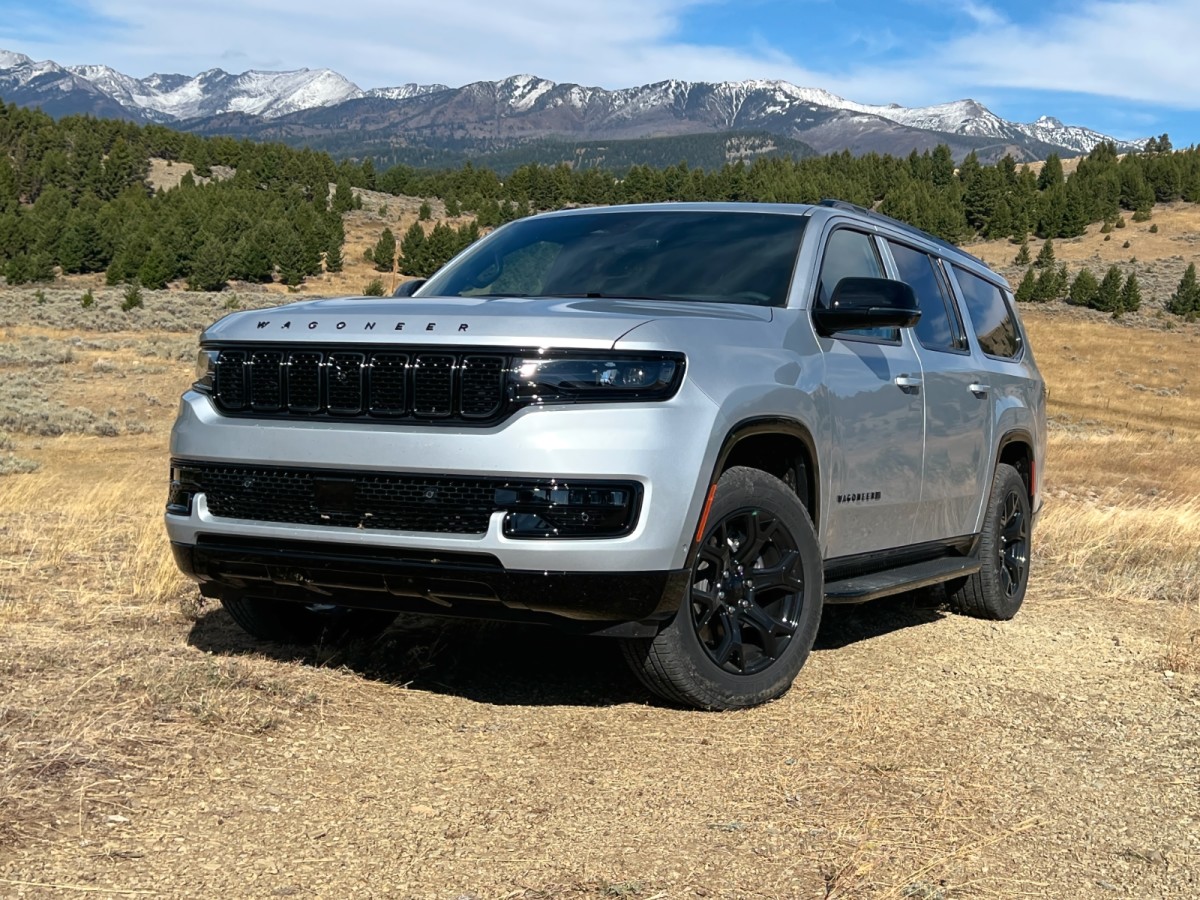
Jeep flew us to Montana to drive the new Wagoneer L, and handed over the key fob to a silver Series II equipped with the Carbide option package, which arrived on the standard Wagoneer halfway through 2022. Carbide equipment adds gloss black exterior accents and 20-inch wheels, a black interior with unique décor, and a triple-pane sunroof that includes a glass panel over the third-row seat. Jeep says Wagoneer L buyers can get the Carbide package in early 2023, so it won’t be available right away.
On the outside, the Wagoneer L looks just like a standard Wagoneer from the front doors forward. From there back, it stretches to add the extra interior room, especially aft of the rear wheels, where a longer overhang reduces the departure angle from 21.1 degrees to 18.8 degrees. Paint one yellow, put some flashing lights on it, and you’d have yourself a school bus. Wheel sizes range from 18 inches to 22 inches in diameter, and the bigger they are, the better the Wagoneer L looks.
Jeep says it spent lots of time perfecting the Wagoneer’s interior materials, colors, and textures, but with the Carbide package it’s nothing but black, black, and more black. However, the huge windows, the triple-pane sunroof, and the reflections on all of the screens and glossy trim surfaces helps to prevent it from feeling like a cave. Not only that, but the Wagoneer L is quiet inside. Jeep says it has made noise, vibration, and harshness improvements and equips the SUV with standard acoustic windshield and front door glass. The twin-turbo Hurricane inline-six also contributes to the remarkable silence at speed.
In addition to the Carbide package, our test vehicle had four-wheel drive (4WD), extra-cost paint, the Convenience Group, the All-Weather Mat Group, and a front passenger interactive display. The Manufacturer’s Suggested Retail Price (MSRP) came to $83,310, including the $2,000 destination charge.

Performance
For the 2023 model year, nearly all Wagoneers have a twin-turbocharged 3.0-liter inline six-cylinder engine. This so-called “Hurricane” power plant replaces the previous 5.7-liter “Hemi” V8 in all but the base Wagoneer in standard-length format, and, compared to the rumbling Hemi, Jeep says it reduces carbon emissions by 15 percent while improving the SUV’s fuel efficiency.
Power and torque rise and are available at lower rpm. The twin-turbo inline six (I6) generates 420 horsepower at 5,200 rpm and 468 pound-feet of torque at 3,500 rpm. Meanwhile, the old 5.7-liter V8 supplies 392 hp at 5,600 rpm and 404 lb-ft of torque at 3,950 rpm. The new “Hurricane 420” engine provides up to 10,000 pounds of maximum towing capacity, more than any other large SUV.
Premium fuel is recommended for the new Hurricane engine, but is not required. Jeep says it should get 20 mpg in combined driving with 2WD and 19 mpg with 4WD, improvements of 2 mpg in each measure. Unfortunately, on a 56.4-mile test drive in the mountains and across the plains northeast of Bozeman, Montana, the trip computer produced a questionable result, so we cannot report a real-world fuel economy number at this time.
The Hurricane 420 employs an eight-speed automatic transmission, and it powers the rear-wheels unless you opt for a 4WD system. Note that with 4WD, towing capacity drops to 9,850 pounds.
Our test vehicle had Quadra-Trac I, a full-time single-speed 4WD system perfect for people who don’t have any plans to head far off the beaten path. You can get a Quadra-Trac II 4WD system with a two-speed transfer case if you think you’ll need it. It comes in an optional Advanced All Terrain Group package that also equips the Wagoneer L with 18-inch wheels with off-road tires, an electronic locking rear differential, skid plates, and Selec-Speed Control, which is an off-road, low-speed cruise control system that also includes hill ascent and descent control.
Used in conjunction with the Wagoneer L’s standard all-season tires, the Selec-Terrain traction system’s Sand/Mud mode, and the optional Quadra-Lift air suspension, Quadra-Trac I helped us to scramble up a hill to snap photos with Montana’s snow-capped Crazy Mountains serving as the backdrop. The other Selec-Terrain modes include Auto, Sport, Rock, and Snow.
Jeep equips the Wagoneer L with the same independent front and rear coil-spring suspension you’ll find on the standard Wagoneer. However, it is re-tuned (along with the steering) to ensure that the longer Wagoneer L rides and handles like the shorter standard-wheelbase version. With the standard suspension, the Wagoneer L offers 8.3 inches of ground clearance.
If you add the Quadra-Lift air suspension to the SUV, it comes with semi-active damping to enhance the driving dynamics. It features several settings including Park (drops the SUV 1.6 inches), Aero (drops 0.6 inches on the highway), Normal (8 inches of clearance), Off-Road 1 (9 inches of clearance), and Off-Road 2 (10 inches of clearance). With Quadra-Lift, maximum water fording capability measures 24 inches.
In just a couple of hours, we traveled on nearly every type of road except for Interstate 90, the only freeway in the Bozeman area. Regardless of the terrain and despite the elevation, the twin-turbocharged Wagoneer L Series II accelerated quickly enough, handled well enough, and took us places a typical crossover likely couldn’t. However, several things about the SUV stood out for comment.
First, the engine is smooth, quiet, and refined. Unlike the twin-turbo V6 in a Ford Expedition, which makes a chuffing sound when accelerating, or the rumbling V8 engines found in rivals from Chevy and GMC, the Jeep’s I6 doesn’t intrude upon the cabin. Depending on your preferences, that might be a good thing or a bad thing. We liked it.
Second, turbo lag is an issue with the Hurricane 420 (and the Grand Wagoneer’s Hurricane 510). Stomp on the accelerator pedal from a stop, and it takes a couple of seconds for the engine to collect its wits and surge the Jeep forward. Once you’re moving, part-throttle response is quicker, but the delay is still noticeable.
Third, there is a distinct difference in acceleration between the Wagoneer L’s Hurricane 420 and the Grand Wagoneer L’s more powerful Hurricane 510. If you test-drive the 510, you’re going to want to find the budget to get it. Nevertheless, the 420 is strong and rewarding enough in this application.
Fourth, our test vehicle’s 20-inch wheels and 275/55 Bridgestone Dueler H/L Alenza all-season tires provided a significantly smoother ride than the 22-inch wheels and 285/45 Goodyear Eagle Touring tires we experienced on the Grand Wagoneer L Series III. The Wagoneer L’s smaller wheels and tires allowed a little more lean in curves, and they don’t fill out the wheel wells in as satisfying a manner, but the superior ride quality and reduced road shock are worthwhile considerations.

Form & function
Every Wagoneer L includes a triple-zone automatic climate control system and standard 12-way power-adjustable front seats with heating and ventilation. Upgrade to Series II trim, and you get a premium Nappa grade of leather instead of the standard Capri hides. Fixed running boards made it easier to climb aboard our Series II Carbide test vehicle, where comfort was easy to find.
Eight-passenger seating is standard in the Wagoneer L, with available second-row captain’s chairs an option that shrinks occupant capacity to seven people. Our test vehicle had the second-row bench seat with the available heated cushions, and it provides a tremendous amount of legroom, headroom, and foot room. Three adults can ride without complaint.
Regardless of your second-row seating choice, the Wagoneer L supplies a Tip n’ Slide function to make it easier to climb into the third-row seat. And it is definitely easy, even for larger adults. With the running boards, it’s almost like boarding a full-size passenger van.
Better yet, the third-row seat is anything but an undesirable seating location. With the tall side windows, the overhead sunroof panel, lots of leg support, reclining seatbacks, and good legroom, grown ups can ride in the third row for long distances without complaint. Based on our recollection rather than a direct back-to-back comparison, the Jeep’s third-row comfort puts the Chevy and GMC to shame and is slightly better than what you’ll find in the Ford.
Storage space is decent in all three rows, but the Wagoneer L lacks solutions that can counter the power-sliding front center console in the General Motors models or the handy cupholders and shelves built into the Ford’s rear door panels, which are great for kids. Nevertheless, there is more room for stashing your stuff than you’ll likely require.
Around the back, a power liftgate rises to reveal 42.1 cubic feet of cargo space behind the third-row seat. That’s 14.7 cu-ft more than the standard-length Wagoneer, and more than you’ll find in the competition. Fold the third-row seat down, and the Wagoneer L can handle 85.3 cu-ft of cargo, while maximum volume with the second-row seat flattened is 130.9 cu-ft. The GM twins beat the Wagoneer L on these last two measurements, but the Expedition Max trails the it.

Technology
In addition to a standard 10.25-inch digital instrumentation display, the 2023 Wagoneer L has a 10.1-inch touchscreen infotainment system running the latest Uconnect 5 software.
Highlights of this infotainment system include:
- Customizable home screen
- Simultaneous Bluetooth pairing for two devices
- Wireless Apple CarPlay and Android Auto
- Amazon Alexa integration
- SiriusXM satellite radio
- Connected services including access to Wi-Fi hot spot
- Navigation system
- Five programmable user profiles, plus a Valet mode
- USB ports in all three rows of seats
- Alpine sound system with nine speakers
- Wireless device charging pad (Series II up)
During the evaluation, Uconnect 5 gave a hit-and-miss performance. Pairing an iPhone 13 to the Bluetooth connection was easy, giving quick access to Apple CarPlay. The test vehicle’s wireless charging pad, accessible behind a gloss black cover that opens to reveal a storage area underneath the climate controls, is easy to see and use. Also, the Alpine audio system provides decent sound quality.
However, despite Amazon Alexa integration, the voice recognition system leaves something to be desired. Uconnect 5 had trouble executing commands that GM’s new Google-based digital assistant and Ford’s available Sync 4 systems can understand. It also did not filter only for hospitals when we told the Jeep in a panicked voice: “I need to go to a hospital!” (Just a test—everyone is A-OK.)
More aggravating, though, was the navigation system’s behavior when we took a different driving route from what Jeep prescribed. Uconnect can store specific, pre-programmed trip routes, and that’s what Jeep told us to use when we set off on our drive in the Wagoneer L. Instead, we opted to deviate from that plan, and when the navigation system did not recalculate a new route based on the direction we headed, we canceled the pre-programmed guidance.
Then, we pushed the Talk button and asked for directions to our hotel in Bozeman. Uconnect couldn’t handle that task. It said the nearest Kimpton hotel was over 500 miles away. Switching to Apple CarPlay, Siri found the hotel in no time at all and calculated a new route. Needless to say, people expect voice recognition systems to work like Siri or Google Assistant or Alexa. When they don’t, they cause frustration, distraction, and irritation.
To help solve for this, Jeep offers an optional front passenger interactive display. Essentially, this is a 10.25-inch touchscreen embedded into the trim panel on the right side of the dashboard, and it allows front-seat passengers to assist the driver with navigation and keeping track of other trip requirements. It also gives them access to their own entertainment screen.
Additional features available for the Wagoneer L include a configurable head-up display with a 10-inch viewing area, a rear-seat entertainment system with dual touchscreen displays and Amazon Fire TV integration, and a McIntosh premium sound system with 19 speakers.

Safety
There is plenty of safety tech aboard the new Wagoneer L, too. The standard equipment list includes:
- Forward-collision warning with pedestrian and cyclist detection
- Automatic emergency braking
- Blind-spot monitoring
- Rear cross-traffic alert
- Front and rear parking sensors with automatic braking
Upgrade to Series II trim, and the Wagoneer L adds adaptive cruise control with stop-and-go capability and Active Lane Management, which includes lane-departure warning and lane-keeping assistance systems. When you drift over a lane marker, you get a visual indicator and a vibration through the steering wheel. If you’ve set the system with steering assistance, it can try to prevent a lane departure by steering the Jeep toward the center of the lane of travel. Drivers can turn the system off using a button on the center console.
Safety-related upgrades include automatic high-beam headlights, a surround-view camera system, a semi-autonomous parking assistance system that steers the Wagoneer L into parallel and perpendicular spaces while the driver operates the transmission and pedals, and Intersection Collision Assist (ICA). With ICA, the Wagoneer L can warn a driver when other vehicles are approaching from either side as the SUV noses out into an intersection.
If you want more driving assistance tech than this, you’ll need to upgrade to a Grand Wagoneer L. Of course, Jeep benefits from making this distinction by encouraging you to spend more on the luxury-oriented model. But with Chevrolet, Ford, and GMC all offering hands-free driving assistance on the Wagoneer L’s direct competitors, the automaker might at least want to make its Active Drive Assist system available on the Wagoneer L. It’s not a hands-free system like Super Cruise or BlueCruise, but it’s close.
During testing, the Wagoneer L’s driving assistance and collision-avoidance features worked as expected. The adaptive cruise control could improve by responding faster to changing traffic conditions ahead, such as when another vehicle cuts into the gap in front of the SUV or when a slower vehicle changes lanes to clear the road ahead.
Crash-test ratings from the National Highway Traffic Safety Administration (NHTSA) and the Insurance Institute for Highway Safety (IIHS) were unavailable as this review was written.

Cost-effectiveness
The Wagoneer L is expensive when you compare its base model to the least expensive examples of the Chevy Suburban, Ford Expedition Max, and GMC Yukon XL.
However, Jeep offers more standard equipment than its primary rivals, and the Wagoneer L comes with five years of complimentary scheduled oil changes and tire rotations, plus perks including 24-hour customer support and VIP event access. When you compare the Wagoneer L to an equivalently optioned Chevy, Ford, or GMC, the price premium for the Wagoneer L shrinks or outright evaporates.
Still, there’s no getting around this (or any) full-size SUV’s price tag, and it can rise fast when you start checking option boxes. Also, compared to a standard-length Wagoneer, you’ll pay a premium of $3,000 for the Wagoneer L’s added length ($3,500 with base trim to also add the twin-turbo Hurricane 420 engine). So, if you don’t need the extra cargo space, perhaps that money might prove better spent on upgrades to a standard-length Wagoneer.
Or, you could accept less interior room and towing capacity and instead get a smaller Jeep Grand Cherokee L packed with many of the same features that are available for the Wagoneer and Wagoneer L. But then you wouldn’t be able to enjoy the impressive new twin-turbo Hurricane 420 I6.

What owners say
Love everything about it except for the gas mileage. The sticker states 19 city and 21 highway. It seems to get a combined 14-16 mpg.
January 11, 2026Loved the huge cargo capacity and that the bench seats lay completely flat. Very stylish.
December 14, 2025Trims & specs
Base MSRP $69,945 | Seating 8 |
Engine 3.0L 420 hp I6 | Cargo Capacity 42.1 cu ft |
Combined MPG 19 | Drivetrain 4X4 |
Base MSRP $69,695 | Seating 8 |
Engine 3.0L 420 hp I6 | Cargo Capacity 42.1 cu ft |
Combined MPG 20 | Drivetrain 4X2 |
Base MSRP $74,810 | Seating 8 |
Engine 3.0L 420 hp I6 | Cargo Capacity 42.1 cu ft |
Combined MPG 20 | Drivetrain 4X2 |
Base MSRP $76,945 | Seating 8 |
Engine 3.0L 420 hp I6 | Cargo Capacity 42.1 cu ft |
Combined MPG 19 | Drivetrain 4X4 |
Base MSRP $73,390 | Seating 8 |
Engine 3.0L 420 hp I6 | Cargo Capacity 42.1 cu ft |
Combined MPG 20 | Drivetrain 4X2 |
Base MSRP $65,945 | Seating 8 |
Engine 3.0L 420 hp I6 | Cargo Capacity 42.1 cu ft |
Combined MPG 19 | Drivetrain 4X4 |
Base MSRP $62,945 | Seating 8 |
Engine 3.0L 420 hp I6 | Cargo Capacity 42.1 cu ft |
Combined MPG 20 | Drivetrain 4X2 |
Base MSRP $72,640 | Seating 8 |
Engine 3.0L 420 hp I6 | Cargo Capacity 42.1 cu ft |
Combined MPG 19 | Drivetrain 4X4 |


Pricing trends
MSRP range
$63,670 - $77,810
Current avg. market price
$35,838
Trending down by 1.6% this month
May 2026 - November 2026


