2022 Ford F-150 Lightning Reviews, Pricing & Specs




Pros & cons
What we like
Impressive electric powertrain
Standard all-wheel drive
Comfortable
What to consider
Extended-range models are pricey
Expert review
An evolution of the F-150 signals a revolution for the auto industry
Electric vehicles have been kicking around America for some time now. From the ill-fated General Motors EV1 to the early success of the Nissan Leaf and on to the meteoric rise of Tesla, we’ve had plenty of time to get used to EVs. But there’s never before been an EV with as much mass appeal as the 2022 Ford F-150 Lightning.
out of 10 expert review
Look & feel
When you consider the fact that the 2022 Ford F-150 Lightning is likely the most important vehicle debut in decades, it can be astonishing to realize just how normal it looks. The F-150 Lightning does have some unique exterior styling cues but, for the most part, it looks an awful lot like all the other run-of-the-mill F-150s driving around on American roads.
Shoppers can purchase an F-150 Lightning in one of four trim levels: Pro, XLT, Lariat, and Platinum. Unlike other, gas-engine variants of the F-150, the Lightning comes equipped with only one cab style and one bed length. Want an electric F-150? That means a crew cab and a 5.5-foot bed.
Don’t confuse Ford with Apple. On the Lightning, “Pro” signals the base trim level. Essentially, the Lightning Pro is meant to be the EV F-150’s Work Truck trim. With a starting price in the low $40,000-range (including destination), it’s an appealing choice for fleet use and any shopper looking for a cost-effective entry into the world of electric pickup trucks.
So, how can onlookers identify an F-150 Lightning? Well, there are a few differences between it and a gas F-150, and once identified, they’re not too subtle.
The most recognizable cue is the big LED headlight bar stretching across the front. Below that bar, careful inspectors will realize the space where the real grille on a gas F-150 would be has been replaced with a plastic façade. And, to the sides of that faux grille, there are stacks of three lights.
At the back of the Lightning, there are badges on the rear flanks shouting the new model’s name, but otherwise, it’s more tame F-150 styling. The Pro and XLT trim levels retain Ford’s blue oval emblem in the middle of the tailgate, with the F-150 name stamped below it. Our Lariat-trim test vehicle and the Platinum trim above it both get a taillight bar spanning the rear width, relegating the blue oval to the left corner.
Step inside any F-150, and it becomes clear that this isn’t just a work truck. It’s also a family car. With a maximum of 43.9 inches of front-seat legroom and 43.6 inches of maximum rear-seat legroom, there’s more space for passengers inside an F-150 Lightning than in most two-row crossovers.
Interior materials are good, too. There are plenty of plastic components in the Lariat trim, but considering it’s a pickup truck first and foremost, there are a surprising number of nice touchpoints, too. And, when it comes to ergonomics, Ford’s 75-odd years of practice with the F-Series prove dividends; ergonomics are nearly perfect.
The F-150 Lightning Lariat also features a massive panoramic sunroof, and the rear seat flips up to reveal extra under-seat storage. Thanks to the optional 9.6-kilowatt-hour (kWh) pro power onboard power supply, our truck also had power outlets everywhere. There’s one up between the front seats, one for the rear seats, four in the frunk, and five in the bed, including a 240-volt outlet.
Crucially important in hot climes like Texas, the F-150 Lightning features strong air conditioning, which blows cold and cools the big cabin quickly. We also appreciated the ventilated seats on our Lariat trim.
Finally, our test truck boasted one more nifty trick. Although not new to the F-150 lineup, the Lightning offers Ford’s interior work surface feature. Press a button to fold down the shift lever, and then flip the lid of the center console forward to create a workspace. It seems simple and gimmicky, but we found it to be hugely useful in a number of situations, from eating lunch to writing this review.

Performance
Party tricks aside, what makes the Lightning special clearly isn’t its looks. It’s what’s inside that counts. Or, more accurately, what’s underneath. Specifically, the Lightning employs dual electric motors, one on each axle, that provide 426 horsepower when equipped with the standard range battery, 563 horsepower when paired with the extended range battery, but an insane 775 pound-feet of torque regardless of battery. The dual motors mean all Lightning models benefit from all-wheel drive (AWD). Considering the standard AWD and standard locking differential, we figured the F-150 Lightning could tackle the wilderness. However, our test truck’s tame tires had us reconsidering any trips off-road, regardless of the truck’s powertrain.
A Lightning with the standard-range battery should travel an EPA-estimated 230 miles on a full charge. Although that spec falls below the base-trim ranges of competing electric trucks, 230 miles still feels respectable. After all, the F-150 Lightning is a big vehicle with a lot of weight to carry, and its competitors cost more and feature larger batteries.
So, what are those competitors? Presently, the Rivian R1T and the GMC Hummer EV are the only other electric pickup trucks on sale. The R1T is a smaller vehicle, while the GMC Hummer EV is larger. There’s not a clear apples-to-apples comparison to make right now, but we can start by looking at our test truck and its larger, extended-range battery pack.
Our Lariat-trim test truck had an extended range battery, which adds 90 miles of range for a total of 320 miles. With the additional horsepower and the huge torque, it positively rockets off the line, and when the roads are wet, drivers will be able to chirp the tires with very little effort. Driver beware.
When the truck is moving, the batteries’ low center of gravity does help the Lightning feel a little less rollie-poly, but that doesn’t make the Lightning a corner carver. The Lightning is extremely fast—it puts the F-150 Raptor to shame on pavement—but it has its limits. With a curb weight well over three tons, the Lightning is always going to have to contend with the laws of physics—particularly on a winding road.
Interestingly, the Lightning also uses an independent rear suspension, rather than the leaf springs on pretty much every other full-size pickup. The decision was made for packaging reasons, as the battery packs required the F-150 to be re-engineered a bit. So, even if it looks a lot like all the other F-150s from the outside, there is that critical difference underneath.
The standard-range battery measures 98-kilowatt hours while the extended-range battery is 131-kilowatt hours. That’s big, although it’s smaller than the Rivian R1T’s trio (105-kWh, 135-kWh, and 180-kWh R1Ts are planned) and the GMC Hummer EV’s battery (a massive 212.7 kWh). You can charge an F-150 Lightning on 120-volt and 240-volt outlets, although doing so on a normal 120 plug will take more time than most folks will find practical. Find a DC station fast-charger outputting 150 kW. While fast charging the Lightning’s battery should rise from 15 to 80 percent in less than 45 minutes.

Form & function
The F-150 Lightning is a pickup truck, first and foremost. As such, shoppers can expect plenty of functionality and capability. The 5.5-foot bed isn’t quite long enough to move most sofas, but it comes equipped with plenty of tie-down points—with a few ratchet straps, there’s not much a Lightning can’t move.
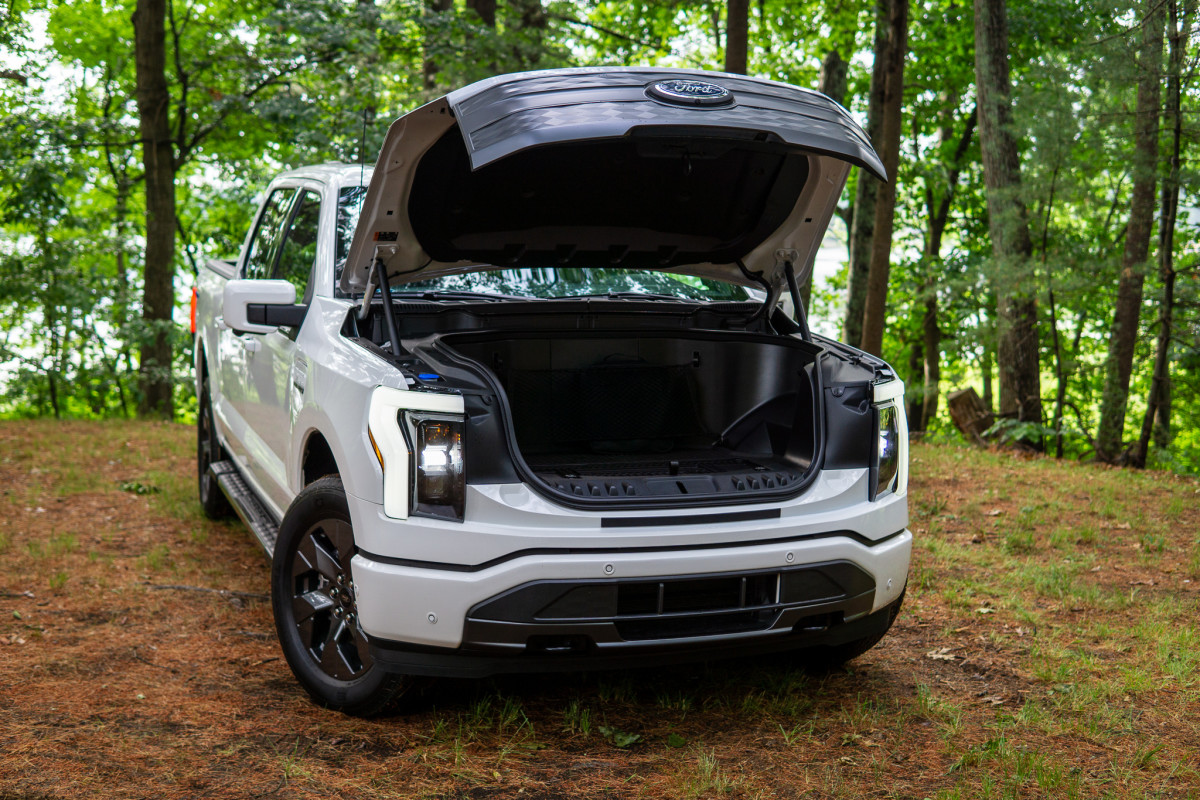
And, of course, there’s the Lightning’s biggest party trick: the whole front end of the Lightning lifts open—it’s powered—to reveal a front trunk. At 14.1 cubic feet, the huge, “Mega Power Frunk” is large enough to fit one 5’11” auto writer when properly contorted (we tested this). Even better, the frunk houses an underfloor storage bin with a drain at the bottom, making it perfect for storing ice to keep things cold.
When it was first announced, one of the highlights of the F-150 Lightning’s capabilities was its usefulness as a backup generator. In cases of a power outage, with a full battery, the Lightning should be able to power the typical household for three days. But even if the grid is still working and there’s no need to power a whole house, the F-150 Lightning’s 9.6-kilowatt onboard power supply is incredibly handy for powering smaller items. Like, say, power tools on a job site.
Being a truck, there’s a natural interest in the Lightning’s towing and hauling numbers. Take these with a grain of salt. Although the Lightning maxes out at 10,000 pounds of towing capacity, and 2,000 pounds of payload capacity in the bed, approaching those figures will mean that the truck’s driving range is likely to drop. Luckily, Ford has included a nifty feature to help manage this. Onboard scales display just how much weight is in the truck bed, and the remaining driving-range estimate adjusts as the payload gets heavier.
Technology
The F-150 Lightning is loaded with visually impressive technology, but we suspect that the lower-level trims may benefit from a more conventional layout than the expensive, higher-level trims can offer. In terms of primary touchscreen interfaces, all trims of the F-150 Lightning get at least a 12-inch touchscreen running Sync 4 and offering three years of navigation. On the Pro and XLT trims, the 12-inch display is landscape-oriented and looks and operates similar to what we tested in the Ford Bronco. The Lariat and Platinum, however, get 15-inch portrait-oriented screens, similar to the system we tested in the Ford Mustang Mach-E.
While the 15-inch screen was stunning, we found its layout and organization to be a bit fuddling. Were it our choice, we’d have opted for the 12-inch system across the trim lineup.
Pro trims make do with an AM/FM radio, but the other trims get SiriusXM satellite radio. The Lariat adds an 8-speaker B&O stereo. And the top-tier Platinum trim upgrades the B&O system to 15 speakers.
Our Lariat trim also featured a wireless charging pad and wireless Apple CarPlay and Android Auto. Back to party tricks, our F-150 Lightning tester also had a selection of games programmed into the infotainment system. Normally we’d see these as silly gimmicks, but they were actually useful in an EV. While waiting for our truck to finish charging at a public station, we killed some time playing Sudoku.

Safety
The Lightning comes equipped with plenty of safety features, too. All of Ford’s EV trucks get some level of the company’s Co-Pilot 360 advanced driver assistance systems (ADAS). Automatic emergency braking, lane-keeping assist, and blind-spot warning with rear cross-traffic alert all come as standard equipment. Shoppers can also add a 360-degree surround-view camera, Ford’s Pro Trailer Backup Assist, Trailer Reverse Guidance, and a forward sensing system as options on the Pro trim.
The XLT trim level packages the surround-view camera as standard equipment, and it offers a few additional options like adaptive cruise control, intersection assist, and rain-sensing windshield wipers.
Shoppers can add Ford BlueCruise at the Lariat level. A hands-free driving system, BlueCruise doesn’t leave much to chance. A driver-facing camera makes sure the person behind the wheel is actually paying attention, and the system works only on designated stretches of road. Once lane-keeping assist and adaptive cruise control are turned on, BlueCruise will employ the rest of the truck’s outward-facing cameras and sensors to keep it cruising down the road.

Cost-effectiveness
If a 230-mile range is manageable, then the F-150 Lightning is easily the best-value EV pickup truck on the market.
However, if the extended-range battery pack is a must, then the Lightning gets a lot more expensive. First off, the bigger battery is not available on the Pro trim level. Shoppers can swap in the extended range battery on the Lariat trim for an additional $10,000, but they won’t save much coin by dropping down to the XLT. On that trim, the $10,000 extended range option has to be packaged with an additional $9,500 equipment package, meaning shoppers pay $19,500 over MSRP to get it. The cheapest extended-range Lightning will carry a $74,269 MSRP, including the $1,795 destination fee. Our test vehicle rang in just north of $80,000. Platinum models start painfully high, at $92,269 after destination.
Admittedly, that Platinum price tag is tough to look at. But it’s possible to spec a regular F-150 to similar prices as our Lightning Lariat, so an $80,000 pickup truck isn’t ludicrous in today’s market. But it’s still a lot of money. There are some arguments in Ford’s favor: tax credits are available (even if incentives are in short supply), and Ford has a robust dealership network.
Keep in mind, the Rivian R1T starts at $67,000 for a smaller truck featuring a 260-mile driving range. Bump up to the bigger battery on that truck, and its price rises just as quickly as the Ford’s. And then there’s the GMC Hummer EV. This monster is effectively a six-figure truck, unless shoppers can wait until the spring of ’24 for the base model—which should deliver only 250 miles of range and still costs nearly $85,000.
The F-150 Lightning can be had for significantly less cash than its rivals, and that’s a good headline for Ford. More importantly, it makes electric mobility a reality for more drivers, whether they be weekend warriors with home improvement projects to tackle or professional contractors looking to cut down on fuel costs. Although the ideal F-150 Lightning with all the bells and whistles won’t cost anywhere close to $40,00—that would be filed under “too good to be true”—even that higher-cost variant feels impressively worthwhile. The reality is, this is an incredible machine, and at its current pricing, it’s good enough to change the entire industry.


What owners say
"Overall, owners of the 2022 Ford F-150 Lightning have a positive view of this truck, appreciating its powerful performance, smooth drive, and stylish design. Many are excited about the electric features and quiet ride, with some referring to it as an upgrade from traditional gas models. However, there are concerns about battery range, charging infrastructure, and pricing, with several comments on the high markups at dealerships, leading some to feel frustrated about the value for money."
Phenomenal vehicle. Much of the look and feel of a gas Platinum F-150. Smooth drive, quiet, and aesthetically pleasing.
May 25, 2023The range is not as advertised. at 100% charge only 180 miles range
March 5, 2023Love this truck! Battery is t great but the truck is so good it’s almost forgettable that the battery and the infrastructure aren’t there yet
December 7, 2022What owners say
Phenomenal vehicle. Much of the look and feel of a gas Platinum F-150. Smooth drive, quiet, and aesthetically pleasing.
May 25, 2023The range is not as advertised. at 100% charge only 180 miles range
March 5, 2023Love this truck! Battery is t great but the truck is so good it’s almost forgettable that the battery and the infrastructure aren’t there yet
December 7, 2022The Lightning I drove was fantastic. Quiet, powerful, and there were more features than you could try out for a long time. I want one of these trucks.
August 6, 2022I looked at the Pro and the Platinum series of this model truck. Pro left a lot to be desired, But the Platinum left me in love with this truck. Very nice and fast like the name Lightening!!! Wow!! If there were more charging stations and faster charges then I would have bought this in seconds. Ford did a great job with this truck. But it is a bit on the over priced and long wait times for the F-150 Lightening. If I were to purchase online I would have to wait 2 years before I could have one. Not going to work for me. But all in all It is a Beautiful Truck.
August 1, 2022Awesome experience so far. Truck drives like a car, super powerful, and well designed. As a former F150 owner, I feel this one is definitely an upgrade and not having to deal with regular maintenance, gas stations, and oil changes, makes it a no brainer. Having owned Teslas along the way, I can say that Ford did not a very nice job catching up (more work needed on the user interface and software).
August 19, 2023Trims & specs
Base MSRP $63,345 | Seating 5 |
Engine 452 hp Electric | Cargo Capacity 14.1 cu ft |
Combined MPG 69 | Drivetrain AWD |
Base MSRP $54,780 | Seating 5 |
Engine N/A | Cargo Capacity 14.1 cu ft |
Combined MPG N/A | Drivetrain N/A |
Base MSRP $74,995 | Seating 5 |
Engine N/A | Cargo Capacity 14.1 cu ft |
Combined MPG N/A | Drivetrain N/A |
Base MSRP $84,995 | Seating 5 |
Engine N/A | Cargo Capacity 14.1 cu ft |
Combined MPG N/A | Drivetrain N/A |


Pricing trends
MSRP range
$39,974 - $90,874
Current avg. market price
$40,386
Trending down by 2.2% this month
May 2026 - October 2026


