2025 Alfa Romeo Giulia Reviews, Pricing & Specs
Write a review--
Original MSRP
5.5
of 10
expert review
avg user rating
(0 reviews)
Pros
Stylish design
Fun to drive
Premium interior materials
Cons
Cramped back seat
Outdated technology
Poor value for the money
Style, passion, and dynamism make the 2025 Alfa Romeo Giulia almost irresistible to driving enthusiasts. Unfortunately, that’s not enough to make the 2025 Giulia irresistible to a broader customer base.
Enthusiasts are the target audience for Alfa’s sole non-crossover. For starters, it’s a sedan in a world gone mad for SUVs. Also, crash-test ratings are nonexistent, making it a non-starter for anyone who cares about safety. But the elephant in the room is wearing a hat that says reliability and, depending on which publication or research organization is doing the reporting, all the signs point in the wrong direction.
Verdict: With only a four-year/50,000-mile warranty protecting Alfa Romeo owners from potential doom, buying a Giulia is a gamble. Leasing one might be fun, as long as it spends more time in your driveway than in the shop. If only the Giulia boasted the dependability of a Toyota Camry, it could be the most desirable car in its class.

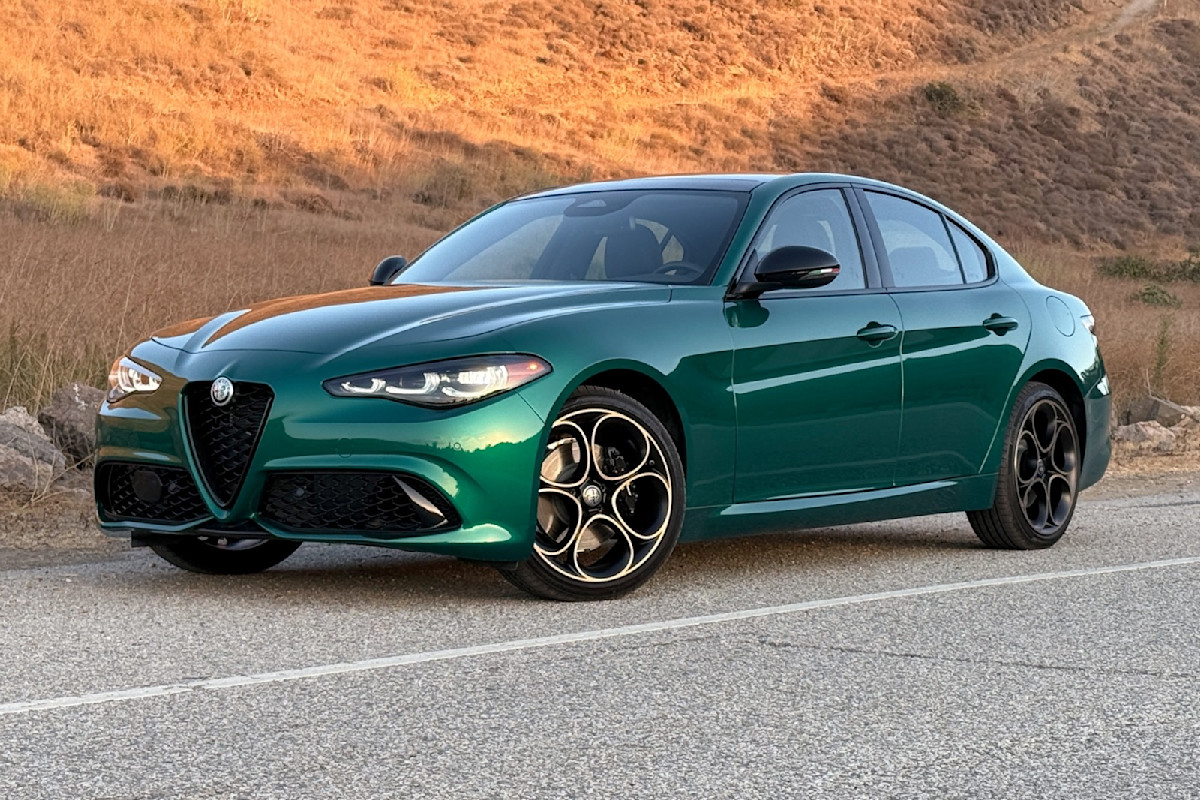
Led by its distinctive V Scudetto grille flanked by Trilobe headlights, and rolling on its available classic five-hole wheels, the 2025 Giulia is instantly identifiable as an Alfa Romeo. The car’s blunt nose, sculpted flanks, and dramatic dash-to-axle ratio are undeniably alluring, even if they taper into a somewhat featureless rear end.
For 2025, the high-performance Alfa Romeo Giulia Quadrifoglio goes out of production, and Alfa slims down the rest of the Giulia lineup to a base model with an available Veloce Package, a new Intensa trim level, and a limited-production Tributo Italiano model. The only other update is that Verde Fangio metallic paint, previously an exclusive color for the Quadrifoglio, is now available on the standard Giulia.
You can see Verde Fangio in all of its green glory in the accompanying photos. Our test car arrived with Intensa trim, which features black wheels with gold surfacing, black brake calipers with gold lettering, a black leather interior with tan accents, and leather on the dashboard and door panels. In addition to Verde Fangio, the Giulia Intensa comes in Rosso Etna (red) and Vulcano Black.
In addition to Intensa trim and the expensive ($2,200) Verde Fangio paint, the test vehicle included all-wheel drive (AWD), a dual-pane sunroof, the Driving Assist Package, and an incredibly high destination charge of $3,250. Those options and that lofty destination charge brought the manufacturer’s suggested retail price (MSRP) to $59,245.
The Giulia’s interior is a snug, but comfortable, fit. Large round air vents anchor each end of the dashboard and reside on the back of the center console for use by passengers. The fixed, column-mounted paddle shifters are works of art, rendered in aluminum. The climate control panel is a model of perfection, featuring large knobs with rubber grips. Lastly, the singular knob on the center console controlling the volume, tuning, and stereo mute functions is an utterly perfect design. And as measured by the look and feel of the interior materials, the Giulia’s quality is robust. Nothing suggests cost-cutting in this cabin.
Despite these appealing details, there are a few missteps. Alfa Romeo places the engine stop/start button on the steering wheel, so, depending on how you parked the car last, it may move to an unexpected location. Also, the floor mats use Velcro and stick so securely to the underlying carpet that when you finally yank them free, whatever was on the mats is now on the floor. And that carpet grips hair and lint as though they're glued on.

With the departure of the Quadrifoglio, every 2025 Alfa Romeo Giulia has a turbocharged 2.0-liter four-cylinder engine making 280 horsepower and 306 pound-feet of torque that flows through an eight-speed automatic transmission and a carbon fiber driveshaft. In proper sports sedan fashion, rear-wheel drive (RWD) is standard, but Alfa’s Q4 all-wheel-drive system is an option, and with it, the Giulia zooms to 60 mph in a claimed 5.1 seconds. RWD models are a few tenths slower, at 5.5 seconds.
The Giulia’s transmission is a traditional torque-converter automatic, but it behaves like a dual-clutch automated manual gearbox. We don’t know if that’s a good or a bad thing. Regardless, it lacks refinement in stop-and-go driving. That, combined with the rough automatic engine stop/start engagement and the occasional graunching sensation when accelerating in first gear, makes this transmission a liability instead of an asset.
The Giulia isn’t as fuel-efficient as advertised, either. The official rating is 26 mpg in combined driving, but we observed fuel economy of 22.6 mpg on our mountainous Southern California evaluation loop.
Despite the disappointing gas mileage and questionable transmission antics, the Giulia’s turbocharged powertrain is otherwise quite satisfying. Most of the time, the Alfa is delightful to drive thanks to its quick acceleration, sharp and responsive steering, and nimble and athletic handling.
In the city, with the DNA drive mode selector in Normal, the Giulia can feel a little soft and springy, but this is to its benefit. The added compliance makes it agreeable on imperfect pavement and more comfortable to drive in urban settings. Switch to Dynamic mode, and the active suspension firms up to make maximum use of the 225/40 performance all-season tires (wrapped around 19-inch wheels). Additionally, drivetrain response sharpens, and the steering adds some weight.
In Dynamic mode, we pointed the Alfa’s distinctive nose down Mulholland Highway in the Santa Monica Mountains. The Giulia proved fast on this writhing ribbon of blacktop, its tidy size and impressive grip helping us to conserve velocity in the curves and corners. Here too, the suspension soaked up the pavement irregularities and undulations without diluting the driver’s feel for the road.
However, we experienced three traits that dented our confidence. First, the brakes briefly conveyed a hint of fade. It was momentary, but unexpected considering the performance-oriented Brembo components. Second, the steering didn’t feel as resolute on-center as we remembered from previous testing. Third, despite its optional Q4 AWD system, our Giulia’s corner-exit balance proved occasionally unpredictable, the nose pushing wide or the tail feeling unsettled.
Since our last stint behind a Giulia’s steering wheel, we’ve driven both an Audi S4 and BMW 330i M Sport on this same driving loop, and the German cars felt more composed and unflappable than this Italian. Despite these observations, the Alfa is undeniably fun to drive.

Like many compact luxury sedans, the Alfa Romeo Giulia is a snug fit. However, the front seats are exceptionally comfortable, despite their robust side bolsters that hold you in place while rounding curves in the road. Our Giulia Intensa test car featured an eight-way power driver’s seat, a six-way power passenger’s seat, heated front seats, and a heated steering wheel. Seat ventilation is unavailable.
Our test car also had the optional dual-pane sunroof, which adds a power-opening glass panel over the front seats and a second fixed glass panel over the rear seats. It is unusual, expensive, and something you can live without.
Moving the front seats to accommodate tall people turns the back seats into a torture chamber. We struggled to cram 33-inch-inseam legs and size 13 feet into the Giulia. However, once we settled in, this seating location offered just-acceptable legroom and a properly supportive seat. Large round vents matching the front design provide cool air on hot days, and the test car had heated rear seats and a single USB charge port. However, it’s USB-A instead of USB-C, as are the two ports up front.
Typically, cars with cramped cabins offer little practical storage space, but that’s not the case with the Giulia. The tray located forward of the cupholders is perfect for small items. Smartphones have a dedicated charging slot, and there is a tiny bin next to the shifter for the car’s key fob.
At 13.4 cubic feet, the Giulia’s trunk is small. You can expand the space thanks to a 40/20/40-split folding rear seat, and Alfa Romeo thoughtfully encloses the trunk lid hinges so you can pack without concern that you might crush something when shutting the lid. Additionally, there are handles on each inner side of the lid, making it convenient to swing it closed from either side of the car.

The Giulia’s deeply recessed analog gauges departed the car after the 2023 model year, replaced by a modern 12.3-inch digital instrumentation panel. However, Alfa Romeo has retained the panel's binocular-shape housing, and a Heritage theme replicates the look of the marque’s historical gauge faces. (Evolved and Relaxed are the other two themes.)
To the right, integrated into the dashboard rather than perched on top of it, you’ll find the 8.8-inch touchscreen infotainment system. The screen is small by today’s standards, and the system lacks wireless smartphone integration, a comprehensive package of connected services, and a conversational voice recognition system.
The digital assistant easily found the nearest Starbucks. A request for Chipotle required us to say “Chipotle Mexican Grill.” In response to a request for directions to the nearest hospital, only one of the top five responses was a hospital. On a day trip to Santa Barbara, the tech was not helpful when searching for a new restaurant we hadn’t tried before. But you can still connect a cable to connect your phone and use the Apple CarPlay or Android Auto instead.
Those stumbles aside, the touchscreen layout is intuitive, and the standard satellite radio and the volume/tuning knob on the center console make living with the system easier. We also liked the sound quality from the 14-speaker Harman Kardon audio system.

If the infotainment system checks the minimum number of boxes, so too does the Giulia’s complement of driver assist features. It has the standard equipment you expect to find on a modern compact luxury car, but Alfa doesn’t offer much above and beyond it. Driving purists are likely to prefer that, anyway.
The Giulia has forward collision warning, automatic emergency braking, lane-departure warning, lane-keep assist, and an active blind-spot monitoring system with rear cross-traffic alert. Additionally, it features front and rear parking sensors, a traffic sign recognition system, and adaptive cruise control with full stop capability.
A Driving Assist Package is new for 2025. It equips the Giulia with an Active Driving Assist system with lane-centering assistance working in conjunction with the adaptive cruise control for highway driving situations. It also adds an anti-theft alarm and a feature that automatically recommends a lower speed when it detects the speed limit has changed.
Overall, the Alfa’s lane-assist technologies proved disappointing. They issue too many false warnings, and the Active Driving Assist system turned itself off with surprising frequency. It emits an audible alert when it does so, and during early evening testing, driving toward the sun on Pacific Coast Highway, the Giulia was bing-bing-binging regularly. It settled down on the freeway, but still struggled in the absence of lane markings, such as when driving past exit and entrance ramps. All of this behavior fell short of expectations.
We also noticed that it can occasionally take a long time for the reversing camera to load, so if you’re impatient, you’re on your own. One nice thing about the Giulia’s outdated tech is that it at least didn’t unnecessarily slam on the brakes at the bottom of an angled driveway, thinking the car was about to collide with the street.
You won’t find any crash-test ratings for the 2025 Giulia. Neither the National Highway Traffic Safety Administration (NHTSA) nor the Insurance Institute for Highway Safety (IIHS) has performed evaluations of this car.

Unless you’re choosing a base 2025 Alfa Romeo Giulia with no options, you’re likely to pay over $50,000 for one. Add the Veloce Package and 19-inch wheels to the base model? Choose the limited-edition Giulia Tributo Italiano? Get the stylish Giulia Intensa? They’re all over $50,000, partly due to the $3,250 destination charge.
Additionally, color choices and combinations are limited compared to the competition, making it harder to tailor a Giulia to personal preferences. Add a four-year/50,000-mile powertrain warranty that merely meets instead of exceeds expectations, and we would suggest leasing the Alfa instead of buying it. Unfortunately, the Giulia doesn’t hold its value well, so the lease deals aren’t very appealing either.
There are other factors to consider, too. Our test car didn’t get the gas mileage listed on the window sticker, and a simple search on Google regarding the Giulia’s reliability suggests the car could be a gamble.
So, we’re led to conclude that an Alfa Romeo Giulia is not a cost-effective car to own. The value in this automobile resides in the heritage of a storied Italian brand, its artful design, its passionate driving experience, and that Giulias are relatively rare on the road. Especially when it is painted in the impossible-to-ignore Verde Fangio color.


