The Nissan Murano debuted in 2003 as the Japanese manufacturer's first crossover SUV. It represented a sportier alternative to the few other midsize SUVs of the time and enjoyed considerable success, while later generations strayed from the sporty personality to garner broader appeal with shoppers.
Nissan Murano Buying Guide: Cost, Reliability, and the Best Years to Buy
Search for Nissan Murano
See all


Not only was the Murano the first crossover SUV from Nissan, but it was also the first Nissan in the U.S. equipped with a continuously variable transmission (CVT) that eliminated the traditional gears for a twin-pulley system that essentially gave it infinite gear ratios. It promised smoother operation and improved fuel economy but was held back by its lazy reactions that made the vehicle feel slower than it really was.
The latest Murano is the first to come with a standard automatic transmission and the second-largest SUV in Nissan's current range, sitting between the Ariya and the Armada.
Nissan Murano Buying Guide: Cost, Reliability, and the Best Years to Buy
- Frequently Asked Questions
- Nissan Murano Pros and Cons
- Nissan Murano generations
- Fourth generation (2025 - present)
- Third generation (2015 - 2024)
- Second generation (2009 - 2014)
- First generation (2003 - 2007)
Frequently Asked Questions
Which Nissan Murano years are the best?
The current fourth-generation Murano is arguably the best. It distinguishes itself from previous Muranos with its traditional automatic transmission instead of a CVT but also comes with many more safety and infotainment features than its predecessors.
Which Nissan Murano years are the worst?
The first-generation Murano, from 2003 to 2007, doesn't quite deserve the title of being the worst in the SUV's history, as it was actually quite good for the time. It's listed here mainly because later generations improved in almost every aspect, making it feel primitive by today's standards.
Is the Nissan Murano a good deal?
Up until the current fourth generation, the Murano was typically considered a good deal for the money. As with most Nissans, it was priced more affordably than other Japanese SUVs, though it wasn't as refined as its rivals inside. The latest Murano is luxurious by comparison but comes with a price tag that flirts with the luxury class. Used Muranos had a tendency to retain their value better than the average SUV for the first several years, then depreciated at a more typical rate afterwards.
Nissan Murano Pros and Cons
Pros:
- Early generations were sportier than their rivals
- Luxurious top trims
- Comfortable seats in later generations
Cons:
- Weak and unresponsive CVTs
- Cargo capacity and towing were often sub-par
- Latest model is expensive for the class
Nissan Murano generations
Fourth generation (2025 - present)
The new Nissan Murano debuted in the 2025 model year. It had almost identical measurements to its predecessor, except for overall width, which increased by 2.6 inches. Styling, however, took a very different direction. The "V Motion" grille that was Nissan's primary design motif was mostly replaced by a unique split grille with a hint of the "V" flanking it in illuminated strakes, along with a subtle strip of gloss-black trim between what Nissan calls its "Crystal Cube" LED headlights. From the side, the most prominent feature was an arching chrome trim element that bowed over the windows from the mirrors to the taillights. The rear was more futuristic, with bold LED lights that spanned the width of the liftgate, and the Murano badge extended just underneath.
Every new Murano had a 2.0-liter four-cylinder engine producing 241 horsepower and 260 lb-ft of torque. It was paired with a nine-speed automatic transmission, and all-wheel drive (AWD) was standard on all models except the base, which was front-wheel drive (FWD).
Three Nissan Murano trim levels were offered: SV, SL, and Platinum. The entry-level Nissan Murano SV trim—which had a starting MSRP of $40,470 at the time of writing—started you off with synthetic leatherette seats, a digital instrument panel, a 12.3-inch infotainment touchscreen with the NissanConnect tech suite, which included wireless Apple CarPlay and Android Auto, plus a wireless charging pad. The Nissan Safety Shield 360 suite was standard, including intelligent cruise control, automatic reverse braking, parking proximity sensors, high-beam assist, and traffic sign recognition. In 2026, Nissan added the availability of ProPILOT Assist 2.1, which allows for stints of hands-free highway driving.
Specs for the SL trim included a panoramic moonroof, additional sound insulation, Google Built-in infotainment services, a Bose premium audio system, a surround-view camera system, and an enhanced cruise control system that reduced speed for curves, using several sensors and GPS map data. The top Nissan Murano Platinum trim topped off the features list with larger wheels, a hands-free power liftgate, semi-aniline leather upholstery, front seats with ventilation and massage functions, heated rear seats, and a head-up display.
The Murano's interior marked a big step forward, both in terms of design and quality. As with many modern vehicles, it featured fewer physical buttons and knobs than before, giving the cabin a clean, minimal look. This forced many controls into the infotainment touchscreen, though climate adjustments still had separate capacitive-touch buttons built into the dashboard.
The front seats were more spacious, though the rear seats lost more than two inches of legroom. Behind those seats, the cargo area could hold up to 32.9 cubic feet, representing an increase of 1.8 cu-ft over its predecessor. This was still somewhat small for a midsize SUV, and the sloping rear window could impede bulkier items.
From the driver's seat, the fourth-generation Murano was noticeably better to drive than the previous model. Much of this was down to the nine-speed automatic that replaced the old continuously variable transmission (CVT). It was more responsive and didn't suffer from the typical CVT drone when accelerating. The Murano could reach 60 mph in 7.5 seconds, which was about average for the class, and was tuned more for comfort than for sporty driving, which made sense for family-focused shoppers. Engaging and exciting to drive it was not, but those are rarely priorities for midsize SUVs.
Despite the switch to a traditional transmission, which is usually less efficient than CVTs, the fourth-gen Murano achieved nearly identical EPA fuel economy estimates to its predecessor. Both front- and all-wheel drive Muranos were rated at 21 mpg city, 27 mpg highway, and 23 mpg combined.
In crash tests conducted by the National Highway Traffic Safety Administration (NHTSA), the 2025 Nissan Murano earned five out of five stars in overall and side impact protection, and four stars in frontal and rollover tests. The Insurance Institute for Highway Safety (IIHS) gave the Murano its top score of "Good" in all evaluations and named it a Top Safety Pick+, which is the Institute's highest honor.
The MSRP of a new 2026 Nissan Murano started at $43,215, including destination fees, and climbed to $51,345 for the top-of-the-line Platinum trim.
In its inaugural year, the fourth-generation Murano received only two recalls. This is impressive for a fully redesigned vehicle and could help it retain its value in the future. At the time of writing, there was still insufficient data to predict depreciation, but the Murano has historically lost more value over time than its direct rivals.
Third generation (2015 - 2024)
The third-generation Murano arrived as a 2015 model and was slightly larger than the second-generation model it replaced. It grew by almost three inches in length and by more than an inch in width. The exterior design was more notable, featuring a much larger "V" grille that dominated the front fascia. The body was also distinct for its organic sculpting and "floating" roof.
Under the hood was a 3.5-liter V6 engine that produced 260 horsepower and 240 lb-ft of torque. A continuously variable transmission (CVT) drove the front wheels, and AWD was available as an option with all trim levels. By industry standards, Nissan's CVT was noticeably better than others. It wasn't as slow to respond as competing CVTs, but it was still considered a downgrade when compared to traditional automatic transmissions. Despite this, the Murano would hit 60 mph in 7.5 seconds, which was quick for the class.
In its debut 2015 model year, the Nissan Murano was available in S, SV, SL, and Platinum trims. The base S trim came standard with 18-inch alloy wheels, dual-zone automatic climate control, and a seven-inch infotainment touchscreen display. The SV upgraded to an eight-inch touchscreen with navigation and added roof rails, power-adjustable front seats, and a leather-wrapped steering wheel.
The Nissan Murano SL trim added leather seats, heated front seats, a power liftgate, a Bose premium audio system, heated mirrors, and a few advanced safety features. These included a blind-spot monitor with rear cross-traffic alert and a surround-view camera system. The range-topping Platinum model upgraded to 20-inch wheels, LED exterior lighting, a heated steering wheel and rear seats, and ventilated front seats. Both the SL and the Platinum were available with frontal collision warning with automatic emergency braking, adaptive cruise control, and a panoramic sunroof.
The 2016 Murano returned largely unchanged, adding only a USB port, making the Bose audio system available on more trims and adding two more speakers. Apple CarPlay made its debut the following year and the SV trim was eligible for more standard safety options, including a driver condition monitor. The 2018 Murano focused even more on safety, adding standard frontal collision mitigation to all models. The SV was also eligible for adaptive cruise control and the surround-view cameras.
The 2019 Nissan Murano received a subtle styling update, an updated navigation system, and a few new safety features, including pedestrian detection, lane-keep assist, automatic reverse braking, automatic high beams, and a traffic sign reader, which were all offered as options for the SL trim. For 2020, many safety and driver assistance features were added as standard for more trim levels, including adaptive cruise control for the SV. This trend continued in 2021, with all but the adaptive cruise and surround-view cameras being standard for all models. Subsequent changes were light, with the final 2024 Murano discontinuing the base S trim.
The third-generation Murano started the trend of prioritizing comfort over sporty handling, but it was still slightly more athletic than some of its competition. The EPA estimated fuel economy at 21/28 mpg city/highway, and 24 mpg in combined driving. These were strong figures for the class, but in the real world, it was difficult to match these estimates. The ratings remained consistent throughout the production run, dropping by only one mpg in later years.
In crash tests conducted by the National Highway Traffic Safety Administration (NHTSA), the 2015 Nissan Murano AWD earned five out of five stars for side crash protection and four stars for overall and other evaluations. The front-wheel drive Murano was rated at four stars until the 2019 model year, when it was upgraded to five. The Insurance Institute for Highway Safety (IIHS) gave the third-generation Murano its top score of "Good" in all tests and named it a Top Safety Pick+ for the first two years of production. That award was reinstated from 2021 until 2023.
Recalls were initially issued for brake fluid leaks, the anti-lock brake system, and the passenger airbag. All but the leaking brakes were addressed by 2017. Other recalls included one for the rearview camera in 2019, suspension parts in 2020, and windows in 2024. In general, the third-gen Murano depreciated at a slightly quicker rate compared to other Japanese SUVs of the time.
Second generation (2009 - 2014)
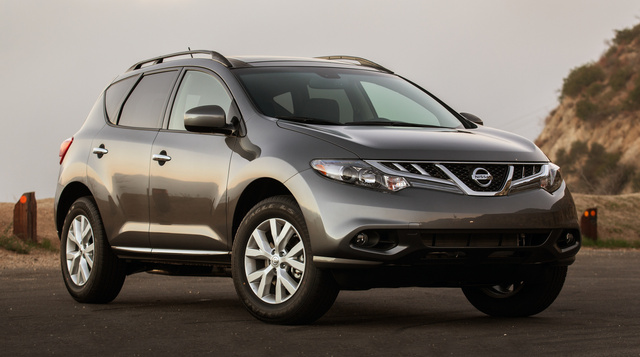
The Murano took a gap year before the second generation debuted as a 2009 model. Rather than rock the boat, this follow-up to the successful first-gen Murano appeared as more of an evolution instead of a complete makeover. It adopted the V-shaped grille that became a corporate design signature for the next 15 years, but otherwise, it looked very similar to the model it replaced.
The 2009 Murano was powered by a 3.5-liter V6 engine that produced 265 horsepower and 248 pound-feet of torque. A continuously variable transmission (CVT) sent power to either the front or all four wheels, with the latter reaching 60 mph in eight seconds. At the time, this was considered quick, and it had a sporty suspension for relatively sharp handling. The second-generation Murano was initially offered in S, SL, and LE trim levels. The S and SL came standard with front-wheel drive, with all-wheel drive (AWD) offered as an option. The LE trim was AWD-only.
The S trim kicked things off with 18-inch alloy wheels and dual-zone climate control. The SL added tinted glass, a power-adjustable driver's seat, and a leather-wrapped steering wheel with audio control buttons. The top LE trim upgraded to 20-inch wheels, roof rails, a power liftgate, xenon headlights, keyless entry/ignition, leather upholstery, heated front and rear seats, a power-adjustable front passenger seat, an auto-dimming rearview mirror, a Bose premium audio system with iPod integration, satellite radio, Bluetooth, and a rearview camera. A sunroof, navigation, and rear entertainment system were optional.
For 2010, the Murano LE was also offered with front-wheel drive, while the rest of the lineup was upgraded to keyless entry/ignition. The SL trim also gained the roof rails, while the LE got a dual-panel sunroof. The following year, the Murano received a minor styling refresh that was most noticeable in the front bumper, and power output was reduced to 260 hp and 240 lb-ft of torque. A new SV trim slotted in between the S and SL models, while most options were integrated into trim levels. The SL and LE were also eligible for an updated navigation system package that added real-time traffic and Bluetooth streaming audio. The 2013 Murano added safety features that included lane-departure warning and a blind-spot warning with rear cross-traffic alert, but they were only available as options on the top two trims.
In 2011, the Murano stepped into uncharted territory by introducing a convertible variant called the CrossCabriolet. It was only offered in the LE trim, only in production until 2014, and criticized for its weight—courtesy of the necessary frame strengthening—an unsettling amount of body twist, and a minuscule trunk when the top was stowed.
The National Highway Traffic Safety Administration (NHTSA) gave the 2009 Murano four stars for frontal crash protection and five stars in side impact tests. The Insurance Institute for Highway Safety (IIHS) gave the second-generation Murano its top score of "Good" in frontal and side tests and a second-worst score of "Marginal" for roof strength. It was named a Top Safety Pick, which was the highest honor at the time.
The Murano received four recalls in its inaugural 2009 model year for its anti-lock brakes, tire pressure monitor, and airbag passenger sensor. These issues were quickly resolved, and the only other notable recall was issued in 2013 for the power steering. Muranos of this era held their value as well as equivalent SUVs.

First generation (2003 - 2007)
The Murano debuted as an all-new model in the 2003 model year. It was based on the same platform as the Maxima and Altima sedans, making it Nissan's first crossover SUV. At the time, the only other Nissan SUVs were the Xterra and the Pathfinder, both of which were more utilitarian. SUVs were still rather sparse back then, but the Murano stood out from the Toyota Highlander and Honda Pilot with its sportier personality.
The first Murano was powered by a 3.5-liter V6 engine, which was initially developed for the Maxima and the Altima. It produced 245 horsepower, 246 lb-ft of torque, and was mated to a continuously variable transmission (CVT). It was the first U.S.-bound Nissan vehicle with a CVT and received praise for its smooth power delivery and fuel economy. It was also criticized for its perceived lack of power.
The 2003 Nissan Murano was available in two primary trim levels—SE and SL—and both came standard with front-wheel drive (FWD), with all-wheel drive (AWD) optional with both. The SE featured 18-inch alloy wheels, a sport-tuned suspension, a power-adjustable driver's seat, reclining rear seats, dual-zone climate control, and keyless remote entry. The SL trim added roof rails, adjustable pedals, and a Bose premium audio system. This trim was eligible for several option packages that included leather appointed seats, HID headlights, a power-adjustable front passenger seat, a sunroof, heated seats and mirrors, a navigation system, a tire pressure monitor, and traction/stability control.
In 2004, the SE trim added a manual shift mode that was previously exclusive to the SL trim. Other additions included satellite radio pre-wiring and more adjustments for the driver's seat. The following year, a more affordable base S trim joined the lineup, and in 2006, a seven-inch infotainment display was added along with a rearview camera for SL and SE trims.
In National Highway Traffic Safety Administration (NHTSA) testing, this first-generation Murano received a five-out-of-five-star rating for front passenger crash protection and four stars for rear passengers in side impacts. Likewise, the Insurance Institute for Highway Safety (IIHS) gave the Murano its top score of "Good" in frontal offset tests.
The 2003 Murano was issued recalls for its air intakes, rear seatbelts, fuel tank, alternator wiring, camshaft sensor, and gearshift selector. The camshaft sensor and shifter were fixed for the 2004 model year, but many of the other problems persisted throughout the production run, so keep an eye out for all the above on a test drive. A recall was issued for the steering wheel lock in 2005. The first-generation Murano retained much of its value early on, but after several years, it depreciated at a comparable rate to other SUVs of the time.
Related Topics



by Mark Takahashi
Mark Takahashi has been in the automotive world since 2001 and over the years has contributed to Edmunds, Car and Driver, Autoblog, and TrueCar. Prior to being an editor, Mark was an art director on various car and motorcycle publications and has competed in amateur open-wheel racing. He is also a juror on the North American Car and Truck of the Year Awards.
The content above is for informational purposes only and should be independently verified. Please see our Terms of Use for more details.


