2026 Polestar 4 Reviews, Pricing & Specs

Pros & cons
What we like
Stylish design
Premium interior materials
Standard advanced safety
What to consider
Unimpressive electric range
Poor visibility
Unintuitive technology
The CarGurus verdict
The Polestar 4's intriguing design masks its middling performance in many other areas.
The all-new, all-electric Polestar 4 has impeccable interior design and flirts with controversy by eliminating its rear window. Unfortunately, these are its most noteworthy elements becasue its range, rear-seat space, technology interface, and cargo capacity all come up short against rivals.
Verdict: Unless avant-garde styling is your priority, you'd be better served by the competition.
out of 10 expert review
Look & feel
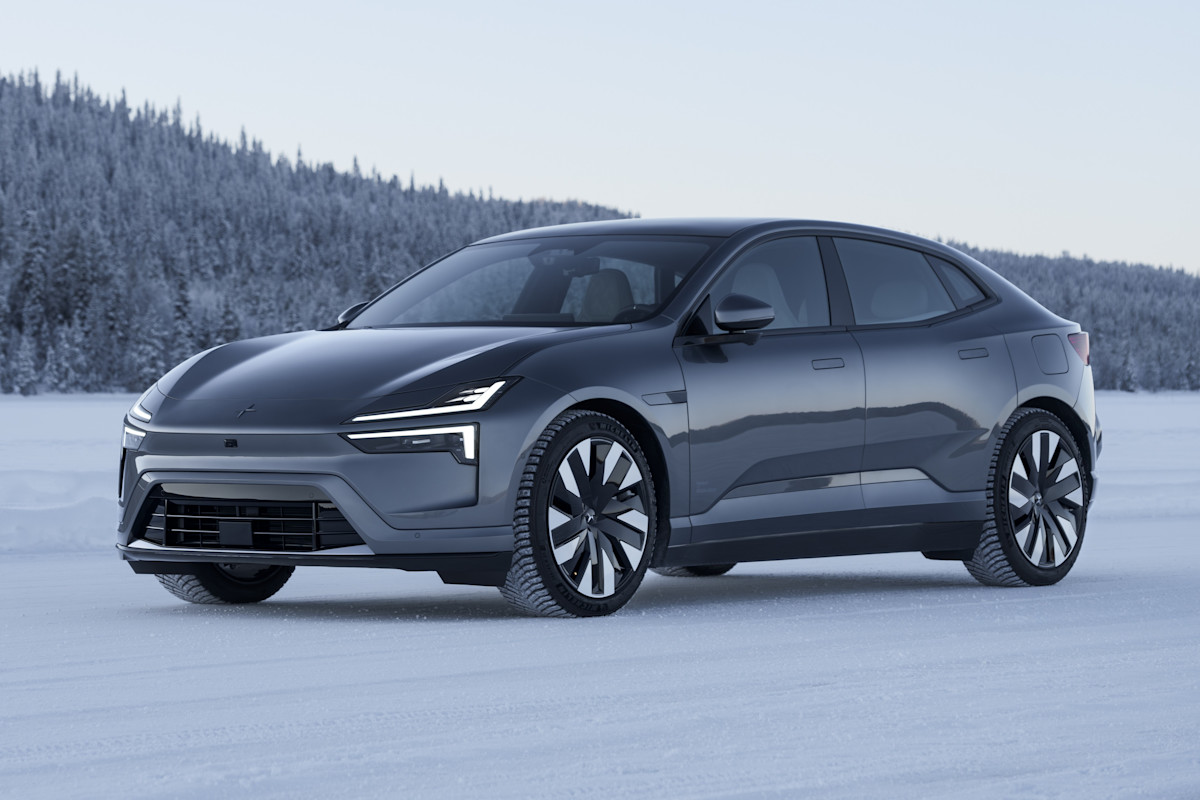
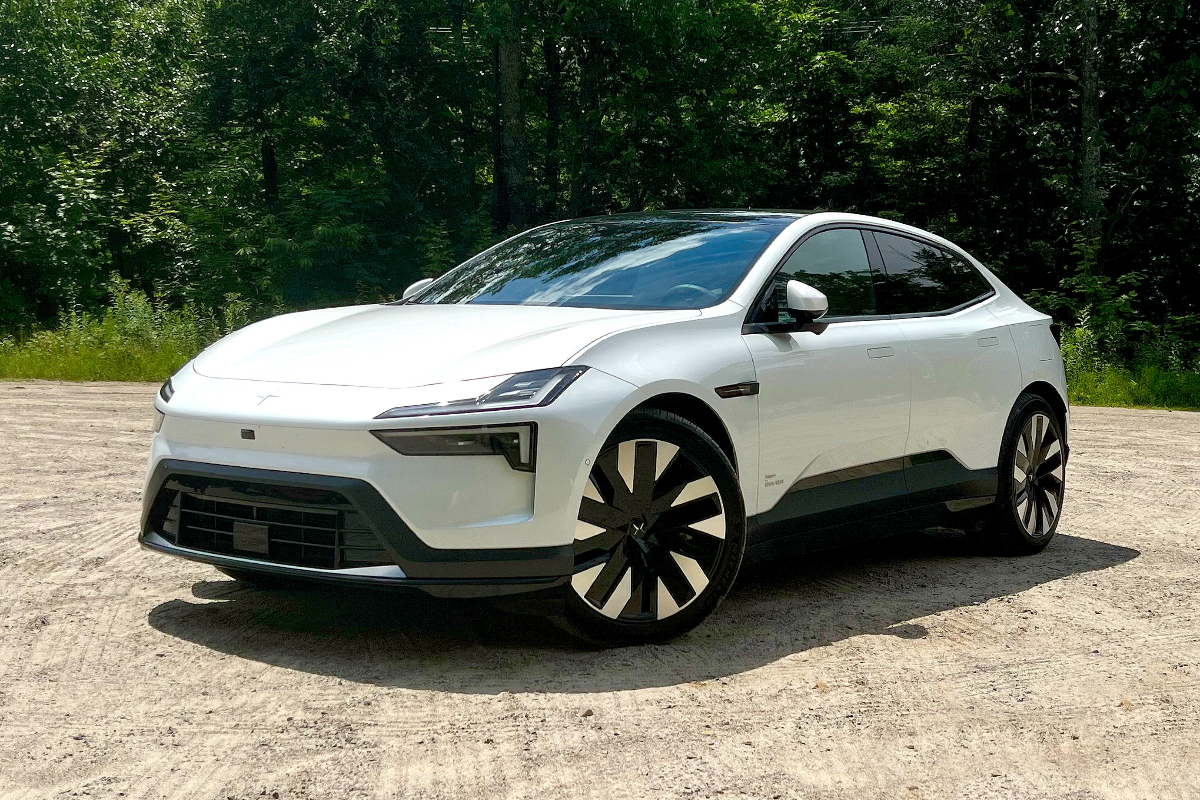
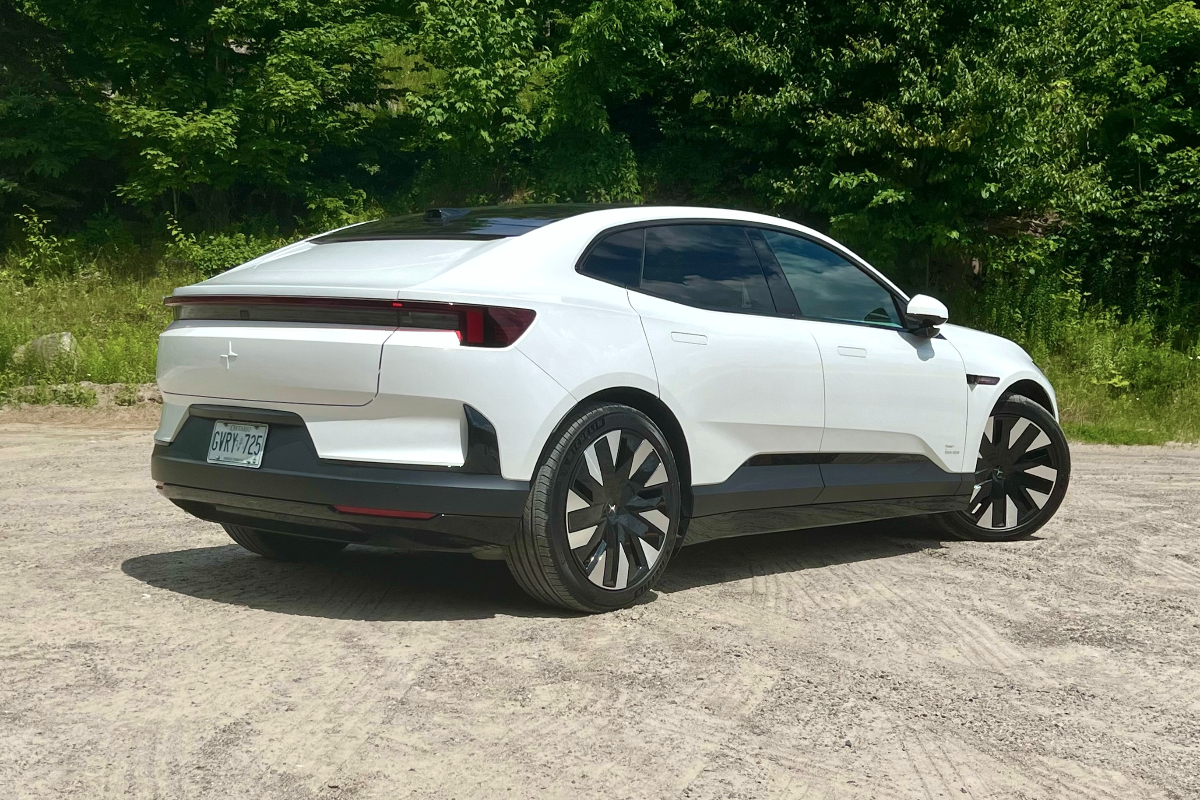
The 2026 Polestar 4 is different. That can mean a variety of things, both positive and negative. Starting with the overall shape and size, it straddles the line between SUV and hatchback although Polestar would rather you think of it as an SUV coupe. It's about five inches longer than the Ford Mustang Mach-E and 3.5 inches lower in height. The Polestar 4's side profile stands out for its sporty tapering roofline, while deep cutouts and sharp creases in the bodywork keep it from looking heavy.
Up front, the headlights retain just a hint of Polestar's relation to Volvo, but the rest of the front fascia is reminiscent of various other EVs. Altogether, the styling works well but is fairly unremarkable apart from that one controversial element at the rear.
Yup, there’s no window in the Polestar 4’s tailgate. According to the designers, this allowed for a more aerodynamic shape and increased rear-passenger space. We're not fully on board with this explanation, but it certainly makes it unique among modern cars (for now). A digital rearview mirror aims to solve rear visibility issues, though opinion seems split on whether this is a good thing. Polestar is quick to point out that most drivers get used to it after a while, which really isn't glowing praise. Our biggest issue is that you don’t get the same kind of depth perception you do with a traditional mirror. It's also not as easy to keep tabs on rear passengers.
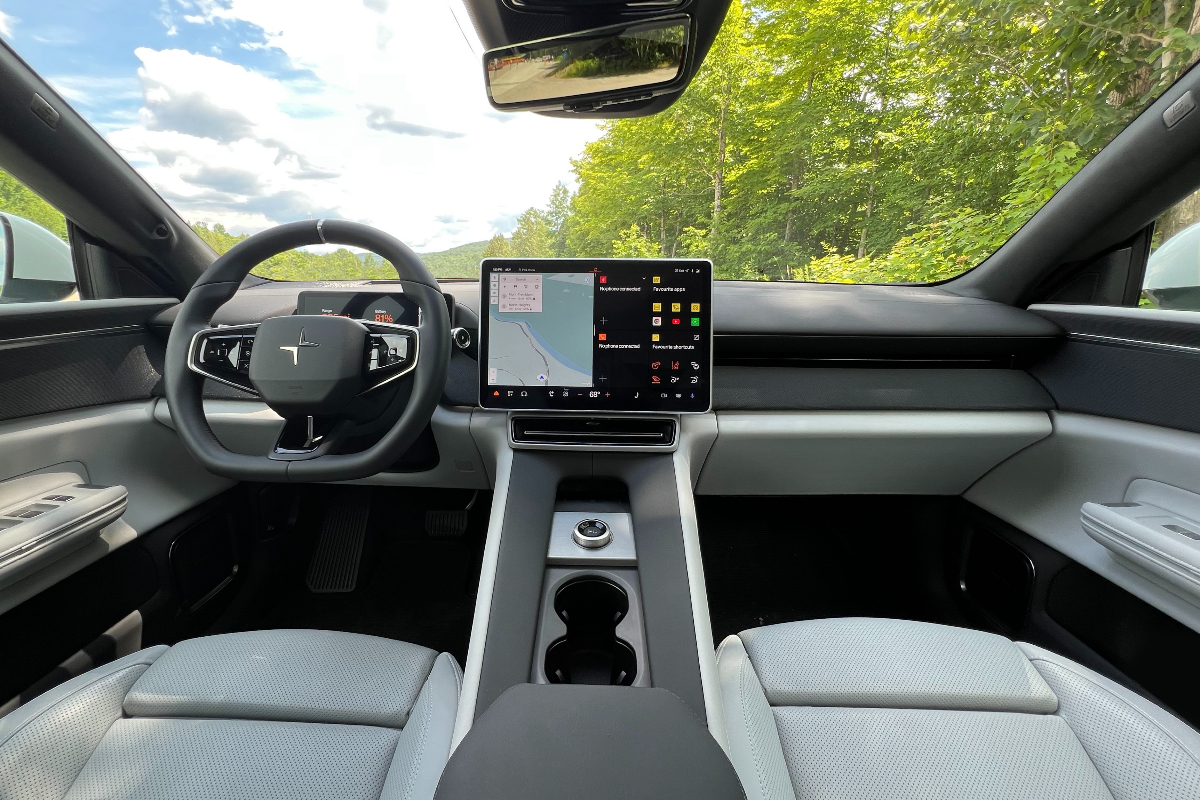
On the inside, the Polestar 4 is almost as minimal and stark as a Tesla, with a centrally mounted touchscreen replacing almost all controls. As simple as the interior is, we found it inviting and pleasant thanks to the liberal use of textiles instead of the typical plastic or simulated leather. Polestar says the fabric coverings on the dash, door panels, and center console were custom-tailored for each element, thanks to a novel manufacturing method developed in conjunction with the Swedish School of Textiles.
As a result, every curve and edge is smooth, making them as attractive to touch as they are to the eye. These textile surfaces blend equally well with the standard seat fabric as the optional Nappa Bridge of Weir leather upholstery, although the textile version is more environmentally friendly.
The Polestar 4 we drove around the Montreal area was a Chinese-built example, while the 2026 models bound for the U.S. will be built in Busan, South Korea. We're assured that there will be no major differences between the two, although the wheels that you see pictured here will not be offered. We're pleased with the overall design and styling, but in practice, some of these decisions negatively affect our initial impressions, and we'll cover those in the following sections.
Performance
The 2026 Polestar 4 will be available in two versions. The base model has a single motor that drives the rear wheels. It's rated at 272 horsepower and 253 pound-feet of torque, which can accelerate this 4,900-pound EV to 60 mph in an estimated 6.9 seconds.
We drove the dual-motor model that adds a second power unit to the front axle for all-wheel-drive (AWD). Combined, they produce 544 hp and 506 lb-ft of torque, and Polestar claims it will accelerate the 5,200-lb EV to 60 mph in just 3.7 seconds. Performance is more than adequate for the vast majority of drivers, though it's not all that impressive when compared with some other EVs.
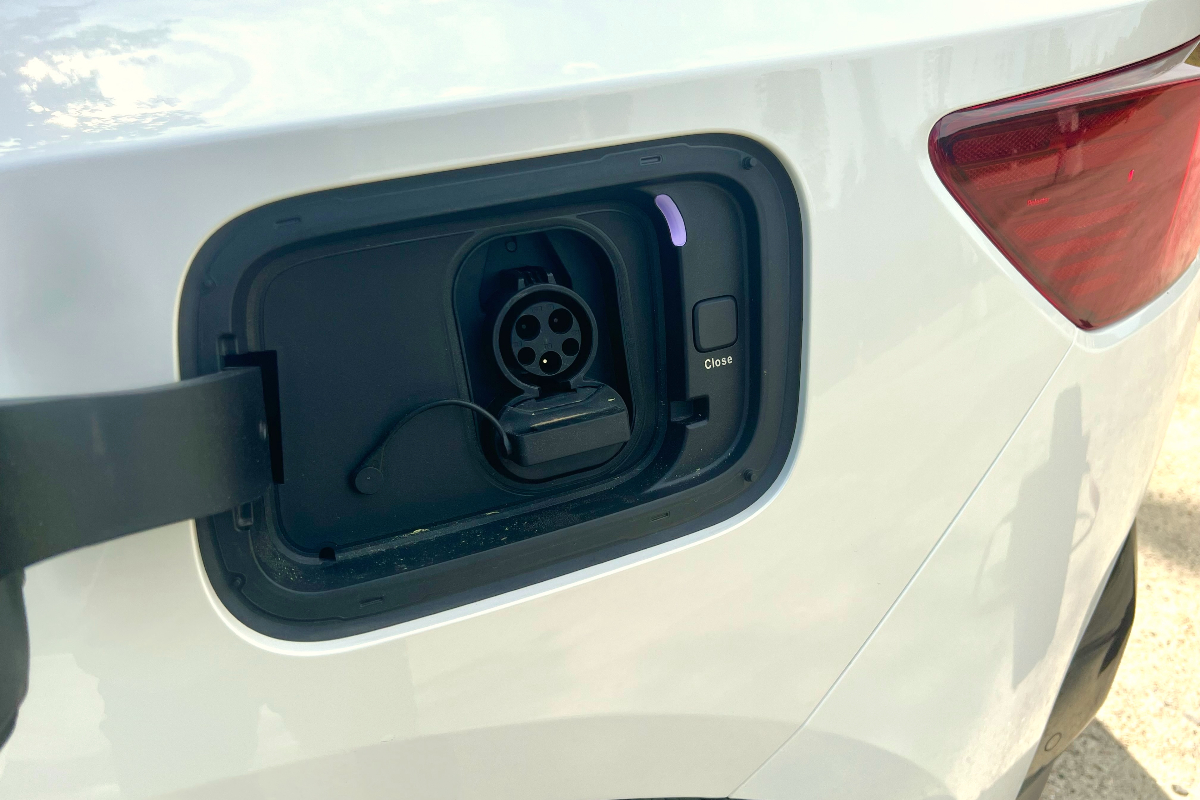
Both versions draw power from a 100-kWh lithium-ion battery pack in the floor. The single-motor Polestar 4 is EPA-rated to return 310 miles of range, while the dual-motor drops to 280 miles. When you need a charge, they're capable of DC fast-charging at rates as high as 200 kW, which should replenish the battery from 10 to 80 percent in 30 minutes. When charging at home, the onboard AC charger maxes out at 11 kW. Our vehicle was equipped with the common CCS Combo charge port, which is compatible with Tesla's NACS port and Supercharger network with an adapter. A native NACS charge port will eventually replace the CCS port.
On the road, the dual-motor Polestar 4 gets up to speed with the kind of immediacy and confidence that has come to define most EVs. The same can be said for its nearly silent propulsion that gives the impression of low-speed flight rather than being tethered to the pavement. When slowing, one-pedal driving is available and is both intuitive and smooth.
The Polestar 4 corners with more athleticism than we expected, although its hefty mass puts a damper on the fun when exploring the performance potential. The main drawback for us was the noticeably stiff adaptive suspension. In the softest setting, we felt every seam, pothole, and bump in the road, with some moderately sized pavement imperfections sending a muted jolt through the cabin. Switching to the stiffer sporty setting amplified those flaws, though handling was only marginally improved.
We also need to point out that our Polestar 4 lacked the optional Performance pack that comes with a sport-tuned suspension and larger wheels. Both will likely compound the ride quality stiffness. After logging many miles on the highway, on backroads, and over cobblestone streets, we'd prefer a softer suspension tune and smaller wheels for improved compliance.
Form & function
The front seats offer plenty of space for drivers of any size, with more than enough adjustment to help you find your optimal position. Our Polestar 4 with the optional Plus pack added even more adjustability along with an extending cushion for thigh support. With the available Nappa upgrade, we also enjoyed ventilated seats with massage functions.
Adjusting the seats is easy, thanks to conventional controls at the base, but the same could not be said for the steering wheel or mirrors. Those require digging into the menus in the central infotainment touchscreen, then using the multifunction directional pads on the steering wheel to move things around. It seems needlessly complicated and annoying when compared to more conventional controls, but we admit that most owners will only need to set it once, then forget it.
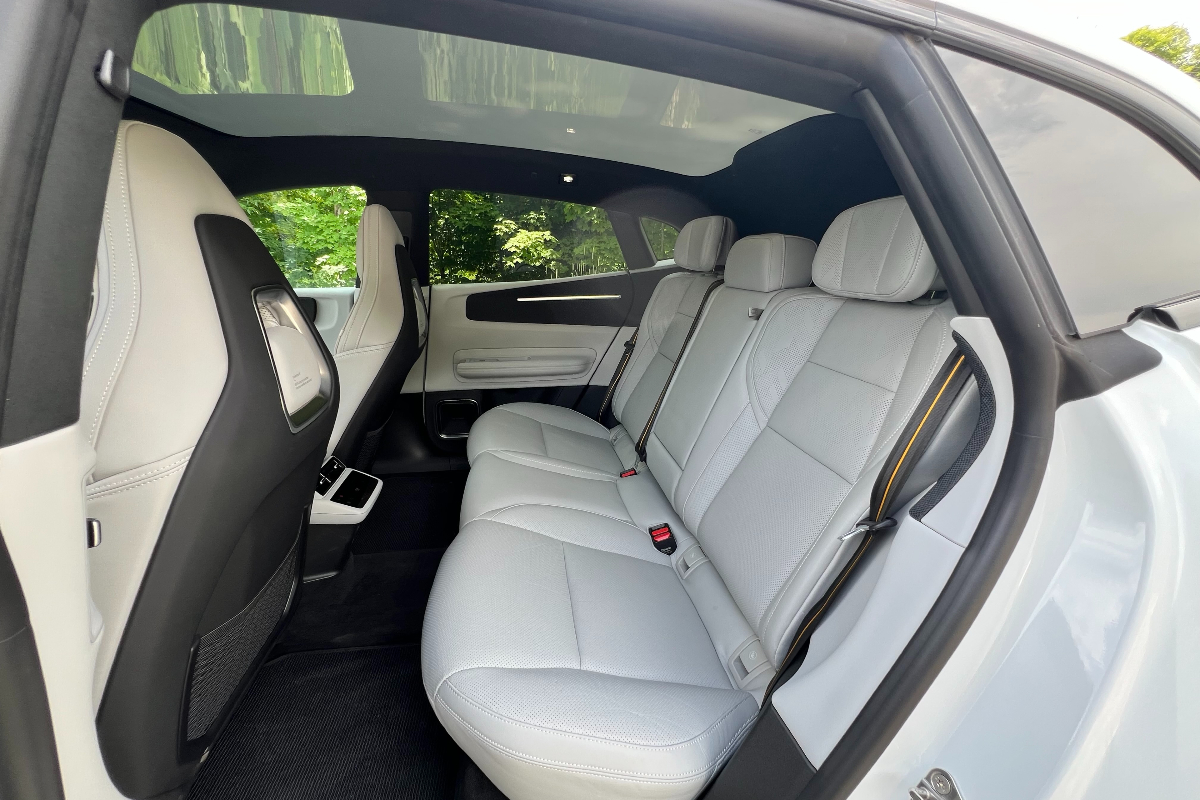
The rear seats provide a good amount of headroom and legroom, considering how much the roof tapers at the tail. These come at the expense of thigh support, though, as the seat cushions are mounted rather low to the floor. This forces your knees to bend into a slight squat position, which could get tiresome for taller passengers. The lack of a rear window tends to make those seats feel as though they're tucked away in a cave, but the huge panoramic sunroof keeps the overall feel light and airy. We recommend springing for the optional electrochromic glass roof that turns the glass opaque to keep the midday sun from slow-roasting our heads.
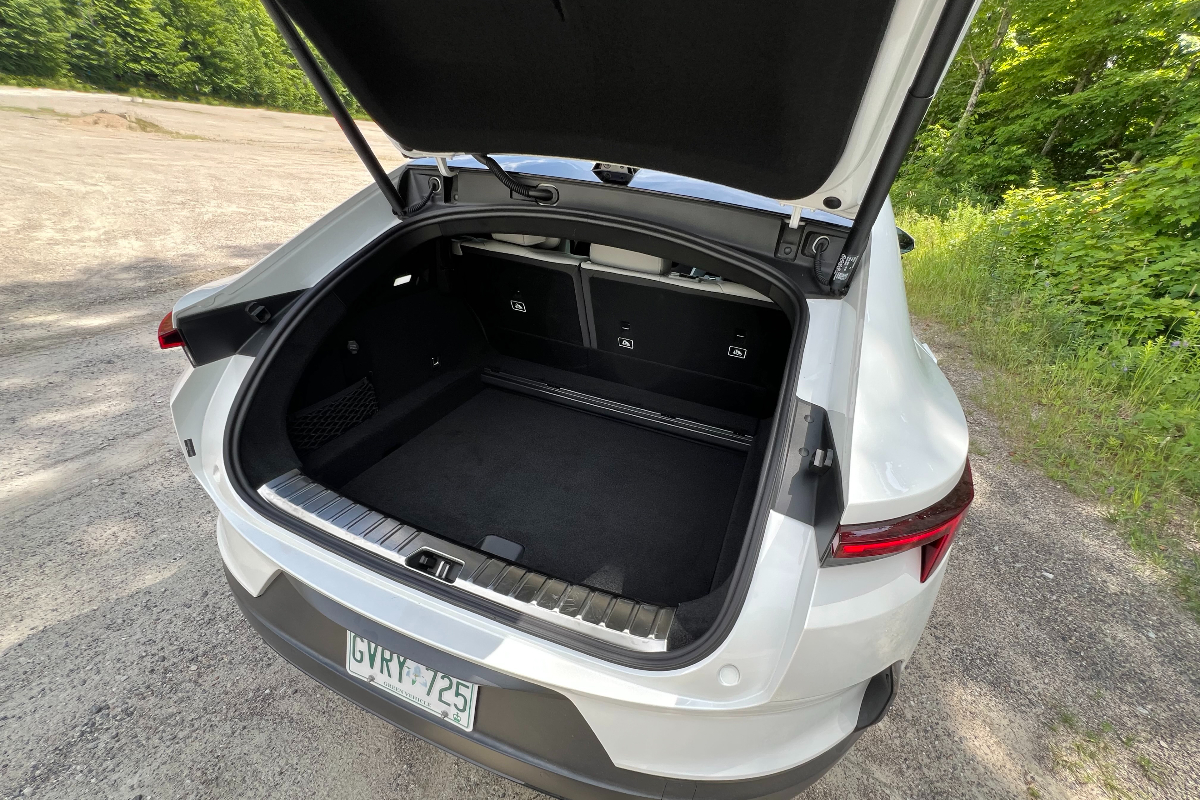
The trunk can accommodate up to 18.6 cubic-feet of cargo, which is on the small side for a crossover such as this. By comparison, the Ford Mustang Mach-E can hold up to 34.4 cubic feet and the Polestar 3 is rated at 22.2 cubic feet. The space is very usable, however, and the low liftover height of the sill makes loading bulkier objects easier. The rear seatbacks can fold flat with the floor for larger items, and the floor can drop by a few inches, too. A small 0.5 cubic-foot frunk is hidden under the hood and is just big enough for charge cables. Properly equipped, the Polestar 4 can tow up to 2,000 pounds in the single-motor version, and up to 3,500 pounds with the dual motor. That's not quite enough to confidently tow a trailer or camper, but it's plenty for activity racks for bicycles.
For smaller personal items, the front seats have medium-sized cupholders, door pockets, and a center console bin. A centrally located wireless charger keeps your phone secure in place, and a large tray underneath the console further improves convenience.
Technology
In stark contrast to the Polestar 4's minimal styling, its use of technology is busy and overcomplicated. Even the simple task of locking the vehicle requires a level of trust that the buttonless key fob will trigger the locks when you walk away. A proximity key card is also available, along with the ability to use your smartphone in the same manner.
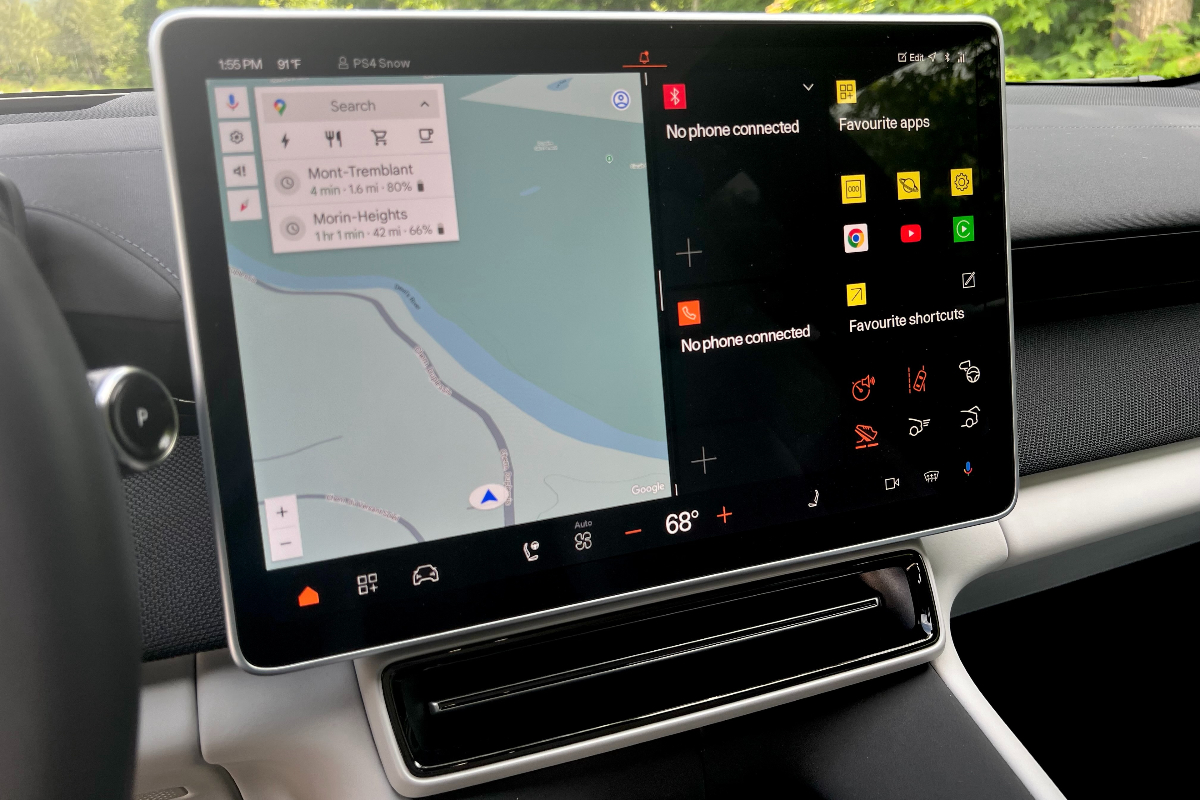
Standard features include a thin 10.2-inch instrument panel, a large horizontal 15.4 infotainment touchscreen, and an 8.9-inch digital rearview mirror. A head-up display is available with the Plus package and has the equivalent size of 14.7 inches. The standard audio system comes with eight speakers, while the Plus pack upgrades to a 12-speaker Harman Kardon system. The Nappa upgrade gets you 16 speakers with headrest speakers.
The Google Built-In operating system delivers crisp graphics and quick responses, but the sheer number of functions and menus makes this one of the more complicated units in the industry. On one hand it's good to have that much control, but on the other it takes quite a while to get used to. With almost all controls integrated into the touchscreen, even the most mundane of tasks seem complex. Turning on the heated or ventilated seats requires a few screen taps that take your eyes off the road. Want to dim the sunroof? You'll have to hunt for it in the menus, too.
Wireless Apple CarPlay gave us some respite from the native infotainment system's complications, and it's particularly noteworthy in full-screen mode. It consumes almost the entire display, with gigantic on-screen tile buttons. They give off a Fisher-Price vibe with their size, but pay dividends for how easy they are to use when driving.
Safety
With Polestar's ties to Volvo still very present, safety remains a priority. All Polestar 4 models come with an extensive list of standard advanced safety features that include frontal collision warning with automatic emergency braking, adaptive cruise control, lane-keep assist, blind-spot monitoring with rear cross-traffic alert, parking proximity sensors, a surround-view camera system, a driver condition monitor, automatic high beams, trailer stability assist, a traffic sign reader, and safe passenger exit assist. In our drive, all of these systems functioned just as they should, with no false alarms or odd glitches.
At the time of writing, crash test scores were not yet available from either the National Highway Traffic Safety Administration (NHTSA) or the Insurance Institute for Highway Safety (IIHS).
Cost-effectiveness
When the 2026 Polestar 4 goes on sale at the end of 2025, it will have a starting manufacturer's suggested retail price (msrp) of $56,400 for the entry-level single motor model. This price excludes the typical destination fees and doesn't take into account any possible state or federal incentives. The dual-motor will start at $62,900. The version we drove came equipped with the Plus pack and Nappa leather upgrade and was priced at $75,000. The single motor model is a great pick for those seeking maximum range, while the dual motor is worth considering if you want more performance or if you live in weather-prone regions.
Compared to other EVs, the Polestar 4 distinguishes itself with its unique design, but not much else. The Hyundai Ioniq 5 and the related Kia EV6 undercut the Polestar by a sizable margin and return similar range estimates. They're a bit smaller and not as nice on the inside, but they offer more rear-seat space and cargo space. The Chevrolet Equinox EV and Ford Mustang Mach-E are closer to the Polestar's size and are also a bargain by comparison. They also have much more cargo capacity and a bit more range.
For a luxury experience that's inline with the Polestar 4, there's the Audi Q6 e-tron, BMW iX, Mercedes-Benz EQE, and Porsche Macan Electric. These will likely cost more once you add comparable options, but most will return more range and cargo space.
What owners say
Trims & specs
Base MSRP N/A | Seating N/A |
Engine N/A | Cargo Capacity 18.6 cu ft |
Combined MPG N/A | Drivetrain N/A |
Base MSRP N/A | Seating N/A |
Engine N/A | Cargo Capacity 18.6 cu ft |
Combined MPG N/A | Drivetrain N/A |