2025 Nissan Armada Reviews, Pricing & Specs




Pros & cons
What we like
Base price carries over from prior generation
New off-road capability
Standard wireless Apple CarPlay and Android Auto
What to consider
Less spacious than some key competitors
Finicky hands-free driving system
The CarGurus verdict
The Nissan Armada enters its third generation with a total makeover and new powertrain.
The everyman’s version of the Infiniti QX80, Nissan’s full-size SUV gets an expanded range for 2025. It’s still offered in familiar SV, SL, and Platinum trims, but Platinum Reserve has joined the roster and so, for the first time ever, has PRO-4X. We tested both new trims on a first drive program hosted by the automaker in Franklin, Tennessee.
Verdict: Nissan has undeniably improved the Armada with this new generation, and the PRO-4X and the Platinum Reserve trim levels both bring something new to the table. The PRO-4X adds just enough adventure-ready content to make it worth a look to shoppers who may not have considered it before, while the Platinum Reserve challenges the value of stepping up to an Infiniti.
out of 10 expert review
Look & feel
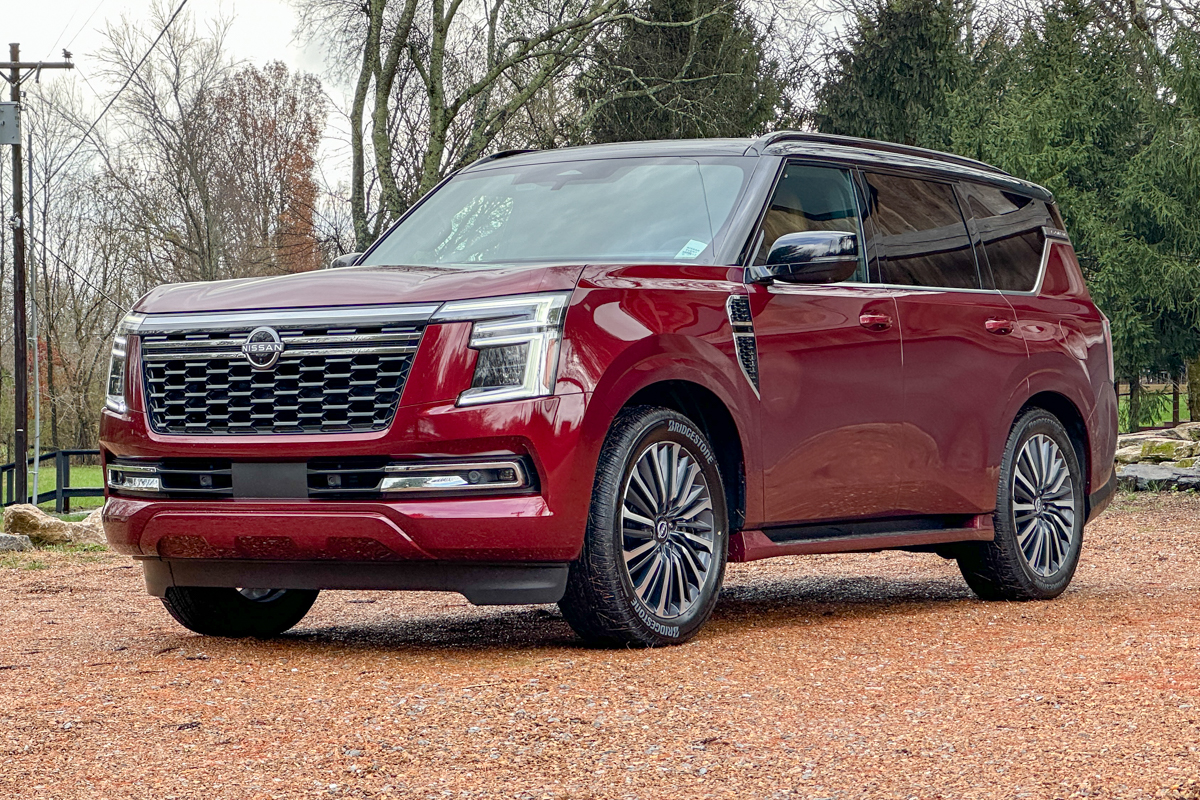
This next-gen Armada features a strikingly high beltline, just like its luxury counterpart, the Infiniti QX80. The grille and front fascia appear much taller, helped along by the SUV’s higher ground clearance and also by the limited portion of the front end dedicated to the lower grille. This is even more obvious on the PRO-4X, the only 2025 Armada to get a skid plate. The new front lighting signature updates the old outward-opening daytime running lights (DRLs) with a new pair of C-shaped LED lines which open inward from each side. Mostly, it’s the large and imposing grille which really makes an impression when the new Armada is viewed head-on, setting it quite clearly apart from its predecessor.
From the side, too, the third-generation Armada appears both larger and more business-like. The beltline looks to be completely parallel with the ground rather than sloping gently downward toward the front end, and the D-pillar is defined by decisive strokes and an ARMADA-emblazoned accent strip-Lava Red on the PRO-4X, chrome on the others. As in other Nissan model ranges, Lava Red can also be seen in the PRO-4X's badges, wheel center caps, and tow hooks. Nissan has kept the round wheel arches, which we think serve the Platinum and Platinum Reserve trims. The round arches do nothing to diminish the PRO-4X’s more rugged character–it simply adds black plastic cladding to say “I go off-road.” The new C-shaped DRLs are echoed in the back by the standard LED taillights, and PRO-4X and Platinum Reserve trims feature a fashionable red lightbar stretching across the expansive backside, just below the rear windshield. Lower trims employ a chrome strip for a similar effect.
18-inch wheels come standard on only the Armada SV, and 22-inch rollers are standard on the top-of-the-line Platinum Reserve. Everything in between gets 20-inch wheels by default, but the PRO-4X’s wheels have a unique design and come wrapped in all-terrain tires. Pro-4X, Platinum, and Platinum Reserve models also get the option for a two-tone paint job, pairing a Super Black roof and pillars with certain exterior colors.
We drove both the Platinum Reserve and the PRO-4X and found both to be comfortably outfitted inside. Even the ostensibly more task-oriented PRO-4X felt premium, with leather covering the seats and the padded center console. Take away that trim’s Lava Red contrast stitching and add in the quilting of the Platinum trims, and the Armada’s cabin becomes downright luxe. While the SV and PRO-4X are available only with a dark and simple Charcoal interior, higher trims add Espresso accents as well as entirely different color combinations. We loved the look of the Chestnut with Rye theme in our Platinum Reserve test car. The tan leather was plentiful, adorning the dash and door cards in addition to the seats and contributing to the sense that we'd entered a bubble apart from the real world.

Performance
The new Armada gets a new powertrain, anchored by a 3.5-liter twin-turbo V6 engine (Nissan claims the engineering was ‘inspired by’ the high-performance GT-R). This gives it an extra 25 horsepower and 103 lb-ft of torque compared to its predecessor, a total of 425 horsepower and 516 lb-ft. The old seven-speed automatic transmission has been replaced with a nine-speed automatic, and every trim save for the new PRO-4X is available with either rear-wheel drive (RWD) or Nissan’s Intelligent Four-Wheel Drive (4WD). The PRO-4X is, of course, 4WD-only, as befits its status as an off-roader.
Additional PRO-4X goodies include dedicated 20-inch wheels and all-terrain tires. It’s the only Armada to get an electronic locking rear differential and metal underbody skid plates, and its exclusive front fascia was designed with an improved approach angle in mind. The Armada PRO-4X shares the new-to-Nissan adaptive electronic air suspension also found on the range-topping Armada Platinum Reserve. When it’s cranked all the way up to its highest setting, with an additional 2.1 inches of ride height, this gives the adventure-ready Armada a 33-degree approach angle, 25.5-degree breakover angle, and 24.5-degree departure angle, plus a full 9.6 inches of ground clearance.
Every 4WD Armada gets hill-descent control and the off-road information display, which shows steering angle and incline and also lets the driver know when traction control is actively engaged. Models equipped with 4WD also get a total of eight selectable drive modes, including Sand, Rock, and Mud/Rut.
Every 2025 Armada is capable of towing up to 8,500 pounds when properly equipped, and Nissan supplies trailer sway control, a trailer brake controller, and trailer blind-spot warning standard. Trailer backup assist, however, is not available on the base trim, and if you want an integrated trailer brake controller, you’ll need to look to the PRO-4X or Platinum Reserve.
Driving on-road, we thought the Armada’s updated electric power steering provided a nice sense of engagement: It felt appropriately heavy for the vehicle’s size without being difficult to operate. We did note a fair amount of lean in corners, hardly unusual for a full-size SUV, and we appreciated the extra comfort of the adaptive air suspension in the Platinum Reserve. Off-road in the PRO-4X, that same suspension served a different purpose. We drove exclusively in Mud/Rut mode following a heavy downpour the night before, and it partnered with the adaptive air suspension to automatically raise the SUV for better ground clearance.

Form & function
A push-button transmission replaces the old lever-style gear selector for 2025, which automatically frees up center console space. This space is allocated to a pocket-style wireless charging pad in all but the base SV trim. We liked that it kept the phone angled, but from our seating position, it was still too deep in the console to actually be visible. (Not a problem for those relying on Apple CarPlay or Android Auto, of course.)
Our Armada Platinum Reserve was equipped with Nissan’s “Zero Gravity” seats, which are certainly comfortable. Here, however, they felt a little deep, almost as though a thigh extender were deployed–but the Armada doesn’t come with a thigh extender. It does still offer standard eight-way driver's-side power adjustment, which becomes more customizable with each trim before topping out at 12-way adjustment with four-way lumbar on both sides of the front row. Heated front seats become standard on the SL trim, and both Platinum and Platinum Reserve offer front-row seat cooling and second-row seat heating as well (accommodations that are available as options on the PRO-4X). A second-row bench seat comes standard except on Platinum trims, which get captain’s chairs in the middle by default but can be configured with a bench if you prefer. It’s a three-row SUV, and the third-row seats are offered exclusively in 60/40-split bench form, with power one-touch folding on all but the base trim. For 2025, the third row now folds flatter to allow for easier loading and free up more cargo space in the rear.
In fact, cargo volume is up across the board: by almost four cubic feet behind the third row, a whopping 6.4 behind the second row, and 1.7 in the first. Those numbers now sit at 20.4, 56.3, and 97.1, still lower than the Ford Expedition’s and Chevrolet Tahoe’s cargo specs, but higher than the Toyota Sequoia’s.
The Armada’s headroom when equipped with a sunroof is up an inch in the front row but down 2.2 in the second and .2 in the third now that the glass opening (and, by extension, the roller shade mechanism) extends further back. Without the sunroof, headroom is up substantially in the second row, but it’s otherwise pretty close to 2024 numbers. Front-row legroom has increased to 43.8, having stolen two inches from the second row, which is down to 39.2. Passengers in the way-back are the ones who really make out with the update: They gain 4.5 inches, bringing third-row legroom up to 32.9. On passenger space, too, the Armada generally falls short in comparison to its American rivals but beats Toyota’s offering.

Technology
Two large screens come standard on every 2025 Armada. These are 12.3-inch displays on the SV and SL trims, while PRO-4X, Platinum, and Platinum Reserve come with two 14.3-inch screens. Either way, the two live side by side in a single housing, though Nissan bucks the trend a bit by keeping it flat rather than curving the display unit around the steering wheel and center stack. It sits lower in the dash overall than the old infotainment screen did, but the entire display is still perfectly visible from the driver’s seat, with all key information easily viewed through or around the steering wheel.
Wireless Apple CarPlay and Android Auto are standard, along with six USB-C ports. The SL trim adds a wireless charging pad and Google Built-In, which, interestingly, is not tied to the availability of Nissan Connect (standard) or to the size of the infotainment touchscreen. Google Built-In makes Google Maps native, meaning it can still be viewed on the driver-information display even while the infotainment screen is used to manage music or other controls–a clear advantage over the version accessed through smartphone projection.
A head-up display is optional starting at the SL trim level, but it is never standard; it's available only as an extra-cost option, even on the Platinum Reserve trim. The base Armada SV comes with a six-speaker sound system, but a 12-speaker Klipsch Premium Audio System becomes standard starting at the SL trim level. No doubt because this is Nissan’s first collaboration with Klipsch, we were offered a demo with product specialists from the audio company which helped us to see the merits in the speaker array. We’re not sure we would have been sensitive enough to notice the nuances on our own, but audiophiles should be pleased.

Safety
Nissan’s ProPILOT Assist suite of advanced driver-assistance technologies is standard on the 2025 Armada, but some trims get enhanced versions. The most basic is found on the SV and PRO-4X trims, and it does include such desirable features as adaptive cruise control with active lane-centering steering assistance. ProPILOT Assist 1.1 comes standard on the other three trims, adding the ability to proactively manage speed based not just on the vehicle ahead but also on approaching curves and intersections, information gleaned from the navigation system. Armada SL, Platinum, and Platinum Reserve buyers may also opt to upgrade to the most advanced version, ProPILOT Assist 2.1, which adds hands-free highway-driving assist technology similar to GM’s Super Cruise or Ford’s BlueCruise. Our test vehicle was equipped with this top-end technology, and we were impressed with its smooth and natural adjustment to curves and lane changes. However, we felt that “hands-free” was a bit of an exaggeration. On Interstate 840 near Franklin, Tennessee, we couldn’t even go a full minute without a visual alert appearing on the dash to demand that we grip the wheel. We did appreciate that it waited a few more seconds before actually beeping and vibrating, and we also liked that we could just lightly touch the bottom of the steering wheel to assure the vehicle that we were still paying attention. It would certainly be fair to say that this is a not a “hands-at-10-and-2” system.
Aside from the varying iterations of ProPILOT Assist, every Armada also comes with Nissan Safety Shield 360. This title refers to a host of passive and interventional safety and driver-assistance features which include traffic-sign recognition, automatic emergency braking with pedestrian detection, blind-spot warning (which also works with a trailer attached), lane-departure warning and prevention, rear cross-traffic alert, and more.
A surround-view camera becomes standard on the Armada SL; climb any further up the trim ladder, and this is replaced with Nissan’s 3D Around View Monitor. All but the SV also get Nissan’s Invisible Hood View, which provides the driver with a feed of the terrain directly below the engine bay, as well as Front Wide View, meant to help extend visibility further down the road. With Nissan’s blessing (all right, Nissan’s encouragement), we put the camera through its paces with a “blindfold” applied to the windshield. Using just the Intelligent Around-View camera, with no physical line of sight, we were able to navigate between hay bales and even line up our tires with wooden planks to successfully “cross” a simulated bridge. How would this be useful in everyday life? If you’ve ever fought rising panic when confronted with guide rails at an automated car wash, you’ll appreciate this feature.

Cost-effectiveness
Incredibly, the starting price of the 2025 Nissan Armada is precisely level with 2024’s base MSRP, at $58,530 with the mandatory $2,010 destination and handling fee, which is included in all prices quoted here. It's frankly shocking to see new-car pricing remain static across a new model year, let alone a generational gap. The 4WD version of the 2025 Armada SV is also priced the same for 2025, at $61,530. That $3,000 premium for 4WD applies all the way up the trim ladder, but higher trims (reasonably) show more of a bump over 2024 for the new generation. The FWD Armada SL starts at $64,980 and the Platinum at $71,940. The new Platinum Reserve comes at a base price of $79,000, less than $10,000 from the QX80’s starting point, but still in a separate ballpark when viewed as the high end. The 4WD-only 2025 Armada PRO-4X carries a base price of $75,750. EPA-rated combined fuel economy is 18 mpg for two-wheel drive models, while four-wheel drive versions return a combined 16 mpg.
The pricing of its Infiniti counterpart makes the Armada look like a bargain at any trim level, but comparing different market segments doesn’t tell the full story. The SUV’s true competitors include other non-luxury, full-size SUVs, such as the Chevy Tahoe, the Ford Expedition, the Honda Pilot, the GMC Yukon, the Jeep Wagoneer, and the Toyota Sequoia, two of which it undercuts. Only the Tahoe starts closer to the $60k mark, coming to $60,495 with destination fees. It’s also freshly updated for 2025, but Chevrolet seems to have aimed a bit more truck-like and a bit less premium in terms of look and feel. Which of these approaches is most appealing in a body-on-frame SUV is a question every shopper will have to answer for themselves.

What owners say
My new Armada has certainly exceeded my expectations! It has such a smooth ride and the ProPilot assist makes it feel so safe and easy. So far, there has been no technical glitches and zero rattling of any kind.
May 11, 2025Trims & specs
Base MSRP $72,930 | Seating 8 |
Engine 3.5L 425 hp V6 | Cargo Capacity 20.4 cu ft |
Combined MPG 17 | Drivetrain 4X4 |
Base MSRP $69,930 | Seating 8 |
Engine 3.5L 425 hp V6 | Cargo Capacity 20.4 cu ft |
Combined MPG 18 | Drivetrain 4X2 |
Base MSRP $73,740 | Seating 8 |
Engine 3.5L 425 hp V6 | Cargo Capacity 20.4 cu ft |
Combined MPG 16 | Drivetrain 4X4 |
Base MSRP $79,990 | Seating 8 |
Engine 3.5L 425 hp V6 | Cargo Capacity 20.4 cu ft |
Combined MPG 17 | Drivetrain 4X4 |
Base MSRP $76,990 | Seating 8 |
Engine 3.5L 425 hp V6 | Cargo Capacity 20.4 cu ft |
Combined MPG 18 | Drivetrain 4X2 |
Base MSRP $65,970 | Seating 8 |
Engine 3.5L 425 hp V6 | Cargo Capacity 20.4 cu ft |
Combined MPG 17 | Drivetrain 4X4 |
Base MSRP $62,970 | Seating 8 |
Engine 3.5L 425 hp V6 | Cargo Capacity 20.4 cu ft |
Combined MPG 18 | Drivetrain 4X2 |
Base MSRP $60,520 | Seating 8 |
Engine 3.5L 425 hp V6 | Cargo Capacity 20.4 cu ft |
Combined MPG 17 | Drivetrain 4X4 |
Base MSRP $57,520 | Seating 8 |
Engine 3.5L 425 hp V6 | Cargo Capacity 20.4 cu ft |
Combined MPG 18 | Drivetrain 4X2 |


Pricing trends
MSRP range
$57,520 - $79,990
Current avg. market price
$57,724
Trending down by 1.5% this month
May 2026 - November 2026


