2024 Subaru Crosstrek Reviews, Pricing & Specs



Pros & cons
What we like
Standard all-wheel drive
Impressive technology
Outstanding off-road capability in Wilderness trim
What to consider
Underwhelming base engine
Interior materials feel cheap
Expert review
The best-selling subcompact crossover on the market gets Subaru's rugged Wilderness treatment.
It is hard to believe that the little Subaru Crosstrek has been with us for 11 years, but here we are, looking at the 2024 model. It has come a long way since 2013, and in its third generation, we benefit from multiple engine options, a dazzling touchscreen, upgraded safety features, and a new Wilderness trim level that increases the tough little SUV's capability off-road. And, because this is Subaru, you can bet that it comes standard with symmetrical all-wheel drive (AWD).
out of 10 expert review
Look & feel
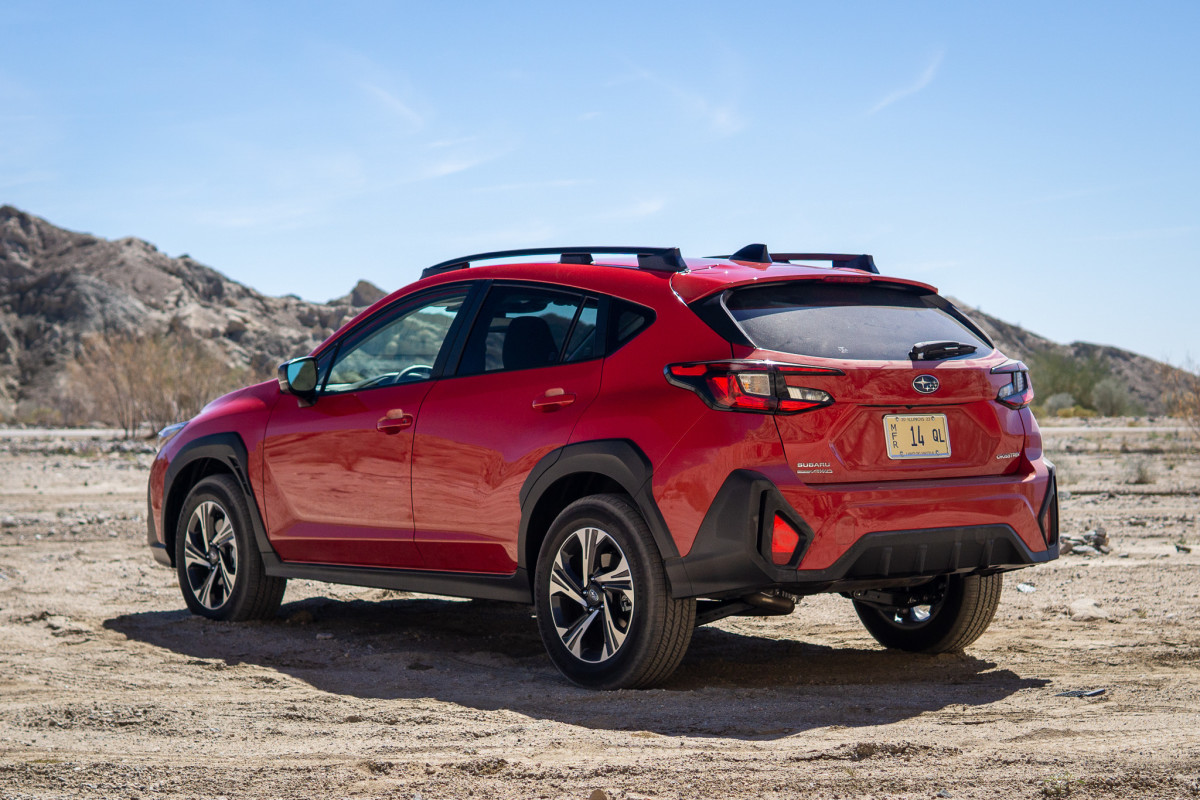
The 2024 Subaru Crosstrek, truthfully, looks an awful lot like the 2023 Subaru Crosstrek. However, this is a new car complete with new sheet metal, a new chassis, and even a few new colors. Sun Blaze, Offshore Blue, and Sapphire Blue join the Crosstrek’s paint palette. For the new Wilderness trim level, an exclusive Geyser Blue paint job also joins the palette.
The wheelbase and overall length remain nearly the same, and the 2024 Crosstrek’s approach and break-over angles are identical to the outgoing model’s. However, the new Crosstrek sports a steeper departure angle, and cargo space gets trimmed by a few tenths of a cubic foot. Ultimately, shoppers familiar with the second-generation Crosstrek are unlikely to notice any dimensional differences when they test drive a 2024 model.
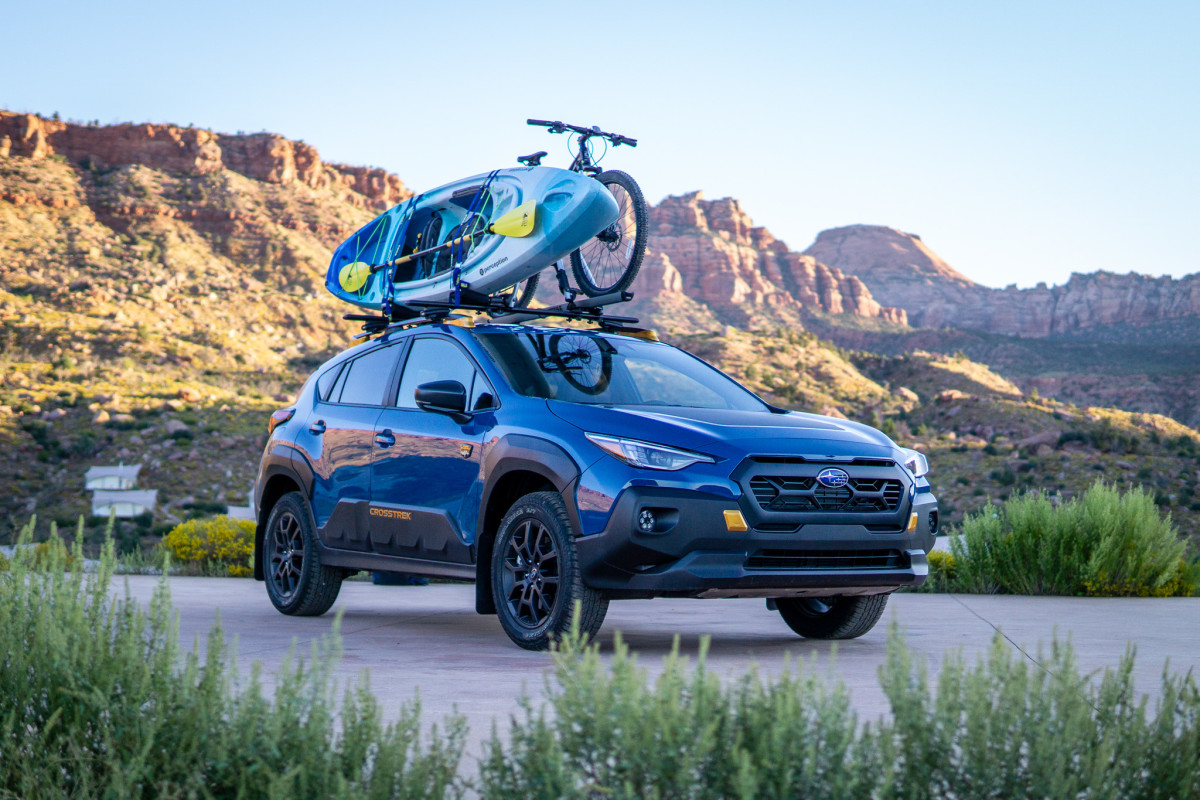
In its base trim, the 2024 Subaru Crosstrek arrives with 17-inch alloy wheels wrapped in all-season tires. 8.7 inches of ground clearance also make this little crossover a safe choice when your drive heads off the smooth pavement and onto dusty, dirt roads or snow-covered driveways. And, although Subaru offers them only as an option on the Base trim level, the Premium, Sport, and Limited trim levels also benefit from standard roof rails. Unlike the Subaru Outback, these rails don’t double as crossbars–you’ll need to purchase those separately. All told, though, the new-design rails maintain Subaru’s decidedly outdoorsy look and feel, and they’re partially a requirement for anyone whose idea of a good time includes a pair of skis, a tent, or a kayak.
For 2024, the Crosstrek’s headlights look like they run right up against the new wing bar that splits the car’s frameless grille. It’s a clever visual trick and because the wing bar has a bit of a curve to it, the Crosstrek’s front fascia has a bit of a Cheshire cat look, almost as if it’s smiling.
Being a Subaru, none of us were surprised to see the ample amount of black plastic cladding protecting each wheel arch. What was a bit more surprising was the air inlets and outlets built into that cladding. This aerodynamic design helps smooth out air that flows around the turning wheels, improving fuel efficiency and lowering road-noise volume.
At the rear, the second-generation Crosstrek’s split taillight design carries over to the third generation, albeit with some tweaks. Compared with the single-piece taillights found on the first-generation XV Crosstrek, the split design allows for wider trunk access. It’s a simple, smart change that we appreciated in the second-gen car, and it’s indicative of Subaru’s “Kaizen” philosophy around product development.
Subaru has also added some Wilderness-trim-specific interior and exterior design elements. On the outside, the Crosstrek Wilderness gets a unique, hexagonal front grille, bigger cladding pieces around the wheels, and new bumpers to help increase approach and breakover angles. The fog lights also adopt the hexagonal LED design and copper accents that are found on the Forester and Outback Wilderness models. Ground clearance increases from 8.7 inches to 9.3 with the Wilderness trim, and a ladder-style roof rack sits atop this Crosstrek. That rack is rated to hold 176 pounds of dynamic load and 700 pounds of static load.
Inside, the Crosstrek Wilderness is upholstered with StarTex synthetic leather--easy to clean and largely waterproof--and more copper accents add some visual flair. All-weather floormats come standard on the Wilderness trim, and the rear tailgate gets an LED light on the inside to help with visability in the cargo area after dark.
As the exterior dimensions have hardly changed for the 2024 model year, interior dimensions are largely the same on the new Crosstrek, too. As we mentioned, cargo volume comes in a touch smaller than before, but not so much that you'd likely notice. Pleasantly, the liftgate has a slightly shorter grip height, and a helper strap option is available–great news for shorter drivers.
A new 11.6-inch touchscreen display is the most noticeable difference between this new Crosstrek interior and the outgoing one. We’ll cover the new infotainment system’s operation in our technology section, but from a design standpoint, it adds cohesiveness between the larger (and more expensive) Subaru Outback and the smaller, entry-level Crosstrek.

Performance
The 2.5-liter flat four-cylinder engine that's been available on the Sport and Limited trim returns, delivering 182 horsepower and 178 pound-feet of torque. That same base engine is now standard on the Wilderness trim, too.
Early in 2023, we tested a Premium trim equipped with the smaller 2.0-liter four-cylinder engine. Although the larger powertrain’s 182 horsepower and 178 pound-feet of torque are more appealing in the Crosstrek, we were overall pleased with the performance of the less-expensive engine option.
152 horsepower and 145 pound-feet of torque from the 2.0-liter are managed solely by a continuously variable transmission (CVT). There’s no getting around the 2.0-liter engine’s poky behavior. The 2024 Subaru Crosstrek is just not a very quick car. And, despite the extra power from the 2.5-liter engine we tested in a Crosstrek Wilderness during the fall of 2023, that's a fact of life no matter which Crosstrek you buy. Yes, more power is better, but neither option delivers the same level of performance you can get in some of the Crosstrek's turbocharged competitors.
Additionally, there is no longer a manual transmission available; regardless of your engine choice, you’ll be living with a CVT. Pleasantly, Subaru has come close to perfecting this particular transmission. Power grows as it runs up the rev range, and the simulated shift points feel deliberate. There’s little droning and the non-Wilderness Crosstrek models do suffer from a little rubber banding, but that issue is largely eliminated in the Wilderness trim level, thanks to its extra pressure sensor. Ultimately, the Crosstrek's CVT is more pleasant and easier to live with than those in many other CVT-equipped crossovers. Buy a Premium, Sport, Limited, or Wilderness trim, and you also get paddle shifters.
The Crosstrek Wilderness has a shorter final-drive ratio, meaning it can tackle more aggressive, uphill terrain and provide better acceleration from a stop. Towing capacity also jumps up to 3,500 pounds on Wilderness trims, more than double the approved towing capacity for non-Wilderness Crosstreks. The downside of the shorter final drive (4.111 versus 3.7 in other Crosstrek models) is that road noise increases and fuel economy decreases, both due to the higher RPMs needed to maintain speed.
Both the updated 2.0-liter powertrain and the 2.5-liter powertrain generate less vibration during start-up and operation than the previous one. Because the Crosstrek’s engine cylinders are horizontally opposed, rather than arranged in-line, they tend to shudder a bit more than is comfortable. Decreasing that shuddering with tuning and improved engine mounts makes features like automatic start/stop much more pleasant.
Although the steering feel remains light and vague, relative to the vehicle’s size, it’s not sloppy or indirect–credit to a new dual-pinion steering rack for that. Additionally, with a stiffer structure, the Crosstrek doesn’t lean quite so much through corners as the outgoing model. There's a bit more roll in the Wilderness, particularly when tackling tight corners on a paved road, but that's due to the vehicle's off-road oriented suspension.
In addition to standard AWD, the Crosstrek also comes equipped with Subaru’s X-Mode traction management system in all trim levels. Essentially, X-Mode can sense when a wheel loses traction, apply the brakes to that wheel, and divert the excess power to the wheels that do have traction.
Base and Premium trim levels receive a more rudimentary version of X-Mode with dirt/snow driving features. Buy a Sport, Limited, or Wilderness trim, and the X-Mode system comes with a bit more beef, upgrading dirt and snow to mud and deep snow. Additionally, hill-descent control is included with both grades of X-Mode.
Fuel economy looks unimpressive compared with increasingly common hybrid and plug-in hybrid vehicles (PHEV) competitors, but they’re still pretty good for a subcompact crossover with AWD. The EPA estimates 27 mpg in the city, 34 highway, and 29 combined for the 2.0-liter Crosstrek. Upgrade to 2.5 liters, and you can expect 26 city, 33 highway, and 29 combined. Figures fall a bit short in the Crosstrek Wilderness, but not terribly so: 25 city, 29 highway, 27 combined. Folks who plan on taking their Crosstrek on long highway journeys will be happy with the big, 16.6-gallon fuel tank.

Form & function
Although it boasts impressive ground clearance and somewhat rugged styling, the Crosstrek is still built atop the Subaru Impreza’s platform. Don’t confuse this with a Subaru Forester–the Crosstrek is small.
Compared with other small, subcompact SUVs, however, the Crosstrek delivers competitive cargo space and impressive utility.
Rear-seat legroom and headroom are good, although very tall passengers may want to call dibs on the front seat. 19.9 cubic feet of trunk space falls short of what you’d find in a Honda CR-V, Mazda CX-30, or Toyota Corolla Cross. However, the available 54.7 cubic feet of total cargo space (when you fold the second-row seats down) is significantly closer to par.
Better yet, Subaru clearly considered its typical customer when designing the Crosstrek’s interior. Materials feel low-rent but robust and easy to clean. A protective cargo tray is standard on the Premium trim level and above. Cupholders abound. Even the center console bin was designed to fit two 32-ounce Nalgene water bottles. Ask any avid hiker, and you’ll learn that Nalgene bottles just don’t fit well in most vehicles. In the Subaru Crosstrek, they do.
The Wilderness adds some extra bits aimed at adventure, too. There are perfectly sized Nalgene cupholders in the trunk, and every Wilderness-trim Crosstrek comes equipped with all-weather floor mats and cargo tray.

Technology
Climb inside a 2024 Subaru Crosstrek, and you’d be hard-pressed to ignore the massive, vertically oriented touchscreen. Previously found on the three-row Subaru Ascent and the flagship Subaru Outback, this 11.6-inch display is a showstopper. Icons and graphics are crisp and bright, and Subaru has done a good job retaining physical controls for temperature, defrosters, tuning, and volume. Additional, often-used features like the automatic stop-start toggle can be programmed to sit in a static and ever-present position on the screen.
The big infotainment system is standard on all but the Base trim. It includes wireless Apple CarPlay and wireless Android Auto, and a wireless charging pad is available as an option across the lineup, standard on the Sport and Limited trims.
The Crosstrek’s technology offering is impressive but not perfect. For one, it does suffer from significant glare when positioned in bright sunlight. For another, some of its features can be difficult to locate, requiring the user to dig through a few too many menus.
Most frustrating, at least for drivers in states where Right to Repair laws have been passed, is that rather than modify the system to comply with those laws, Subaru has instead decided to remove features entirely. Buy a Subaru Crosstrek in Massachusetts, for instance, and you won’t be able to enjoy remote start via the Subaru Starlink telematics app.

Safety
The Subaru Crosstrek has been in production since 2013, and it has been awarded a Top Safety Pick designation by the Insurance Institute for Highway Safety (IIHS) since 2013. The IIHS has yet to review the 2024 model, but we don’t expect much to change.
Similarly, the National Highway Traffic Safety Administration (NHTSA) gave the 2023 Subaru Crosstrek five stars overall, and while it has not yet crash-tested the new 2024 model, we expect it to pass with flying colors.
Part of that expectation stems from the inclusion of Subaru’s acclaimed EyeSight safety system. Included as standard equipment, EyeSight is a camera-based advanced driver assistance system (ADAS) that boasts automatic emergency braking, lane-keeping assist, and adaptive cruise control. New for 2024, EyeSight employs a wider-angle lens to give it a larger view of the road and surroundings ahead, and it also includes automatic emergency steering on cars equipped with blind-spot monitoring. Automatic emergency steering can identify vehicles partially impeding your lane and autonomously direct the Crosstrek around them, keeping it within its lane the entire time.

Cost-effectiveness
The Subaru Crosstrek has been with us since 2013, and it’s been a popular option ever since then. In fact, the Crosstrek is now one of Subaru’s best-selling cars, swapping places with the Forester on any given month.
Part of the Crosstrek’s appeal certainly comes from its rugged, can-do ethos; with AWD, impressive ground clearance, and a utilitarian design, it appeals to active shoppers who want a car capable of taking skiing, hiking, boating, fishing, camping–or anywhere else the paved road ends.
Another part of its popularity comes from its attractive price tag. The Crosstrek has a higher starting price than some competitors like the Honda HR-V or Toyota Corolla Cross–but only if you buy front-wheel-drive (FWD) versions of those cars. Buy one with AWD, and the Crosstrek becomes the better value.
Pricing starts at $26,220 for the Base trim level, including a $1,225 destination fee. Moving up the ladder, a Premium trim costs $27,370, a Sport costs $30,220, a Limited trim costs $32,120, and the Wildernesss starts at $33,290, all including the destination fee. The 2.0-liter-powered Base and Premium trim levels should be available in the spring of 2023, while the 2.5-liter Sport and Limited trims will arrive in the summer.
Subaru has done an admirable job of packaging appealing features into every trim level. Add in the Crosstrek’s on- and off-road capability and the brand’s reputation for strong resale values, and the 2024 Subaru Crosstrek looks like an excellent choice for active, adventurous shoppers.

What owners say
"Overall, drivers really enjoy the 2024 Subaru Crosstrek for its build quality, comfort, and handling. Many appreciate its fuel efficiency, safety features, and value for money. However, some have pointed out that the 2.0 engine can feel underpowered."
I love love love my Crosstrek! It has a ton of cool features and 💯 worth the $$$
January 23, 2026This is a great little SUV. It's my 2nd Crosstrek but a different trim level. The Wilderness has lots of great features and is fun to drive. I get lots of compliments as well.
June 29, 2025Just the absolute best mini off-roader on the market at any price point! The tech and the capabilities of this vehicle is just mind blowing!
June 20, 2024What owners say
I love love love my Crosstrek! It has a ton of cool features and 💯 worth the $$$
January 23, 2026This is a great little SUV. It's my 2nd Crosstrek but a different trim level. The Wilderness has lots of great features and is fun to drive. I get lots of compliments as well.
June 29, 2025Just the absolute best mini off-roader on the market at any price point! The tech and the capabilities of this vehicle is just mind blowing!
June 20, 2024Subaru crosstrek Premium 2024: Good visibility. Good gas mileage. Good handling. Good pickup. Good features. Good overall value.
June 29, 2023Great little car for work and short trips. Great gas milage. Reasonable price. Good warranty. So far very happy with our purchase. Would not be ideal for large or obese people or regular very long road trips.
November 4, 2023Outstanding car, missing nothing. Subaru Outback and Subaru Forrester were contenders.
July 10, 2024I am very impressed by the Crosstrek Premium AWD subcompact SUV. It is stylish, comfortable, handles beautifully, and has lots of safety features and ammenities found on much more expensive cars. I think it is a great value and am very pleased with my purchase so far..
January 24, 2024Great vehicle handles well , great on gas. Easy parking with everything you possibly need for any terrain.
January 17, 2024Great car, build quality is on point. Only issue is that if you have the model that only has the 2.0 engine, the acceleration is somewhat lacking.
June 2, 2023Good vehicle for us as seniors, with safety features, access and seating, and visibility features we need.
July 3, 2024Trims & specs
Base MSRP $26,345 | Seating 5 |
Engine 2.0L 152 hp H4 | Cargo Capacity 19.9 cu ft |
Combined MPG 30 | Drivetrain AWD |
Base MSRP $25,195 | Seating 5 |
Engine 2.0L 152 hp H4 | Cargo Capacity 19.9 cu ft |
Combined MPG 30 | Drivetrain AWD |
Base MSRP $31,095 | Seating 5 |
Engine 2.5L 182 hp H4 | Cargo Capacity 19.9 cu ft |
Combined MPG 29 | Drivetrain AWD |
Base MSRP $29,195 | Seating 5 |
Engine 2.5L 182 hp H4 | Cargo Capacity 19.9 cu ft |
Combined MPG 29 | Drivetrain AWD |
Base MSRP N/A | Seating N/A |
Engine N/A | Cargo Capacity N/A |
Combined MPG N/A | Drivetrain N/A |
Base MSRP N/A | Seating N/A |
Engine N/A | Cargo Capacity N/A |
Combined MPG N/A | Drivetrain N/A |
Base MSRP N/A | Seating N/A |
Engine N/A | Cargo Capacity N/A |
Combined MPG N/A | Drivetrain N/A |
Base MSRP $32,195 | Seating 5 |
Engine 2.5L 182 hp H4 | Cargo Capacity 20.0 cu ft |
Combined MPG 27 | Drivetrain AWD |


Pricing trends
MSRP range
$25,195 - $32,195
Current avg. market price
$26,041
Trending down by 0.9% this month
May 2026 - November 2026