2022 Toyota Corolla Cross Reviews, Pricing & Specs
Write a reviewPros
Easy-to-use technology
Standard advanced safety features
Cons
Fairly pedestrian performance
Uncomfortable seats
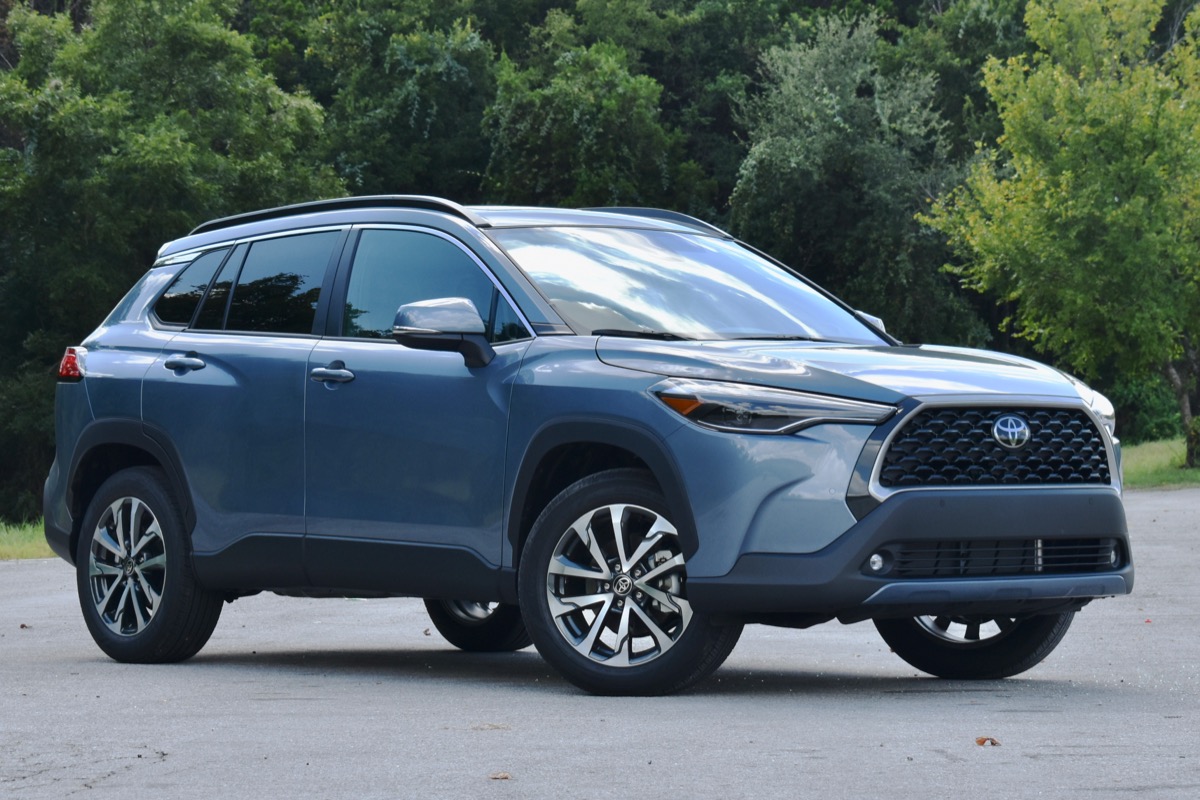
Toyota cross-breeds its most popular car with an SUV.
Toyota Corolla is the most popular automotive nameplate in history, but the compact cars it’s attached to are slowly being usurped by crossover SUVs. So Toyota is trying to achieve the best of both worlds by launching a new Corolla model that’s also a crossover.
The 2022 Toyota Corolla Cross seeks to expand the Corolla lineup in much the same way that the Corolla Matrix hatchback did two decades ago, adding all-wheel drive (AWD) and more upright bodywork but keeping the Corolla name for familiarity. The Corolla Cross shares the TNGA-C platform, as well as a powertrain, with the Corolla sedan and hatchback, but the exterior styling is all SUV.
The Corolla Cross launches into a crowded market segment. At its media preview, Toyota said it’s counted 20 competitors, including the Chevrolet Trax, Mazda CX-30, Honda HR-V, Hyundai Kona, and Subaru Crosstrek. The Subaru is likely the Corolla Cross’s closest rival, as it’s also a small SUV derivative of an existing compact hatchback.
Built at a new factory in Huntsville, Alabama, the Corolla Cross is scheduled to reach dealerships in October. It will be available in L, LE, and XLE trim levels, with standard front-wheel drive (FWD) or optional AWD. We got a chance to sample all three during a day of driving around Austin, Texas.

Toyota has launched some daring designs lately, but the company pulled things back a bit with the Corolla Cross’s styling. Sure, the snub nose recalls the Toyota Tundra pickup truck, and the Corolla Cross has the tall ride height and plastic fender flares that are obligatory on any wannabe SUV, but the overall look is very conservative. It’s almost like Toyota didn’t want the Corolla Cross to outshine its larger sibling, the RAV4.
Speaking of the RAV4, the Corolla Cross is 5.3 inches shorter than that model, making it truly compact. The Cross is also larger than the Toyota C-HR, albeit with a similar wheelbase. The Corolla Cross’s more conventional shape also means it offers more interior space than the C-HR, which has always been a style-over-substance proposition.
Toyota did throw in a few interesting styling details, although they’re very subtle. The body sides have a bit of scalloping around the rear door handles and exterior mirrors, and designers hid more than 20 Corolla Cross logos as Easter Eggs throughout the vehicle. Base Corolla Cross L models get 17-inch steel wheels, midlevel LE models get 17-inch alloy wheels, and the top Corolla Cross XLE gets 18-inch alloy wheels, as well as LED daytime running lights and fog lights.
The interior is the most Corolla-esque part of this vehicle. The overall layout is very close to those of the Corolla sedan and hatchback, although Toyota did add oversized door handles like the ones you get on the RAV4. However, we felt material quality was below that of the Corolla sedan and hatch. Sitting in the base L model was like being in a taxi, and even the XLE felt fairly basic. That trim level does get SofTex leatherette upholstery in place of the L and LE models’ cloth seats, at least, and both the XLE and LE get a leather-wrapped steering wheel. A moonroof is also available on the LE and XLE as an extra-cost option.

All Corolla Cross models get the 2.0-liter four-cylinder engine from the Corolla SE and XSE models, with 169 horsepower and 150 pound-feet of torque. Unlike the Corolla sedan and hatchback, there is no manual transmission option. Every Corolla Cross gets a continuously variable transmission (CVT).
Unlike other CVTs, though, this one has an actual first gear for more responsive acceleration off the line. We were impressed by the response when pulling away from stop lights, but also noticed a fairly abrupt transition when switching over to normal CVT operation. At higher speeds, the powertrain had typical CVT issues, including engine droning and rubber-banding, a substantial delay between pressing the gas pedal and any actual movement.
More power might have helped. The Corolla Cross didn’t feel like a liability on highways, but the engine seemed to be working pretty hard to maintain pace. Other than the near-constant engine droning, though, the interior was impressively quiet at all speeds. Ride quality was fairly good as well, and the Corolla Cross had the same feeling of solidity we’ve experienced in other TNGA-platform vehicles.
The optional AWD system is the same one used in AWD versions of the Toyota Camry. It can send 10% to 50% of torque to the rear wheels, according to Toyota. The system doesn’t require wheel slip to engage, and will also work during hard cornering on dry pavement, Toyota claims. We didn’t really notice that on our test drive, but we did notice a lot of body roll. Handling probably won’t be a priority for most shoppers, granted, but we can confirm that you won’t want to autocross the Corolla Cross.
While it does boast an SUV-like 8.2 inches of ground clearance (8.1 inches for XLE models), the Corolla Cross wasn’t designed for off-roading. Similarly, its 1,500-pound maximum towing capacity is better than what you would typically expect from a normal car, but less than a traditional SUV.

SUV stands for “sport utility vehicle,” so it’s reasonable to expect more passenger and cargo space than the existing Corolla hatchback. The Corolla Cross checks that box, mainly in terms of rear-seat room and cargo space.
Front headroom and legroom are nearly identical to the Corolla hatchback's, but the Corolla Cross has an extra 2.1 inches of rear legroom and 1.4 inches of rear headroom (without the moonroof). Rear climate-control vents are standard as well, and XLE models get dual-zone automatic climate control for front-seat occupants. However, it’s worth noting that the Corolla hatch offers more shoulder room in both the first and second row, contributing to a feeling of spaciousness.
With the 60/40 split-folding rear bench in place, Toyota quotes 26.5 cubic feet of cargo space with FWD (25.2 cubic feet with AWD) and 23 cubic feet for the Corolla hatch, the latter only achievable if you swap the spare tire for a tire-inflation kit. With the rear seats folded, the Corolla Cross has 66.8 cubic feet of cargo space with FWD and 65.5 cubic feet with AWD (Toyota doesn't quote a comparable figure for the Corolla hatchback).
The Corolla Cross also compares well to rival crossovers on interior space, although legroom in both rows is a bit below average. It also offers more cargo space than the Chevy Trax, Chevy Trailblazer, Honda HR-V, Hyundai Kona, and Subaru Crosstrek do.
It may be fairly spacious for this segment, but we didn’t find the Corolla Cross's interior to be particularly comfortable. Seats in both rows were hard and unsupportive. The tall, upright driving position definitely felt SUV-like, but we wouldn’t want to assume it for a long road trip. Storage spaces only met the bare minimum to be useful.

Base Corolla Cross L models get a standard 7-inch touchscreen. LE and XLE models get an 8-inch touchscreen, and the XLE also gets a 7-inch digital instrument cluster. Apple CarPlay and Android Auto are standard on all trim levels, along with Bluetooth, WiFi, Amazon Alexa compatibility, and SiriusXM satellite radio (with three-month free trial). A nine-speaker JBL audio system is an optional upgrade for LE and XLE models.
The infotainment system is typical Toyota, meaning it’s easy to use, but not fancy. We liked the position of the touchscreen and the hard buttons for menus, but the graphics were plain and the screen was slow to boot up when starting the car. The optional digital instrument cluster was an unorganized info dump, while the smaller display crammed in next to the analog gauges in lower-level models mostly showed redundant information.
Two front USB-A ports are standard; moving up to the Corolla Cross LE nets a third port for rear-seat passengers, plus wireless charging. However, the charging pad, which is nestled in a cubbyhole ahead of the shifter, may not fit larger phones. On a slightly different tech note, only the LE and XLE models get pushbutton start, so the base L is one of the few remaining new cars that actually require a key to start the engine.

Crash-test ratings from the National Highway Traffic Safety Administration (NHTSA) and Insurance Institute for Highway Safety (IIHS) aren’t available yet, which isn’t unusual for newly launched vehicles. Ratings for the Corolla hatchback and sedan likely won’t apply to the Corolla Cross because of the latter’s different body shell.
As with other Toyota models, the Corolla Cross gets a decent amount of standard driver-assist tech under the Toyota Safety Sense 2.0 banner. The standard safety features include forward collision warning, automatic emergency braking, lane-departure warning, adaptive cruise control, automatic high beams, traffic-sign recognition, and Lane Tracing Assist automated lane centering.
In addition to those features, the Corolla Cross LE adds blind-spot monitoring and rear cross-traffic alert. XLE models get rear automatic braking and front and rear park assist with automatic braking.

Final EPA fuel-economy ratings aren’t available yet, but Toyota expects the Corolla Cross to achieve 33 mpg combined (31 mpg city, 32 mpg highway) with FWD and 30 mpg combined (29 mpg city, 32 mpg highway) with AWD.
We weren’t in any single vehicle long enough on our first drive to get a meaningful real-world gas mileage estimate, but given how much we needed to thrash the engine, we feel it might be difficult to match Toyota’s estimates. A hybrid version is on the way, with details to come next year.
Toyota offers a three-year, 36,000-mile basic warranty and a five-year, 60,000-mile powertrain warranty. Those are fairly standard terms for a mainstream automaker, but still behind the warranty terms of Hyundai and Kia. Toyota also offers free scheduled maintenance for two years or 25,000 miles (whichever comes first) and 24/7 roadside assistance.
Pricing starts at $23,410 for a base FWD Corolla Cross L (all prices include a mandatory $1,215 destination charge). The Corolla Cross LE and Corolla Cross XLE trim levels start at $25,760 and $27,540 respectively with FWD. AWD is a $1,300 option on all trim levels.
The Honda HR-V undercuts the Corolla Cross’s base price slightly, but that gap shrinks as you move up to higher trim levels. The Toyota also boasts a more powerful engine and more cargo space than the Honda. It’s a similar story with the Chevy Trax and Trailblazer, although they are a bit cheaper in base FWD form. Both the Trax and the Hyundai Kona also have laughably tiny cargo areas for “SUVs,” but the Hyundai at least offers a more powerful optional turbo engine and a better warranty. The Kia Seltos has a similar SUV-like feel to the Corolla Cross, but with better driving dynamics and a better interior.
The Subaru Crosstrek gets standard AWD, but add an automatic transmission and it’s about the same price as an AWD Corolla Cross L, which also gets a larger touchscreen as standard equipment. The Subaru has less cargo space than the Toyota, but it does have more legroom in both rows. It’s also a bit nicer to drive, as it doesn’t have the Toyota’s excessive body roll and engine droning. Subaru also seemed to put more effort into the interior.
The Corolla Cross doesn’t excel in any specific area, but it provides decent utility and is competitively priced. A more spacious interior and available AWD will also likely appeal to new-car buyers looking to trade up from a Corolla hatchback but wanting to stay with Toyota. However, with so many other choices in this segment, brand-agnostic buyers might want to take a look at the competition.


