2022 Hyundai Veloster N Reviews, Pricing & Specs

Pros & cons
What we like
Stylish design
Manual transmission available
Great warranty
What to consider
All-wheel drive not available
Cramped back seat
The CarGurus verdict
The Hyundai Veloster N punches above its weight, but will Hyundai's scrappy sport compact get knocked out?
Hyundai has discontinued most of the Veloster lineup, choosing to instead focus on expanding its roster of (more profitable) crossover SUVs, so the top-spec Veloster N goes it alone for the 2022 model year. But with sport compact car sales flagging and Hyundai making no changes to the Veloster N, one must wonder if the 2022 model year represents the hot hatch's curtain call.
out of 10 expert review
Look & feel
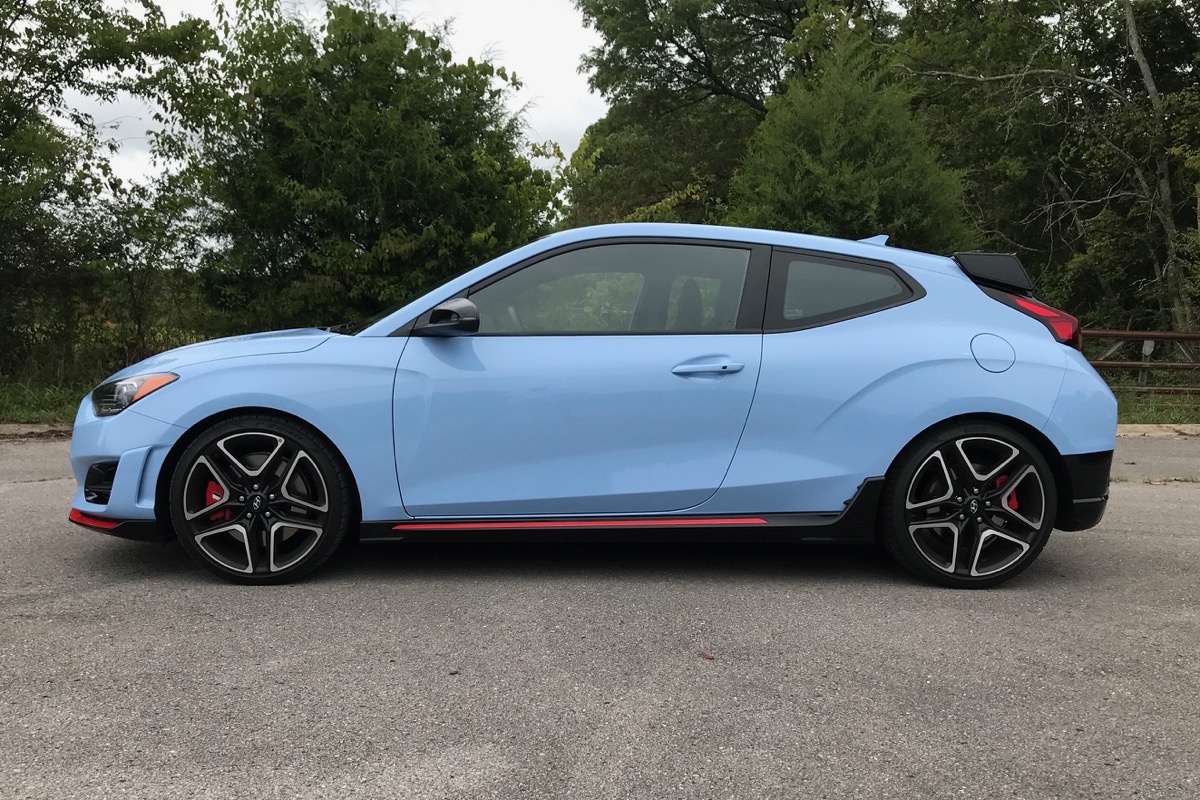
Unlike many compact cars these days, with their bland, unassuming, and forgettable styling that blends in with the crowd, the Hyundai Veloster N makes an immediate impression. Indeed, all it takes is one look at the sporty, low-slung, three-door hatchback, and the Veloster is instantly recognizable. Quirky but not cartoonish, the car's design is distinctive—in a good way.
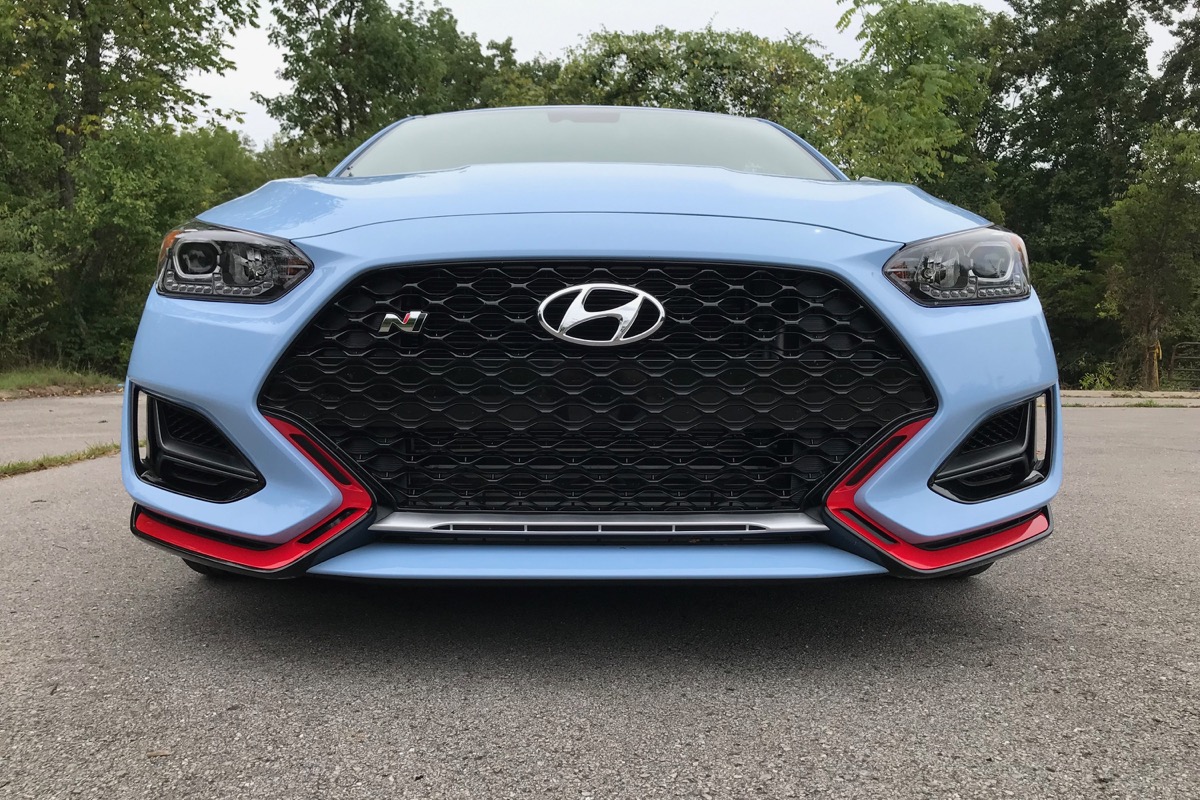
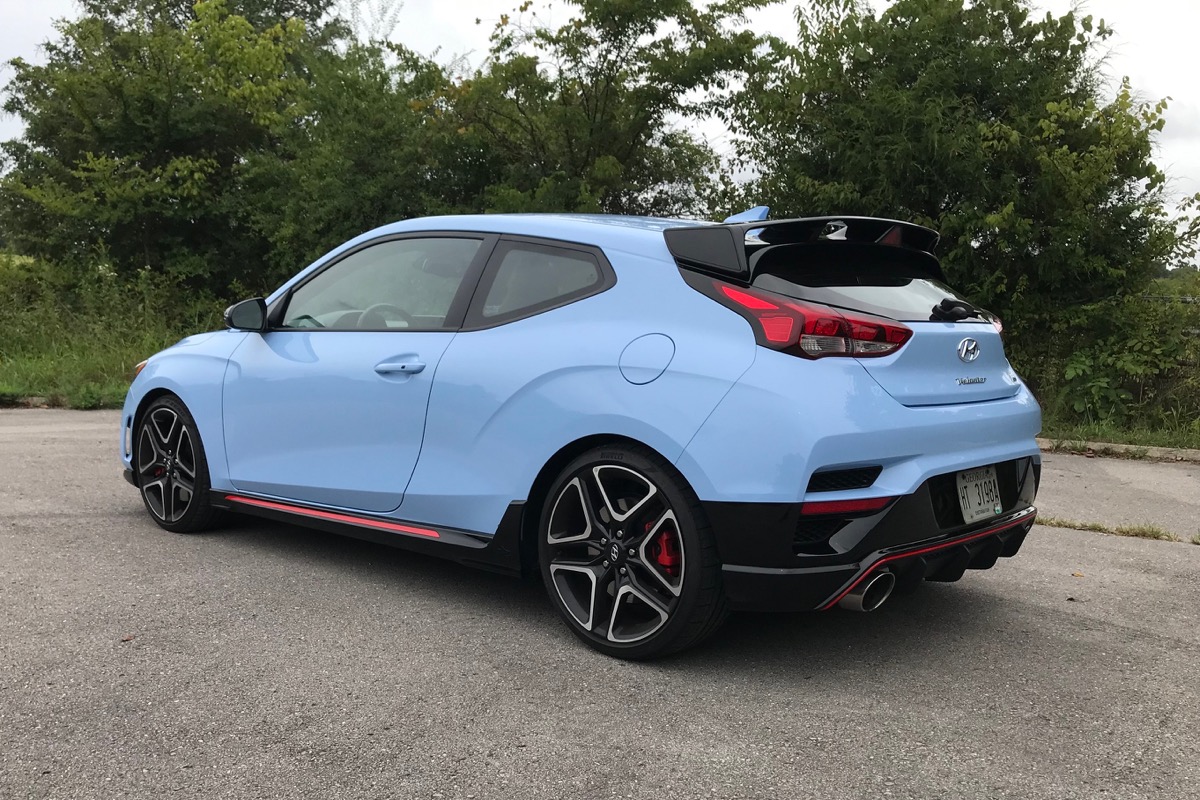
Hyundai applies gloss black paint to a handful of body components to enhance the car's sporty look, including the large crosshatch grille, side mirrors and sills, front and rear fascias, two-stage rear spoiler, and rear diffuser. Complemented by light red accents, the color treatment really works.
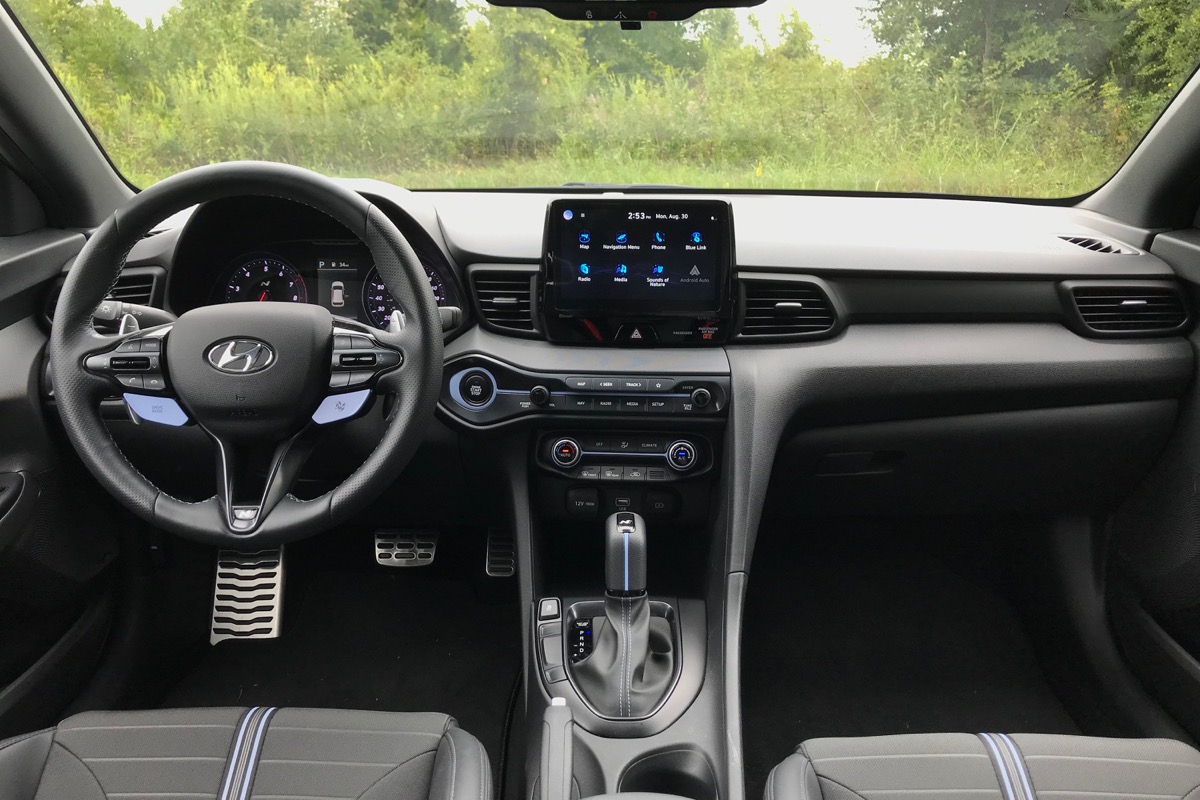
Things normalize somewhat when you step, nay, pour yourself into the Veloster N's driver's seat. The Veloster N's front bucket seats feature cloth inserts surrounded by leatherette bolsters that are attractive and provide good support when zooming around curves. Except for the driver's lumbar, all seat adjustment controls are manual, so it takes a little bit of getting used to which lever performs what function; there is some trial and error involved.
The N Light Sport seats, which are thinner and 4.4 pounds lighter than those found in earlier, non-N versions of the Veloster, have an illuminated N logo just beneath the headrest and feature stiffer side bolsters to hold you in place better when the driving gets spirited.
Even with the low seating position in the Veloster, forward visibility isn't a problem. Those wishing for a good view of the stars, however, will be disappointed, as a moonroof is not available on the Veloster N. Rearward visibility is better than you'd expect, considering the narrow aperture of the rear window glass.
Now, about that exterior color. Our test car came in Performance Blue—a light, almost powdery matte blue paint color that is somewhat polarizing. Some passers-by liked it, while others made less than flattering comments. Say what you will, but the light red trim accents complement the light blue and, in unison with the previously mentioned gloss black bits, succeed in giving the car a sporting flair. The red-painted brake calipers and N badging also contribute to the Veloster's sporty look.
Performance
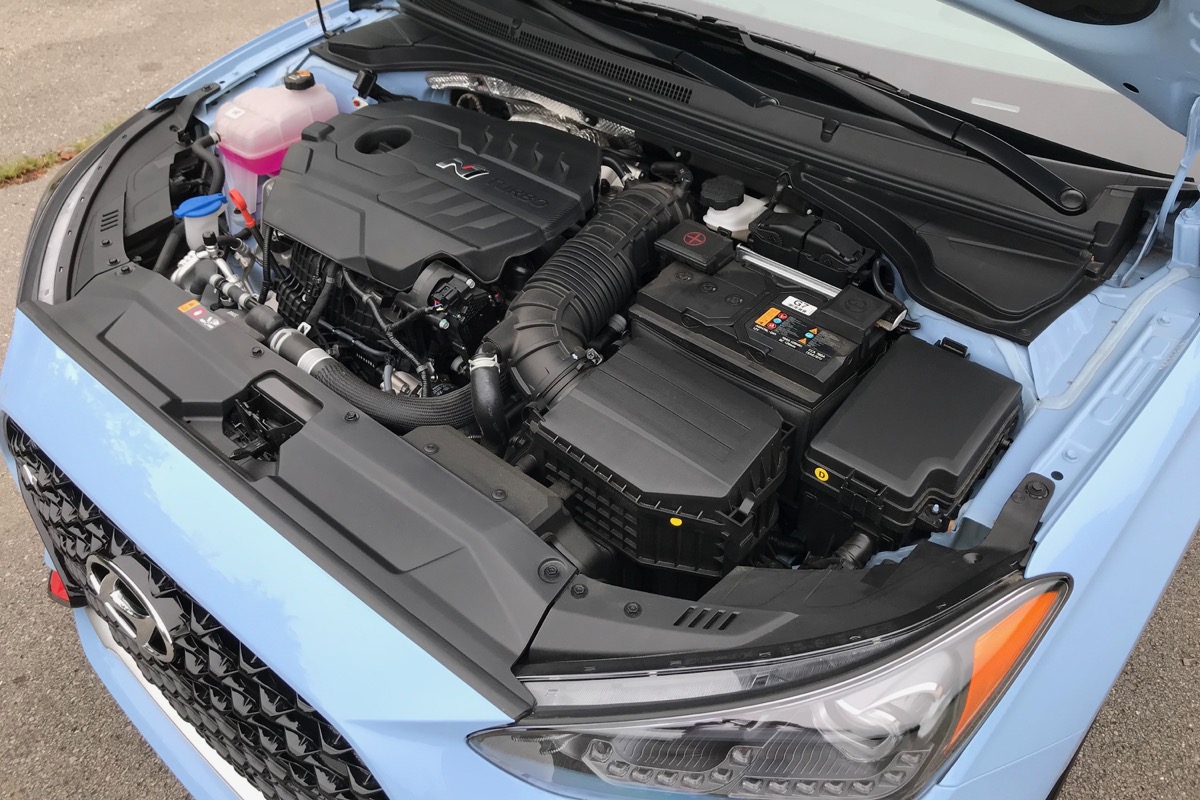
The 2022 Hyundai Veloster N comes standard with a stout, turbocharged, direct-injected 2.0-liter four-cylinder engine. Output measures 275 horsepower and 260 pound-feet of torque. Power is sent to the front wheels—all-wheel drive (AWD) is not available—via a standard six-speed manual transmission with hill-start assist; an eight-speed wet dual-clutch automatic transmission (DCT) is optional.
The DCT's wet-clutch design, which debuted on last year's 2021 model, is noteworthy. Unlike a dry setup, a wet design uses oil to improve lubrication and cooling performance in high-torque applications. According to Hyundai, the wet DCT results in "increased thermal endurance and reduced direct parasitic drag on the powertrain." In other words, it can run hotter without power losses.
While the dual-clutch transmission delivers quick, smooth shifts and comes with paddle shifters on the steering wheel aimed at those who like a little more involvement in the driving task, we couldn't help but lament that the test car didn't have the standard six-speed manual transmission. The market has clearly spoken, considering take rates for manual transmissions continue to drop, but we'd be remiss if we didn't remind our fellow driving enthusiasts that humans have two arms and two legs for a reason. A car like the Veloster N deserves to have its gears rowed manually.
Alas, if we can't properly row through the gears using a stick shift and a clutch pedal, the Veloster N offers the next best thing—manual shifting through the DCT. Intuitively, one pushes the gear selector forward to select a lower gear and rearward to select a higher gear. While manual shift control does provide a modicum of involvement in the driving task, it's a far cry from the connection one feels to the car when allowed complete control over the transmission. But enough about that...
Gamers will appreciate the N Grin Shift feature of the DCT. This feature temporarily boosts torque by seven percent—from 260 to 278 pound-feet—for up to 20 seconds by allowing temporary turbo over-boost. While N Grin Shift doesn't pack nearly as big of a punch as, say, a nitrous system, it will likely appeal to those who spend countless hours playing Forza Motorsport or Gran Turismo on their Xbox or Playstation.
Additionally, the Veloster N's DCT includes what Hyundai calls N Power Shift and N Track Sense Shift. The former maximizes power delivery during upshifts when more than 90 percent of throttle demand is detected. The latter senses road conditions and selects the gear and shift timing to optimize performance. There's no driver involvement required for either of these features as they work in the background.
Another Veloster N feature, N Grin Control is a drive mode selector with five choices: Normal, Eco, Sport, N, and N Custom. Drivers can access the different drive modes via the infotainment touchscreen or the steering wheel. Normal mode is ideal for daily commuting, but again, for those who like to fiddle with vehicle settings to see how it affects driving dynamics and the sound of the exhaust, N Grin Control provides yet another means to do so. We particularly enjoyed toggling through the different modes to hear how it affected the exhaust note—especially in Sport mode and above.
Other performance-related goodies on the Veloster N include torque vectoring control, N brakes with red-painted calipers, 19-inch, double five-spoke alloy wheels, and a variable exhaust valve system. Most of those features help in the handling department, but let's face it, you can only do so much with front-wheel drive (FWD).
Form & function
The Hyundai Veloster is unique in that it has three forward-hinged doors rather than the usual two or four. There's one on the driver's side and two on the passenger's side. While a little unorthodox, this arrangement allows the Veloster to retain its sporty two-door styling but provides easier access to the back seat, at least on one side of the car. While physically challenging from the driver's side, getting into the back seat from the passenger's side is a breeze as the extra door enhances the car's utility.
The Hyundai Veloster N is a small car, and with that comes certain concessions in terms of passenger space and comfort. Surprisingly, there's plenty of head- and legroom up front, even for taller drivers. Indeed, front-seat travel is so generous that we found we didn't need to have the seat in the rearmost setting to find a comfortable driving position.
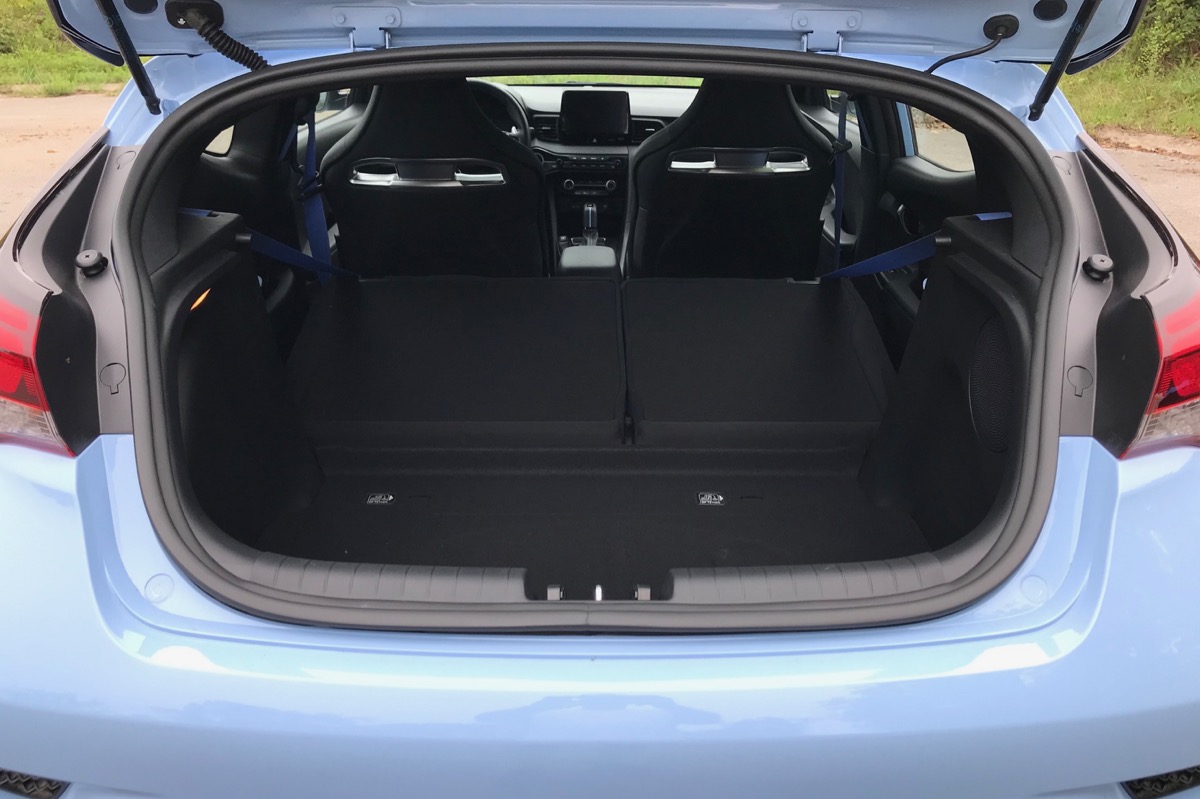
Unfortunately, the feeling of spaciousness enjoyed by those in the front isn't shared by those in the two-passenger rear bench seat, where headroom, legroom, and knee room are at a bit of a premium. Exacerbating the tightness in the back seat is the Veloster N's fast, sloping roofline. While it looks cool from the outside, rear-seat headroom suffers. Back-seat passengers in the Veloster N have a modest 35.9 inches of headroom. Likewise, legroom is poor, with rear-seat passengers only having 34.1 inches in which to stretch out.
At 19.9 cubic feet, cargo space is a bit tight, but when folded down, the 60/40 split-fold rear seat allows for 44.5 cubic feet of area to stow luggage and gear. The rigid, removable cargo cover gets in the way a bit when loading taller items, and vertically challenged owners may find it difficult to reach the liftgate handle when it's in the fully open position. A foot-activated motion sensor beneath the rear bumper would be a welcome addition but is not offered on the Veloster N.
The Veloster N sits very low to the ground, with only 5.3 inches of ground clearance. While it makes for a little more difficulty getting in and out of the car, the low floor also provides a lower center of gravity, which aids in handling—a welcome tradeoff for any sport compact car.
Technology
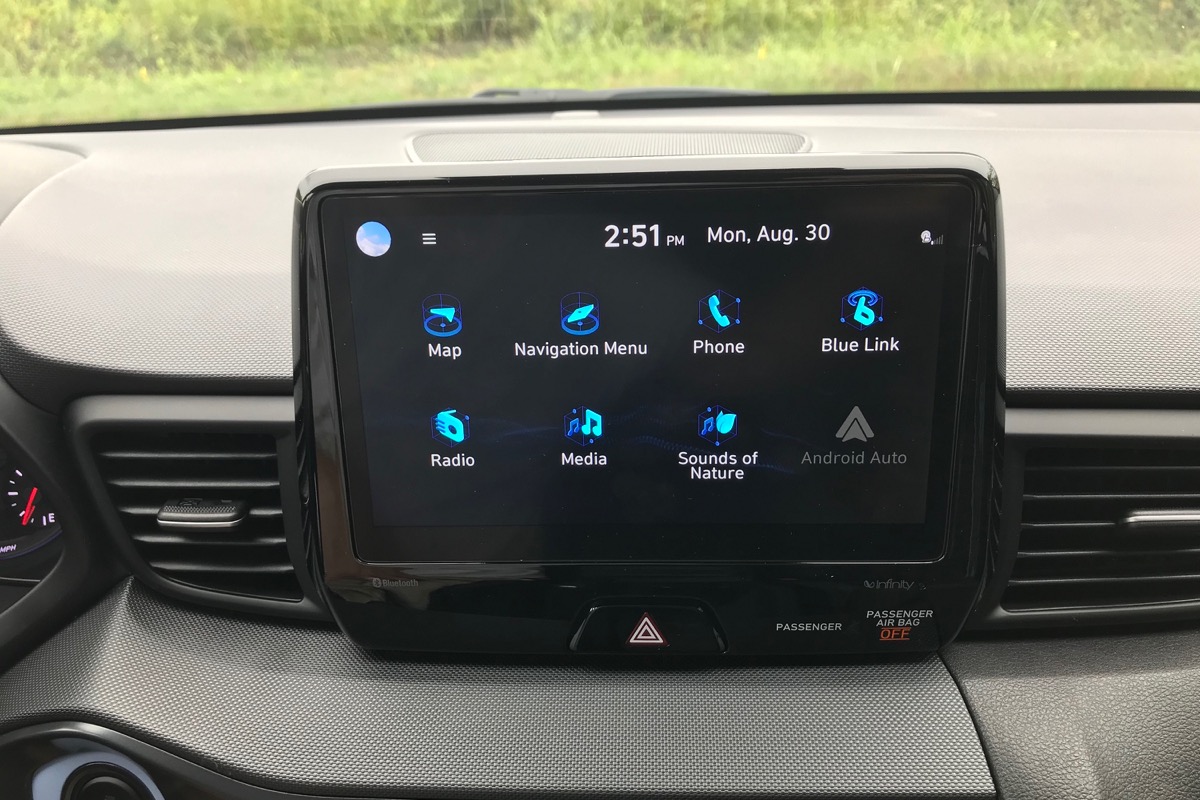
Make no mistake: even with the slick DCT and its various N shift modes, overall, the 2022 Hyundai Veloster N isn't a technical tour de force. Absent are things like adaptive cruise control, a WiFi hotspot, and a surround-view camera system. It offers minimal advanced driving assistance systems, and its infotainment system is nothing to get excited about, looking and operating similar to the ones in most other Hyundai models. It does, however, cover the basics.
Standard features include an 8-inch touchscreen with navigation, Bluetooth smartphone integration with voice recognition, Apple CarPlay and Android Auto, and three USB chargers. Standard audio is an Infiniti eight-speaker system (including subwoofer) with SiriusXM satellite radio, HD Radio, and an auxiliary input jack. While the system provides decent sound, it's a clear step down from the premium Bose 12-speaker system found in other Hyundai models.
While the tech level in the Veloster N isn't awe-inspiring, everything functions as a cohesive unit. Pairing a smartphone is quick and easy, charting a route using the navigation system is painless, and Apple CarPlay integration works seamlessly. Also, accessing all the different bits of tech is made simple by redundant controls, many of which are available on the steering wheel.
Safety
What was previously a competitive disadvantage for the Veloster N was addressed by Hyundai for the 2021 model year by the automaker making standard a handful of safety-related advanced driving assistance systems. These include forward-collision warning, lane-following assist, lane-keep assist, driver attention warning, blind-spot monitoring, and rear cross-traffic alert. While this is a welcome development, it merely brings the Veloster N up to where it should have already been. And since the car is carryover for 2022 with no new safety equipment, the Veloster N, should it live to see the 2023 model year, will need to up its game in this department.
While neither the National Highway Traffic Safety Administration (NHTSA) nor the Insurance Institute for Highway Safety (IIHS) has tested the 2022 Hyundai Veloster N for crashworthiness, the IIHS gave the structurally similar 2021 Veloster N "Good" ratings in all its individual crash tests, including driver and front-passenger small overlap, moderate overlap front, side, roof strength, and head restraints and seats.
In terms of crash avoidance and mitigation, the IIHS gave the 2021 Veloster N an "Acceptable" rating for its headlights and a highest-possible "Superior" rating for vehicle-to-vehicle front crash prevention. The Veloster N received a middling "Advanced" rating for vehicle-to-pedestrian front crash prevention.
During our time with the Veloster N, none of the electronic nannies sounded any false alarms. Of course, with so few alarms present in the first place, the chances of any of them interfering with our drive were slim to begin with.
Cost-effectiveness
The 2022 Hyundai Veloster N has a base MSRP of $33,525, including the mandatory $1,025 destination charge. While Hyundai offers a small handful of extra-cost accessories for the Veloster N, the only option on our test car was the eight-speed DCT, which added $1,500 to the bottom line. The total price of our test car came to $35,025. This compares favorably to the Honda Civic Type R, which retails for $38,910.
According to the Environmental Protection Agency (EPA), the 2022 Hyundai Veloster N is rated to return 22 mpg in combined driving. Compared to its main competitors, these figures are about average. The test car returned an impressive 23.9 mpg during a week of testing. With its 13.2-gallon fuel tank, this result translates into a maximum driving range of 315 miles.
Beyond accessible pricing and above-average fuel economy, one of the major benefits of buying any new Hyundai vehicle is its outstanding warranty. This is a true competitive advantage for Hyundai as the automaker equips every new Veloster N with a five-year/60,000-mile bumper-to-bumper warranty, 10-year/100,000-mile powertrain coverage, seven-year/unlimited miles anti-perforation (corrosion) warranty, and three years/36,000 miles free maintenance.
In addition to providing excellent warranty coverage, Hyundai models perform exceptionally well in terms of quality and dependability as measured by J.D. Power and other groups, which only further enhances their appeal.
What owners say
It’s a great fresh or restart to driving manual! It grips the turns and the exhaust is REALLY nice for a hatchback. Would highly recommend if you’re new to the manual transmission life!
February 20, 2023Trims & specs
Base MSRP $32,500 | Seating 4 |
Engine 2.0L 275 hp I4 | Cargo Capacity 19.9 cu ft |
Combined MPG 25 | Drivetrain FWD |