2022 Ford Bronco Raptor Reviews, Pricing & Specs



Pros & cons
What we like
Fun to drive
Powerful engine
Stylish design
What to consider
Noisy
Poor visibility
The CarGurus verdict
The Ford Bronco Raptor has the extreme capabilities to match its price.
The 2022 Ford Bronco Raptor is the most off-road-capable vehicle you can buy direct from a dealership. Its combination of technology, power, and smart engineering also make it easy to live with when you’re just getting through life. This kind of excellence on both ends of the spectrum is rare and also rather costly.
out of 10 expert review
Look & feel
The Ford Bronco is already one of the most aggressively utilitarian vehicles available today. The new Bronco Raptor demonstrates how far engineers can go to define the word “unstoppable.” Their inspiration comes from the emerging Ultra4 Racing series that combines high-speed Baja-style desert runs with low-speed rock crawling over seemingly impassable boulders.
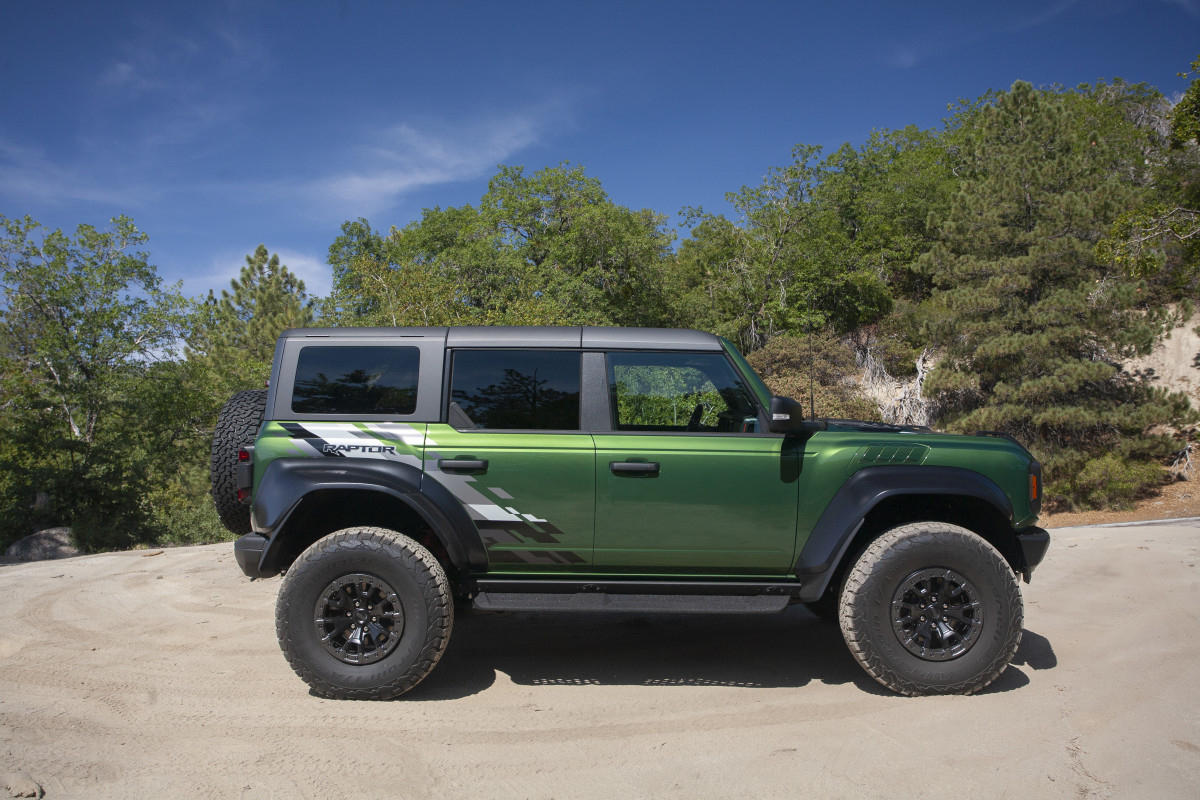
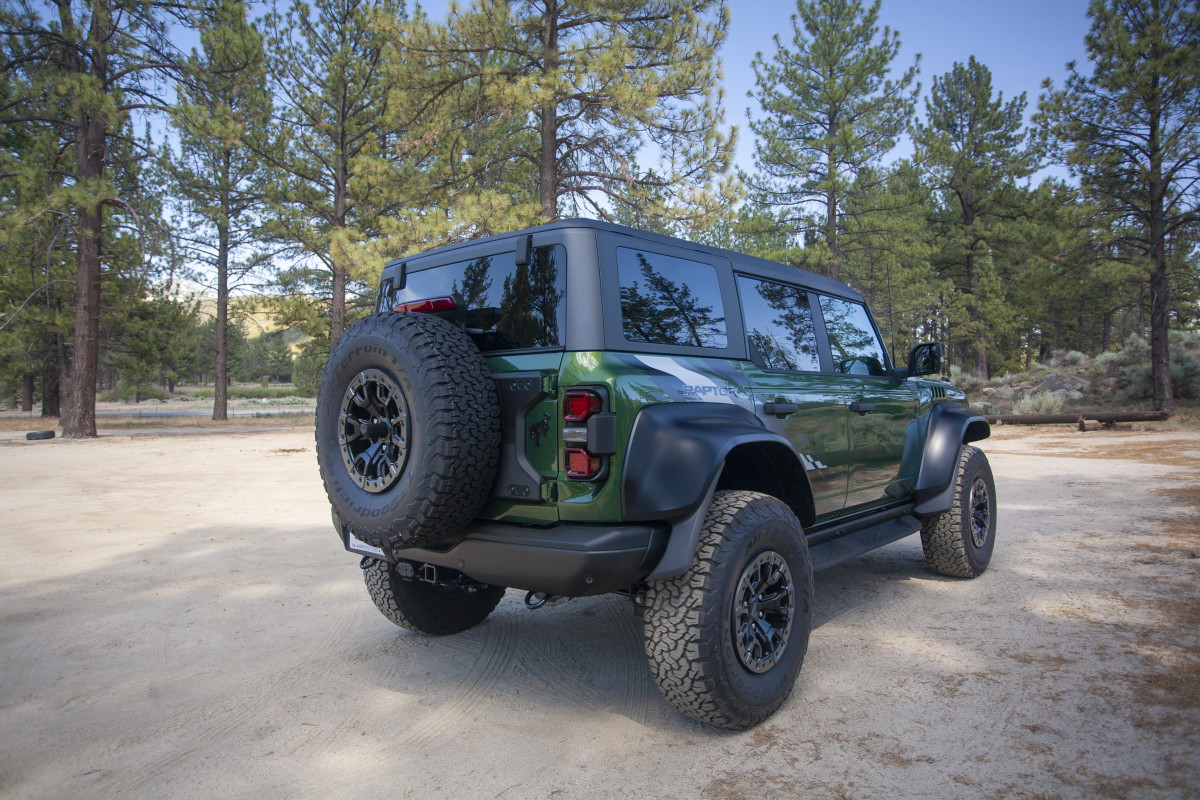
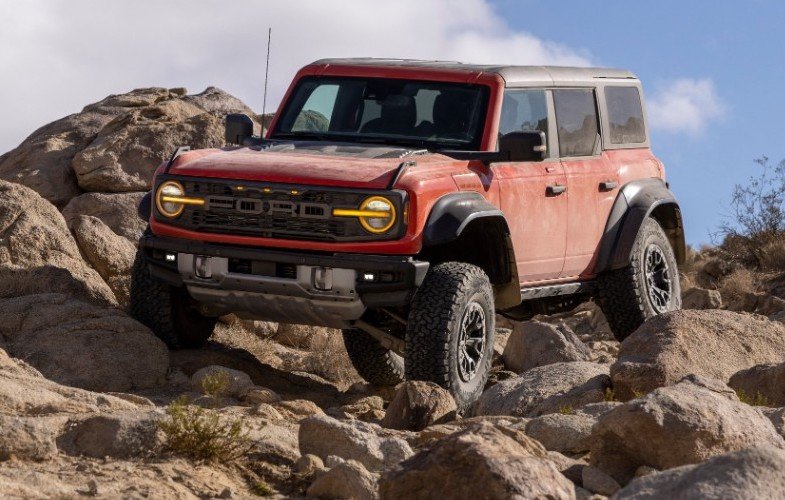
The result is a Bronco that appears as though it's been bulking up for a brawl. It stands proudly on massive 37-inch BFGoodrich K02 beadlock all-terrain tires that are also pushed outward for a wider stance. The Bronco Raptor is 9.8 inches wider than the standard Bronco, and its black fender flares accentuate the increased presence. If the 37-inch tires and big fenders are not enough, the functional heat extractors on the hood and front fenders further the aggression with shark-like gills.
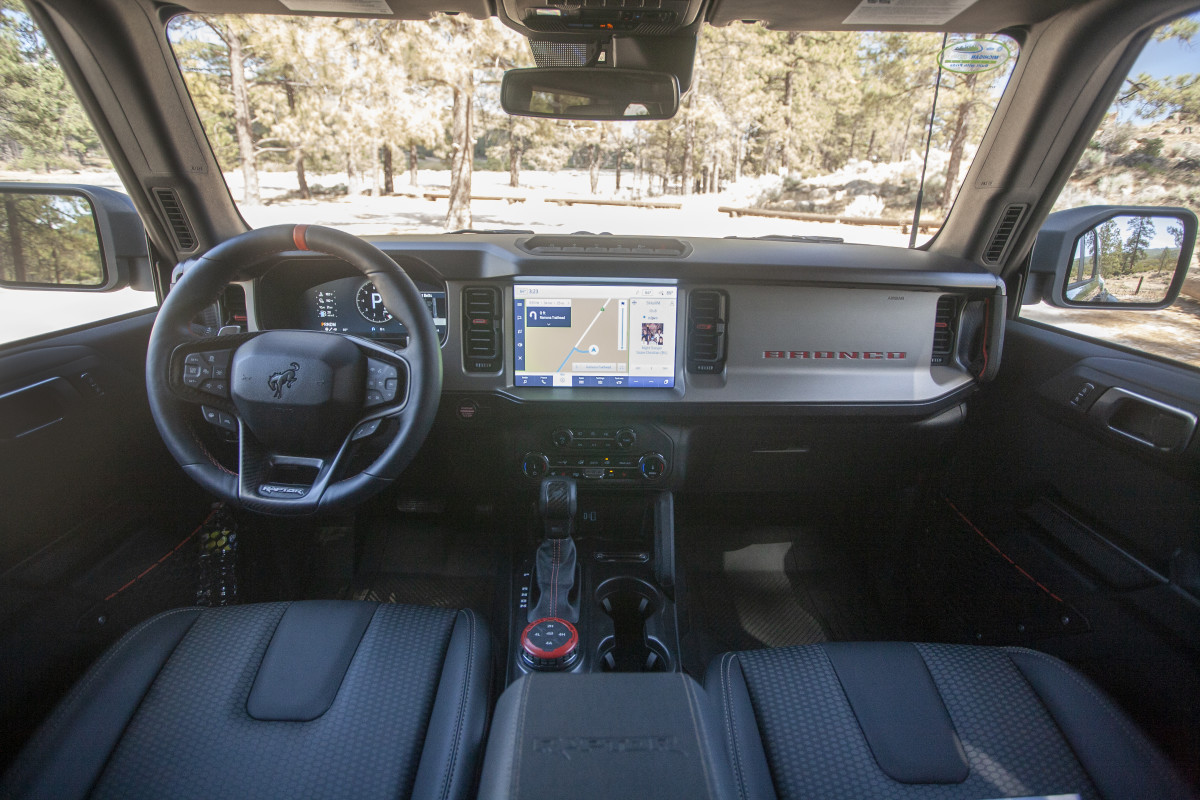
Ford handles the Bronco Raptor’s interior changes more subtlety with a splash of Ford Performance Orange accents and carbon fiber elements dotting the cabin. Otherwise, it’s very similar to the supporting Bronco with its upright retro-themed styling and utilitarian roots. Most switches and buttons are rubberized and sealed, and the upholstery features marine-grade vinyl so you can hose out the interior after a day of kicking up dust; just let the muck flow from the drain in the floor.
The Raptor variant also maintains the Bronco’s extraordinary modularity. Owners can choose to go with either a fabric top or a hard top with removable panels to enjoy varying levels of open-air adventures. Many panels, accessory rails, and grab handles can also be customized to fit your particular needs, too.
Altogether, the 2022 Ford Bronco Raptor has the ominous demeanor to match its all-conquering attitude and capabilities. It has a sturdy build quality that instills confidence with an unbreakable aura.
Performance
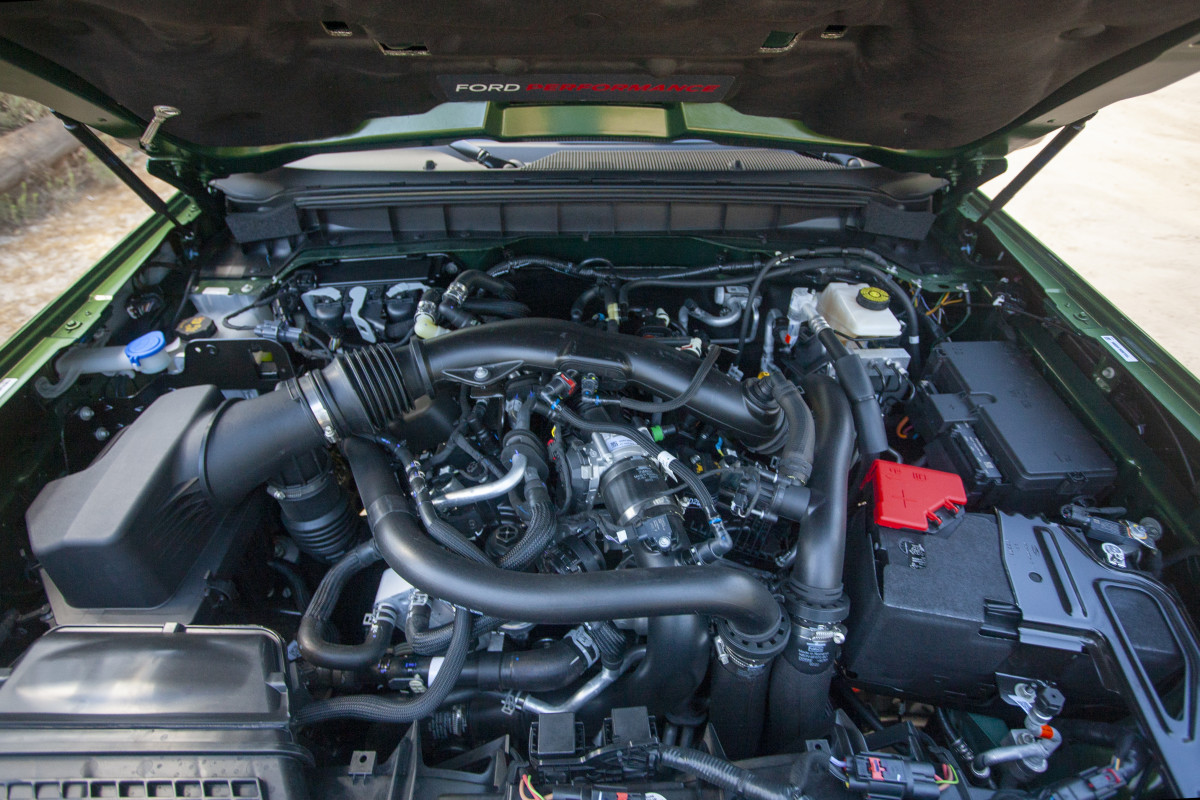
The Bronco Raptor is powered by a twin-turbo 3.0-liter V6 engine that produces 418 horsepower and 440 pound-feet of torque. That’s a commendable increase from the “regular” Bronco’s 330 hp and 415 lb-ft of torque. All that power is routed through a 10-speed automatic transmission and two-speed transfer case, and this driveline gets all 5,731 pounds of Bronco Raptor moving with urgency when called upon. Four-wheel drive is standard, naturally.
Power is only a part of the equation, as the chassis and suspension needed significant upgrades to endure the punishment the Bronco Raptor is intended for. Additional frame reinforcements increase rigidity, and suspension components have been strengthened for severe duty use. The specially developed Fox racing shocks with live valve technology are a critical component and deliver the right amount of compliance or stiffness when needed. Wheel travel is also the name of the game here, and the Bronco Raptor has 13 inches of travel up front and 14 inches in the rear. Compared to the standard Bronco, that’s an increase of 60 percent and 40 percent, respectively.
We put the Bronco Raptor through its paces in the Johnson Valley OHV Area, where California’s King of the Hammers race is held. Since the Raptor was built with this race in mind, it comes as no surprise that it conquered every obstacle placed in its way. On a particularly challenging section (where we wouldn’t even consider crossing on foot), this ultimate Bronco slowly and steadily climbed large boulders with the help of external spotters. Our path through the rock garden demonstrated the vehicle’s impressive approach angle of 47.2 degrees, breakover angle of 30.8 degrees, and departure angle of 40.5 degrees. Ground clearance measures 13.1 inches. Skid plates grace the Bronco Raptor’s belly, but we navigated through with no more than a minor underbody scrape.
We also explored the Bronco Raptor’s high-speed desert racing abilities on a variety of surfaces. Washboard roads that would cause a typical family SUV to shake itself to pieces were effortlessly smoothed over by the suspension and tires. Larger undulations were dispatched with similar ease. Ford even gave us the OK to launch the vehicle airborne at 60 mph.
This level of off-road prowess usually results in poor on-road manners, but that’s not the case with the Bronco Raptor. The steering has a better on-center feel than a Jeep Wrangler. The ride isn’t as bouncy as a Wrangler’s, either. Of course, it can’t completely mask its size or weight, but the big SUV feels much more confident on a twisting mountain pass than we expected.
Ascending the mountains and descending the other side using engine braking did reveal the engine’s tendency to drone at sustained higher revs, which gets annoying after time. There is also a noticeable amount of wind noise at highway speeds, but we’re pleased to note the absence of tire howl, which is impressive considering how deep and blocky the treads are. In our estimation, there’s simply no vehicle you can buy today to drive off-road at this level without heavy modification. Even more astounding is how the Bronco Raptor is also enjoyable to drive on pavement.
Form & function
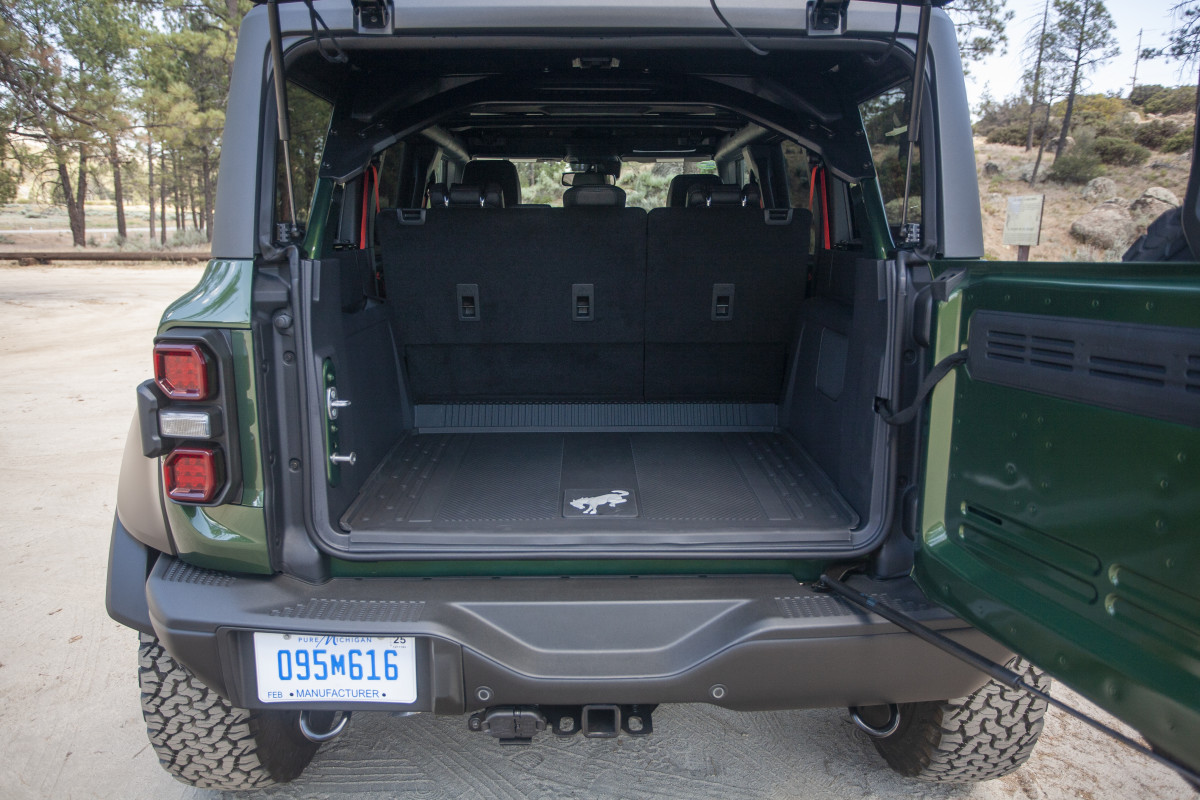
The Bronco’s boxy shape pays huge dividends when it comes to interior space. Both front and rear seats provide an abundance of headroom and legroom, as well as lateral space to give the cabin an even more airy environment. Behind the rear seats, the Bronco Raptor provides a very accommodating cargo area measuring up to 37.1 cubic feet. With those seats folded, the cargo capacity balloons to 73 cubic feet , but those seats don’t fold flat with the cargo floor. The step-up from the floor to the seatbacks means it will be a bit more difficult to load longer and heavier objects. For the overland campers reading, it also means that sleeping in the back of a Bronco Raptor will be uncomfortable if not impossible.
For smaller personal items, there are plenty of storage options. A large center armrest bin and cupholders can hold a lot, while a rubberized tray keeps your phone in place. The netted door pouches can hold a few water bottles and can easily be swapped for a variety of aftermarket solutions. You also can remove the doors with a single bolt for each, and they can be stowed in the cargo area for truly wide-open exploring.
The Bronco’s modularity is also a big benefit on the outside, with several hard points where you can add roof racks and light bars. Clever cleats above the headlights can also be used to secure loads or limb-lifter cables to push foliage out of the way. The giant full-sized spare tire on the rear hatch is certainly reassuring when tacking treacherous terrain, but it does block a lot of the rearward view. Thankfully, the vehicle’s many camera views eliminate any guesswork when maneuvering in tight spaces.
Technology
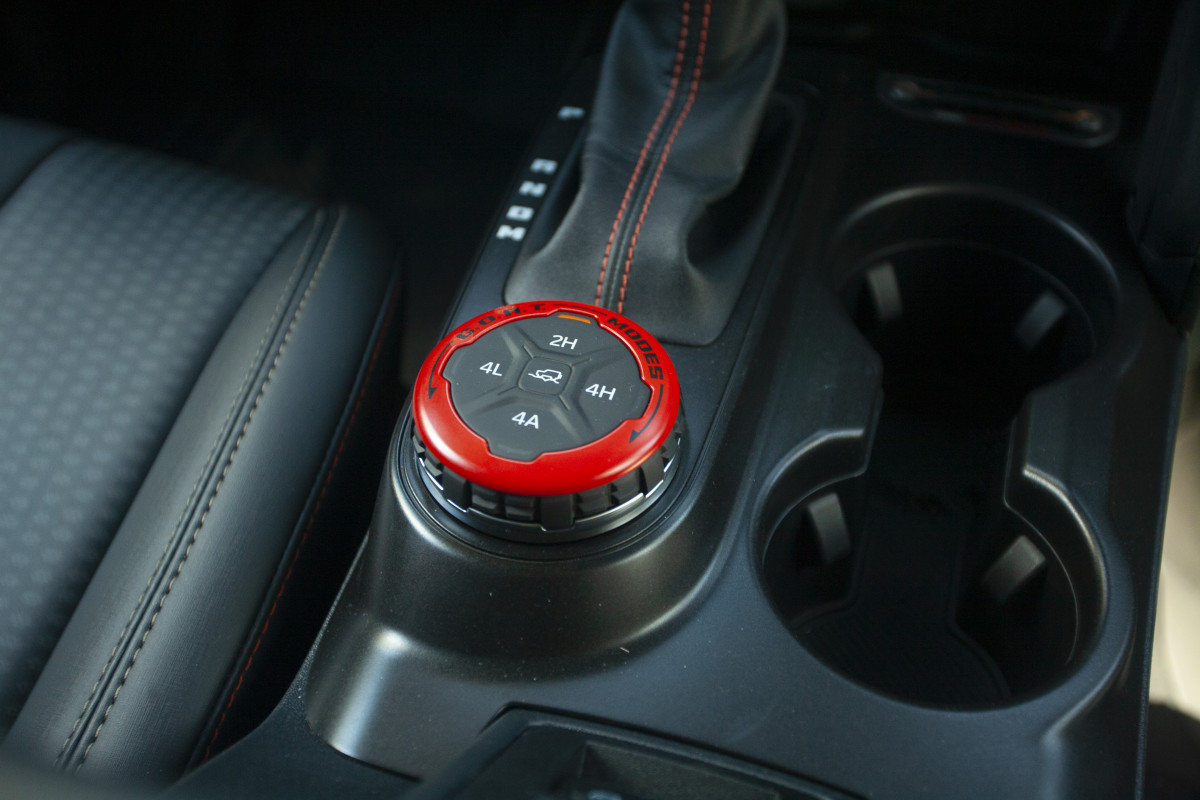
Historically, serious off-roaders have shunned many technology features, favoring mechanical know-how and seat-of-the-pants driving. By contrast, the Bronco Raptor embraces tech, although a lot of it goes blissfully unnoticed. The G.O.A.T. Mode (for “goes over any terrain”) selector on the center console optimizes myriad systems to adapt to any particular condition; from on-road driving, to traversing sand and snow and for the Raptor model, a special Baja mode for bombing through the desert at high speeds. It’s a great shortcut for those who may not know which transfer case or suspension setting may be appropriate. There’s also a shortcut button on the steering wheel to activate your personal preference.
Other features include a Trail Turn Assist system that applies the brakes to an inside wheel during a turn; by braking that wheel, it renders it as a pivot point of sorts, allowing the Bronco to make sharper turns on a narrow trail. There’s also a Tow/Haul drive mode that allows the vehicle to pull up to its 4,500-pound trailer capacity. The most useful tech feature in our off-road excursions, however, was the front-facing trail camera, which greatly increased our confidence when navigating past obstacles.
The Bronco’s tall upright grille keeps you from seeing what’s directly in front, but that camera removes all doubt. The view also superimposes a track overlay to tell you where your tires will end up, making it nearly foolproof to avoid a sharp obstacle or to place a wheel precisely in a spot to climb over a big rock.
Regarding more common tech features, the Bronco Raptor continues to check the boxes. The Sync 4 infotainment system has intuitive menus and quick responses. Apple CarPlay and Android Auto both operate wirelessly, and an integrated charging pad is available as an option.
Safety
The Bronco comes standard with Ford’s Co-Pilot 360 suite of safety features that include frontal collision warning with automatic emergency braking, a blind-spot monitor with rear cross-traffic alert, lane-keep assist, and automatic high beams. A surround-view camera system and front parking sensors are also included. Adaptive cruise control and evasive steering assist are optional.
The Bronco Raptor has not yet been evaluated by the National Highway Traffic Safety Administration (NHTSA), but testing conducted on the related standard four-door Bronco resulted in a four-out-of-five-star rating for frontal crash protection and three stars for rollover protection. The Insurance Institute for Highway Safety (IIHS) awarded the standard Bronco its best score of “Good” in frontal, side, and roof-strength tests. The Bronco received the second-highest score of “Acceptable” for head restraints and seats.
Cost-effectiveness
With a starting price of $70,095 (including destination charges) the 2022 Ford Bronco Raptor is not cheap. Hardcore off-roaders will have an easier time with that price, knowing how capable it is and how much it would likely cost to have all of those enhancements added and alterations performed by an aftermarket company. The most accomplished non-Raptor Bronco is the Wildtrak model with the included Sasquatch package, which starts at $51,375. A well-optioned Jeep Wrangler Rubicon will reach $55,000, but neither the Bronco Wildtrack nor the Rubicon can compete with the Raptor near its operational limits.
That prohibitive price pushes the Bronco Raptor into territory occupied by the more luxurious Land Rover Defender. That said, with the appropriate off-road options added, that price will flirt with $75,000 and it still won’t be as all-terrain capable. Fuel economy is downright terrible: the EPA estimates the Bronco Raptor will return 15 mpg in city driving, 16 mpg on the highway and 15 mpg in combined driving. That’s 2 mpg less than the Bronco Wildtrack and 4 to 5 mpg less than the six-cylinder Jeep Wrangler Rubicon and Land Rover Defender.
Even at the rather exorbitant price and with the thirsty engine, the 2022 Ford Bronco Raptor justifies its cost. In the end, you’ll get the industry’s most capable off-roader direct from the factory. That up-front money pays for the research, parts upgrades, and just as important, a warranty that covers all of that the above.
What owners say
A lot of people said it has poor visibility. I disagree. I’m 6’2” and I could not find a blind spot. The jeep grand Cherokee (new model) has a ton of visibility issues. The only “slight” blind spot is in the rear view mirror area. Still not terrible. And what this Bronco is capable of, man! Very comfortable.
March 27, 2026Trims & specs
Base MSRP $79,995 | Seating 5 |
Engine 3.0L 418 hp V6 | Cargo Capacity 33.4 cu ft |
Combined MPG 15 | Drivetrain 4X4 |


