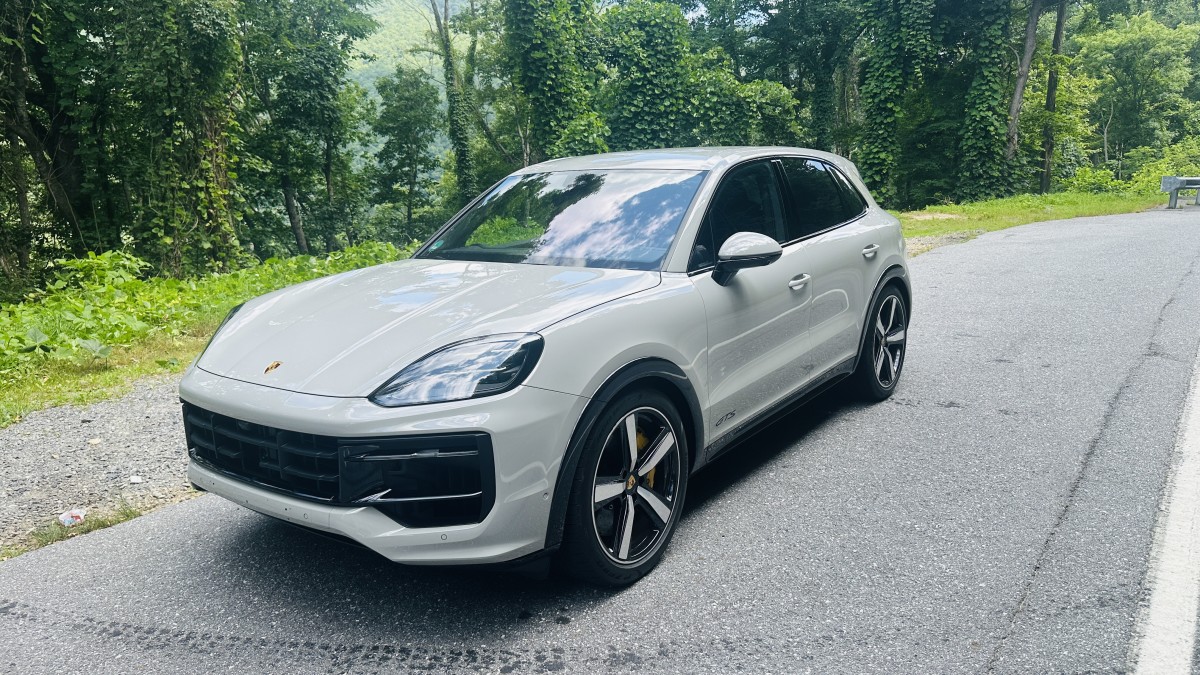
2021 Porsche Cayenne Coupe Reviews, Pricing & Specs


Pros & cons
What we like
Stylish design
Great handling
Fun to drive
What to consider
Poor value for money
Poor visibility
Poor fuel economy
The CarGurus verdict
New for 2021, the Porsche Cayenne GTS Coupe adds V8 power, improved handling, and unique design in an unexpectedly practical package.
There are two kinds of Porsche buyers. The first group buys them because they’re Porsches. So does the second group. The difference between the two is that the first group buys Porsches because of the emblems glittering on the bodywork, while the second group buys Porsches for what the wizards in Weissach devise for use under the bodywork. The new 2021 Porsche Cayenne Coupe GTS is for that second group of buyers.
out of 10 expert review
Look & feel
Employing the same recipe as other luxury automakers building SUV coupes, the 2021 Porsche Cayenne Coupe has a faster roofline, reduced cargo space, and less room for passengers. Yet, it costs more money, in the way anything considered to be more stylish typically does.
For the 2021 model year, there are six different Cayenne Coupe models, each with a specific powertrain. The standard Cayenne has a turbocharged V6, the Cayenne S Coupe gets a twin-turbo V6, and the Cayenne GTS and Turbo Coupes use twin-turbo V8 engines in different states of tune. Two hybrids are also available. The Cayenne E-Hybrid builds on the Cayenne’s engine and specification, while the Turbo S E-Hybrid is based on the Turbo.
Prices range from nearly $80,000 to almost $170,000, and that’s before adding any options.
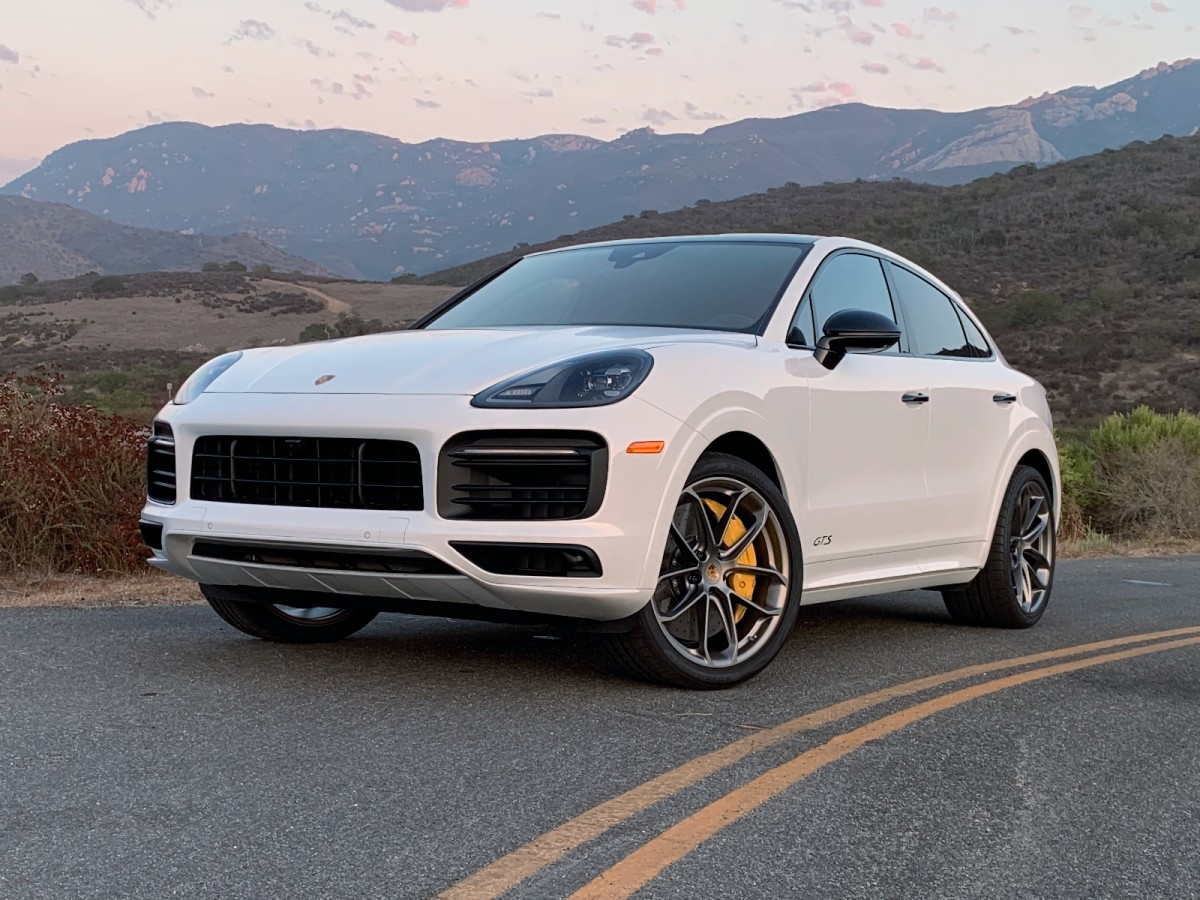
Our test vehicle came in new-for-2021 GTS specification, which splits the difference between the Cayenne S Coupe and Cayenne Turbo. The combination of a 453-horsepower twin-turbocharged V8 engine, dual-mode sports exhaust system, and adaptive damping suspension with a Sport Design exterior package, black 21-inch wheels, and black exterior accents is compelling, and it gives Cayenne shoppers more performance without paying a maximum premium.
Arriving ready to romp, our test Cayenne had the Lightweight Sport Package, Porsche Ceramic Composite Brakes (PCCB), Porsche Dynamic Chassis Control (PDCC), rear-axle steering, adaptive sports seats with memory, and several other options. The price tag came to $148,150, including a $1,350 destination charge. In other words, it had $36,950 in options.
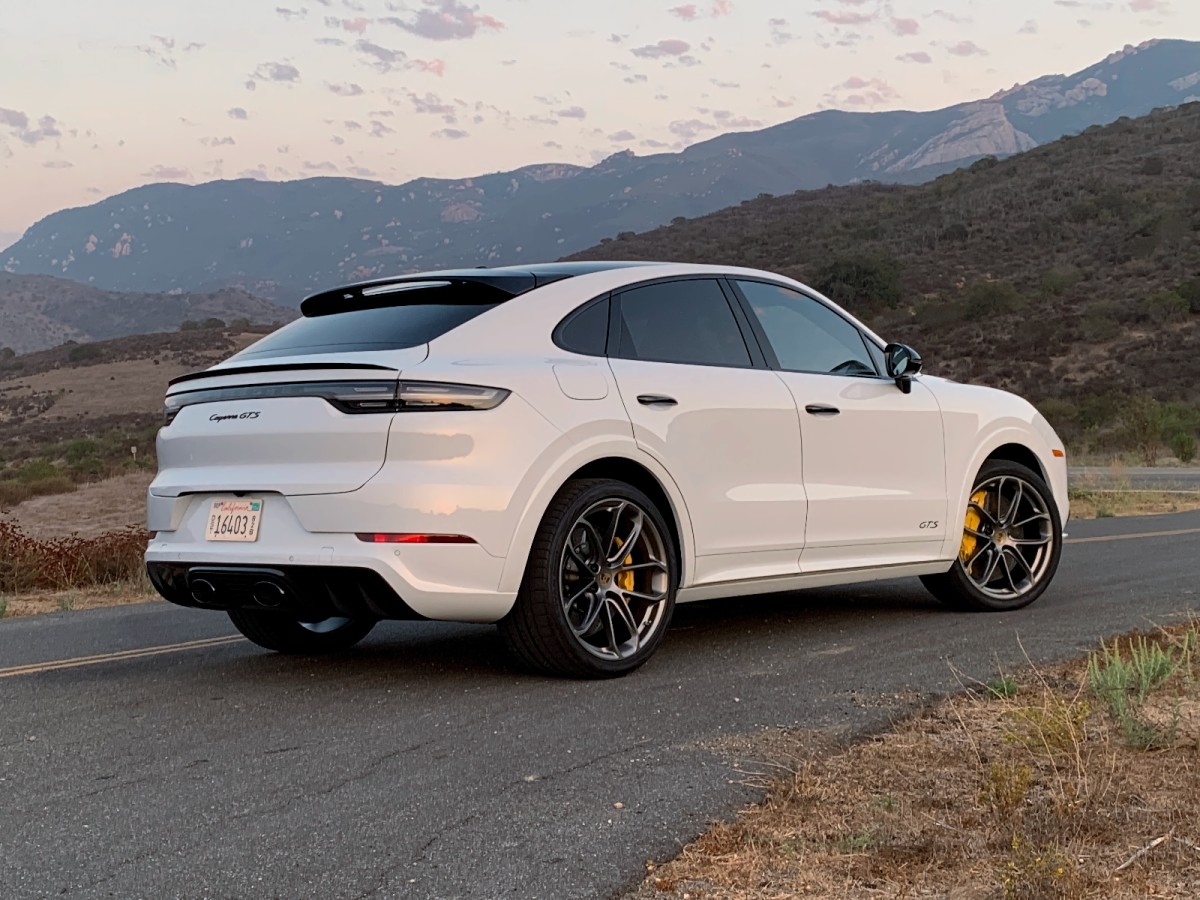
Once ridiculed but now increasingly accepted, the SUV coupe segment is apparently here to stay. Among contenders in this class, the Porsche Cayenne Coupe looks especially appealing, even if it's not quite as distinctive on the road as the company’s sports cars. Our test vehicle’s Carrara White Metallic paint offered sharp contrast against the gloss black trim, 22-inch thin-spoke GT Design wheels, and massive yellow brake calipers.
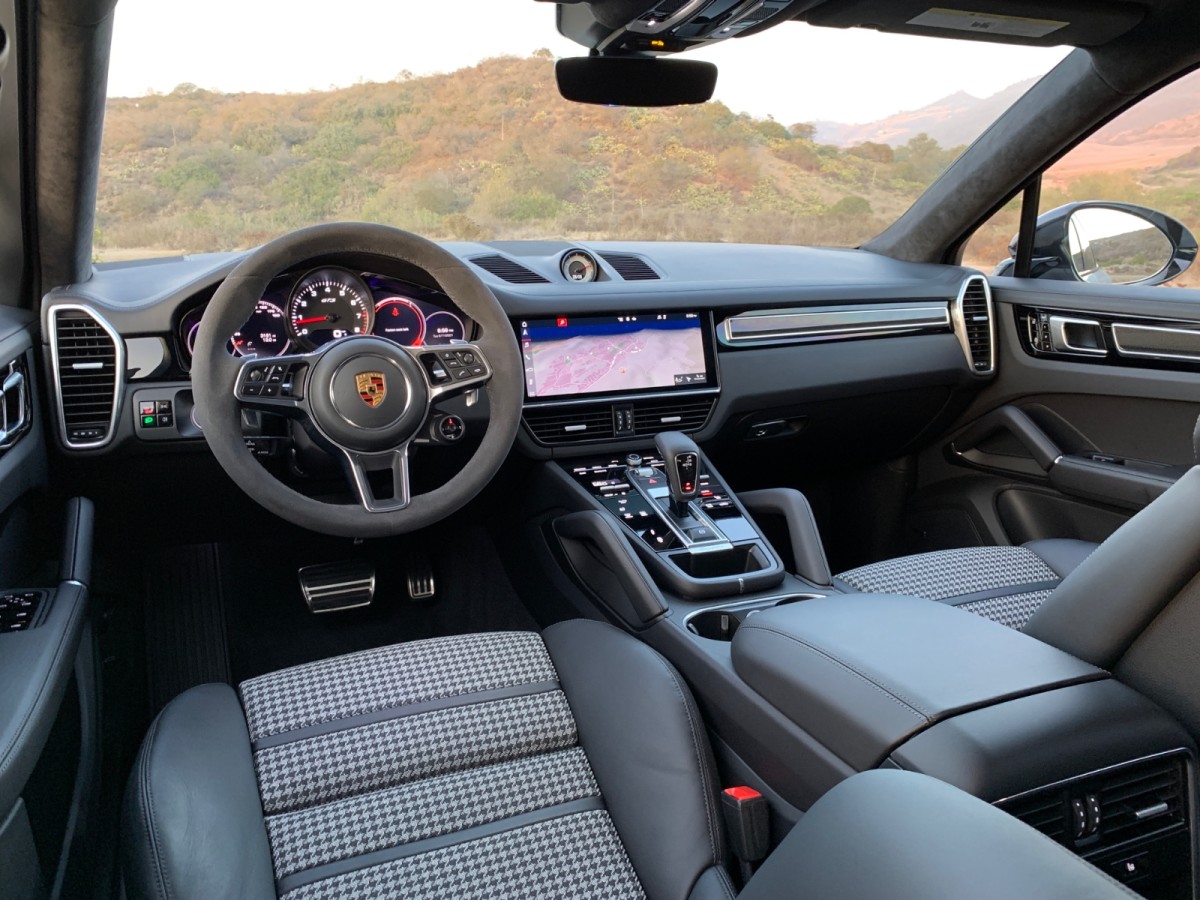
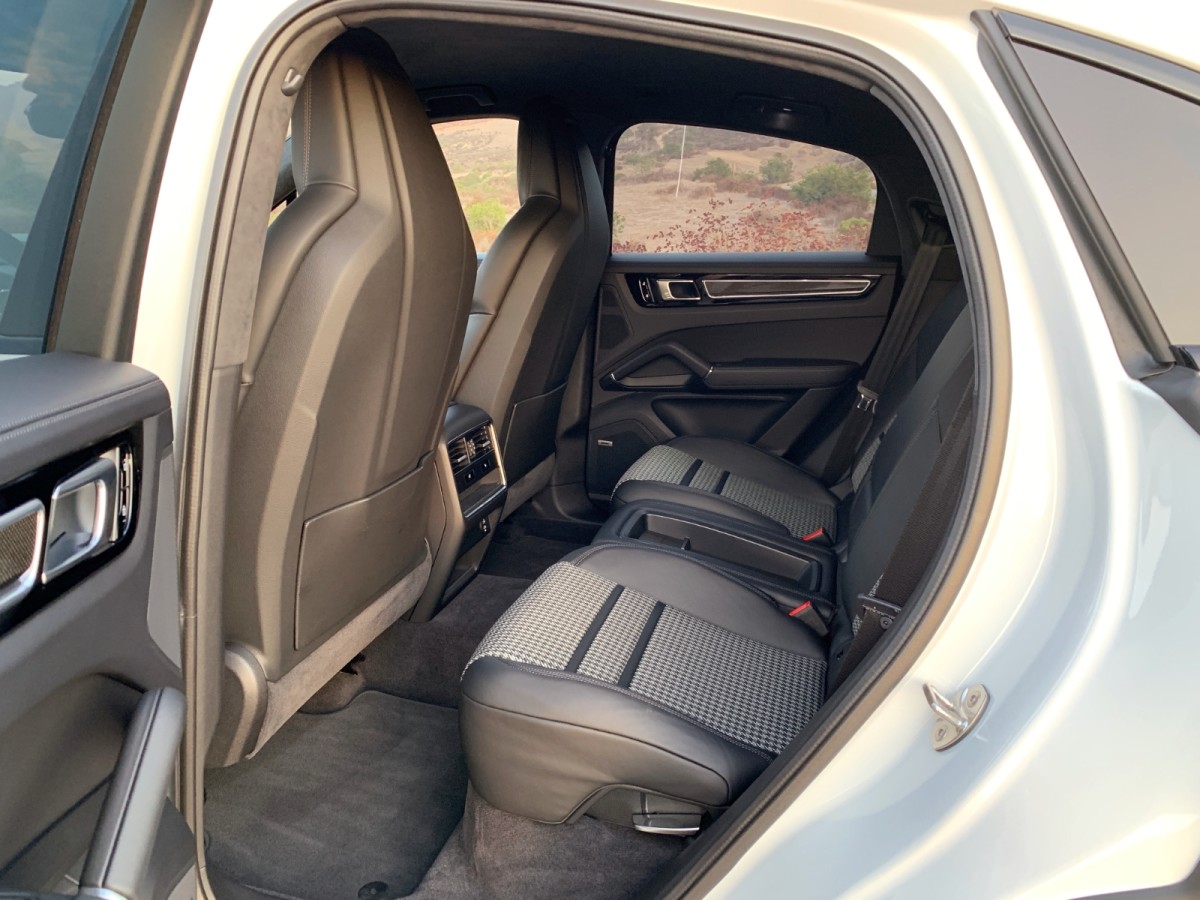
Inside, our Cayenne featured black and white Houndstooth cloth seat inserts with black leather bolsters, a sensational combination that makes the cabin look and feel even more special than it already does. The Cayenne has a simple, no-nonsense dashboard topped with a Sport Chrono stopwatch, and purposeful grab handles that are more helpful to the front passenger than to the driver on both front doors and each side of the center console.
Drivers face five classic round gauges in Porsche’s layered layout, and they’re digital except for the large analog tachometer in the middle. The center console is home to an electronic shifter and a mixture of physical and touch-sensing controls for the infotainment and climate systems, all angled more toward the roof of the SUV than they are towards the driver. The quality of the materials is excellent, though the test vehicle’s left driver’s door panel creaked when pushing the door open or bracing a leg against it.
Overall, our Cayenne GTS Coupe looked good and conveyed the right amount of attitude without being obnoxious.
Of course, if you prefer to drive something that grabs more attention, Porsche is happy to oblige with a wide range of paint, wheel, interior color, and interior trim choices. And you can always use the handy knob on the steering wheel to change into Sport Plus mode, rouse the dual-mode sport exhaust system, and cause everyone within earshot to presume that you’re compensating for a shortcoming or insecurity of some kind.
Performance
Let’s qualify that dig at the people who take something like the Cayenne GTS Coupe, activate Sport Plus mode, and then mash the accelerator down in densely populated areas in order to prove, ummm, what exactly?
If you take your new Porsche Cayenne GTS Coupe to a weekend autocross event or a track, or you’re out in the middle of nowhere on a road you know better than the lines on your face, this SUV’s intoxicating exhaust note is immensely pleasurable to a driving enthusiast. Employ this tactic anywhere else, and, well, you’ll spark irritation in almost everyone within earshot.
To paraphrase Mandy Patinkin’s Inigo Montoya character in The Princess Bride: “You keep making loud exhaust sounds in populated areas. I do not think people are impressed the way you think they are impressed.”
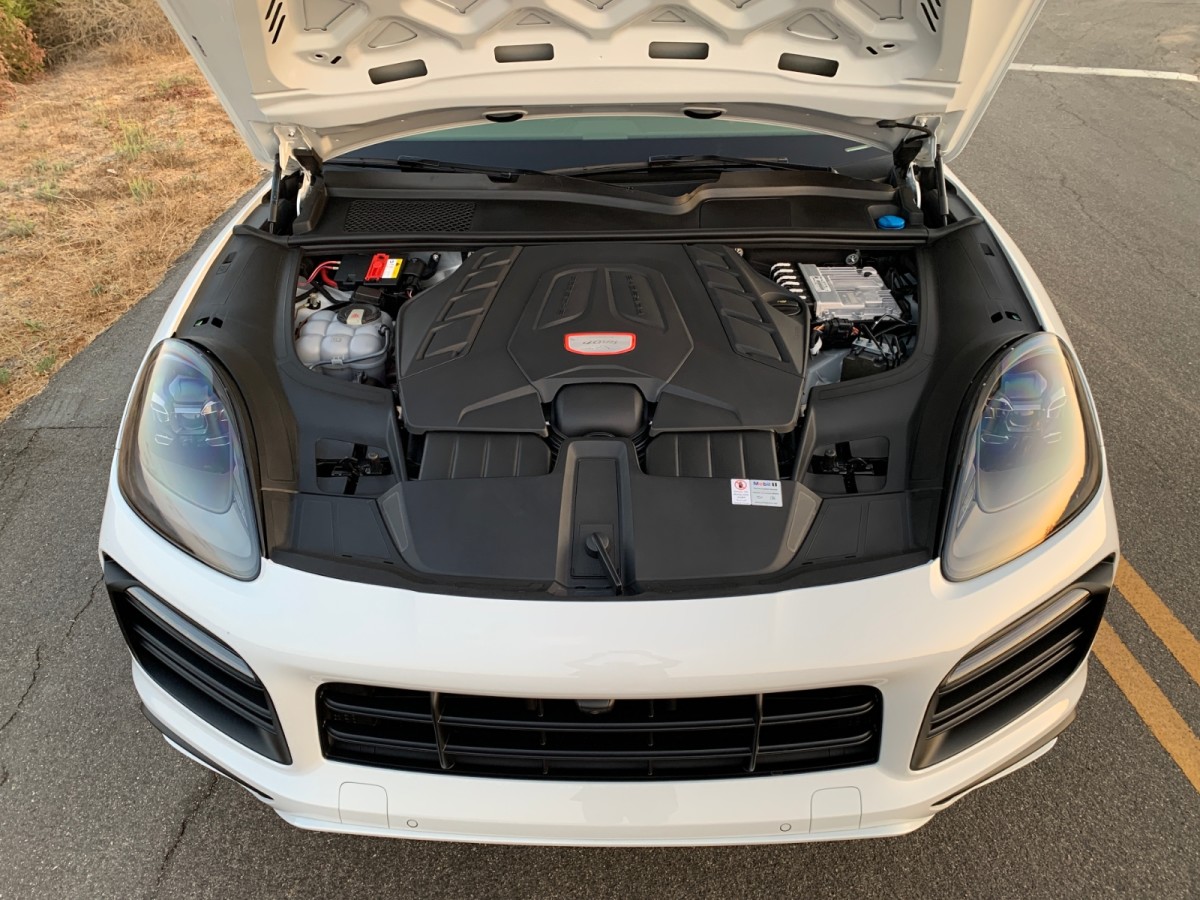
Moving on, the new 2021 Cayenne GTS Coupe has a twin-turbocharged 4.0-liter V8 under its low and short hood. Output measures 453 horsepower and 457 lb-ft of torque, and an eight-speed automatic transmission feeds the power to all four of the SUV’s wheels through a standard all-wheel-drive system.
Normal, Sport, Sport Plus, and Individual driving modes are available, accessed using a knob on the steering wheel. There is a Sport Response button in the middle of that knob, which is a quick way of temporarily dialing the Cayenne GTS Coupe to maximum performance when you need it. Additionally, there are settings for specific surfaces such as Gravel, Mud, Sand, and Rocks. Drivers can also raise the suspension for added clearance off-road.
Speaking of suspensions, in addition to a V8 engine, what makes the GTS a GTS is an adaptive air suspension with Porsche Active Suspension Management (PASM) and the sport exhaust system. To this, the test vehicle added the Lightweight Sport Package with a carbon-fiber roof, a carbon fiber rear diffuser panel, gorgeous 22-inch wheels to go along with a 30mm ride height reduction, and sexy center-mounted tailpipes, among other upgrades. Our evaluation car also had optional rear-axle steering. The point of all of this? Less weight, a lower center of gravity, and maximum grip. Good times.
Look at the Cayenne, and it is clearly a Porsche. Open the door and get in, and if you’re familiar with the automaker’s design ethos, you’d easily make the connection without the Porsche crest glittering on the steering wheel. After you twist the ignition switch on the left side of the dashboard, where Porsche traditionally puts this function, the uniquely Porsche experience starts to fade into something else. Why is that? During the daily drive, the Cayenne GTS Coupe smells, feels, and drives like any high-end European performance SUV.
That’s not a bad thing. But if you’ve driven a Porsche 718 or a Porsche 911, the entire experience, from walking up to the car to getting in, twisting the ignition, and setting off, is unlike that of any other vehicle. Once you’re underway, a Porsche sports car continues to deliver a special, undistilled dynamic character through the sound of the powertrain, the feel of the road, the immediacy of response to your input, and, depending on which version you’re driving, the raw fury of its performance.
A Cayenne Coupe isn’t like that. Until you get it out of the city, away from other people, and where you can drive it like you stole it, that is. Switch the Cayenne GTS Coupe into Sport Plus mode, and you’ll even forget that it's an SUV. Porsche claims the GTS Coupe accelerates to 60 mph in 4.2 seconds when using the Performance Start function. That might be accurate. Since we didn’t take it to a drag strip for quarter-mile runs, what we can tell you is that it's ridiculously fast for an SUV with an internal combustion engine.
Not only that, but the adaptive air suspension with PASM and the PDCC virtually eliminates the body roll and lateral motions that often plague even the highest performance sport/utility vehicles. And despite testing the Cayenne GTS Coupe on a hot late summer day in Southern California, the ceramic brakes performed flawlessly—as was expected.
Porsche Torque Vectoring Plus (PTV Plus) is also standard on the GTS, and in combination with rear-axle steering and AWD it clearly contributes to this Cayenne Coupe’s stunningly good real-world power, performance, and handling. During the daily drive, it might be hard to argue its superiority in comparison to a BMW X6 M or Mercedes-AMG GLE Coupe, let alone the corporate-cousin Audi SQ7, but we haven’t experienced this level of sheer, unrelenting competence on the mountain roads near Malibu in any other SUV.
If you’re wondering, the Cayenne GTS Coupe averaged 17.6 mpg on our testing loop, despite our best efforts to burn as much fuel as possible on parts of the route (an increasingly guilty pleasure). That’s better than the official EPA fuel economy rating of 17 mpg.
Also if you’re wondering, no, we didn’t take the Cayenne off-road. Porsche’s SUVs are more capable than you might expect when the pavement ends and the dirt begins, but with the test vehicle’s 22-inch wheels and performance tires, we decided to literally stick to the blacktop.
There is one other thing certainly worth mentioning. The test vehicle had optional thermally insulated and noise insulated glass, and the cabin was nearly silent at freeway speeds and downright chilly when traveling on days experiencing triple-digit temperatures. We recommend the upgrade.
Form & function
Naturally, you expect the coupe version of any luxury SUV to be less utilitarian than the standard version. But the reality is that people rarely pack an SUV full to the roof, so reductions in cargo space due to the fastback rear window aren’t all that impactful.
What can be problematic is the shrinkage of rear passenger room. But that’s not an issue in the Cayenne Coupe. Adults fit just fine in the rear seats, enjoying surprisingly comfortable cushions and plenty of space for legs and feet. However, our test vehicle’s carbon-fiber roof replaces the standard panoramic glass sunroof. Perhaps in standard form, rear headroom is more restrictive than what we experienced.
Drivers and front passengers also enjoy plenty of room in the Cayenne, though taller people may need to duck because of how the windshield pillars bend into the roof. Our test vehicle had 18-way adaptive sports seats, and in addition to looking great, they provided excellent support both for long highway slogs and rapid travel on twisty roads.
The center console control panel design is less than ideal. It uses a mix of touch-sensing haptic feedback buttons and physical controls, and because they’re aimed primarily at the SUV’s roof, they’re often hard to see. They can be hard to use, too, because the electronic transmission shifter is plopped right into the middle of everything. Also, on bright sunny days, the gloss black surface and metallic detailing throw plenty of glare into the driver’s face.
Practical storage is lacking in front, but there is a small bin that can hold a couple of smartphones and the cupholders can accommodate two venti-sized iced coffees, so perhaps we should be grateful for what the Cayenne Coupe does provide. An optional wireless charging pad is located under the center armrest, using up much of the available space in that location.
Power the Cayenne Coupe’s tailgate open, and it reveals a 27.2 cubic foot trunk. Actual usable space is generous, and it doesn’t seem like the body style forces compromise unless you’re hauling something large home from a big-box store. Fold the back seat down to create 60.3 cubic feet of space.
Technology
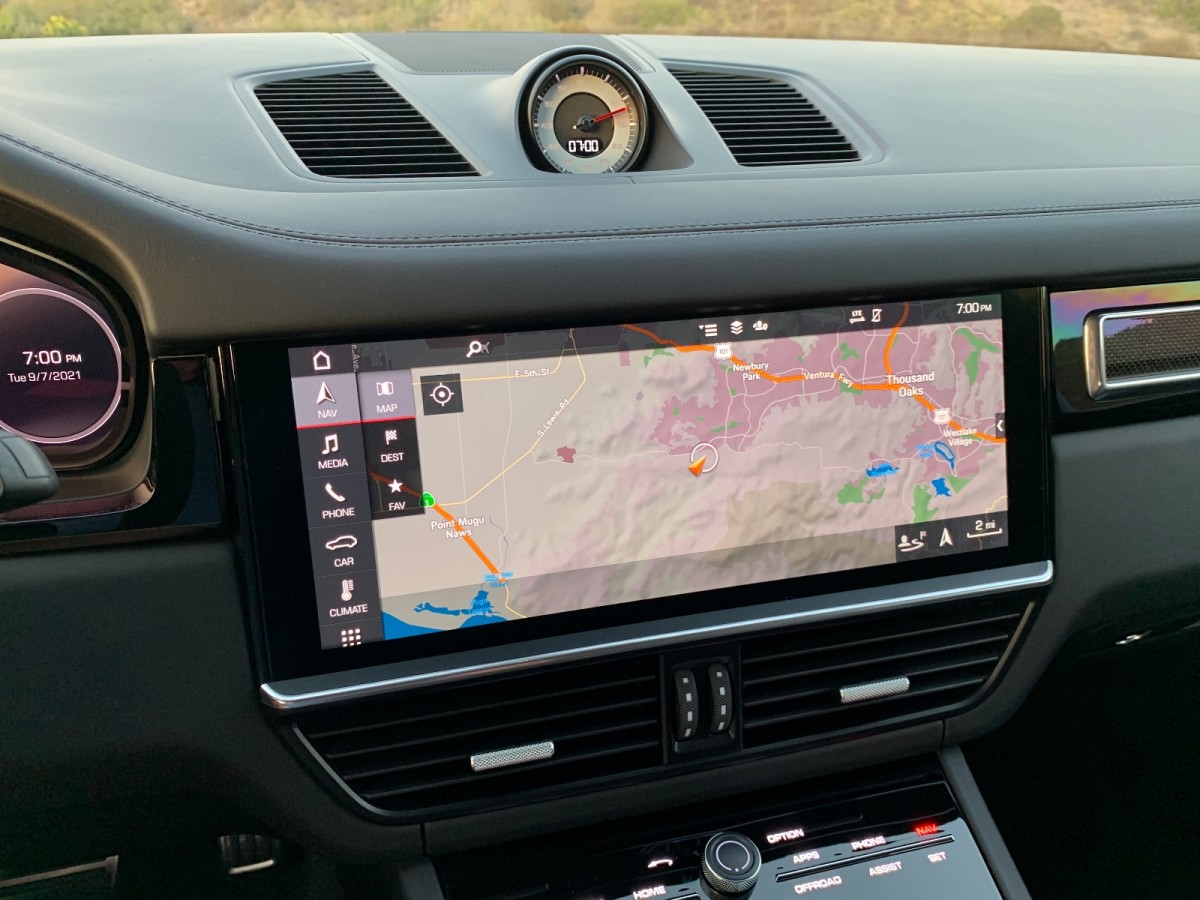
Porsche Advanced Cockpit refers to the Cayenne’s mix of digital and analog instrumentation. A large center tachometer with a digital speedometer is the focal point, as it should be. On either side of it, configurable 7-inch digital displays provide access to plenty of information via the controls on the steering wheel. You can even show the navigation system’s map within the instrumentation instead of on the dashboard’s 12.3-inch center touchscreen.
The touchscreen operates the Porsche Communication Management (PCM) infotainment system. Wireless Apple CarPlay, wired Android Auto, and Porsche Connect Plus connected services are standard, the latter including cloud-based navigation, Voice Pilot natural voice recognition, a WiFi hotspot, and more. A Porsche Connect App provides remote access to the vehicle and data via the owner’s smartphone.
As is true of any technology, PCM requires some acclimation. For example, to activate the excellent Voice Pilot you push a button on the end of the turn signal stalk rather than one on the steering wheel. This actually makes sense because you can activate it without removing your hand from the steering wheel rim. However, you never quite get used to adjusting the stereo volume using the control tucked behind the transmission shifter.
Porsche also equipped our test vehicle with the optional 14-speaker Bose surround sound system. This is the mid-level offering, but it sounds good. Porsche also offers a high-end Burmester 3D surround-sound system with 21 speakers. Undoubtedly, it sounds better.
Safety
Lightly equipped with safety tech, our test vehicle came outfitted for speed instead of cruising on the highways and byways of America. Therefore, it did not have InnoDrive, which is Porsche’s adaptive cruise control, lane-centering assistance, and traffic-jam assistance technology. InnoDrive is part of an Assistance Package that includes a head-up display, a surround-view camera, and Night Vision Assist.
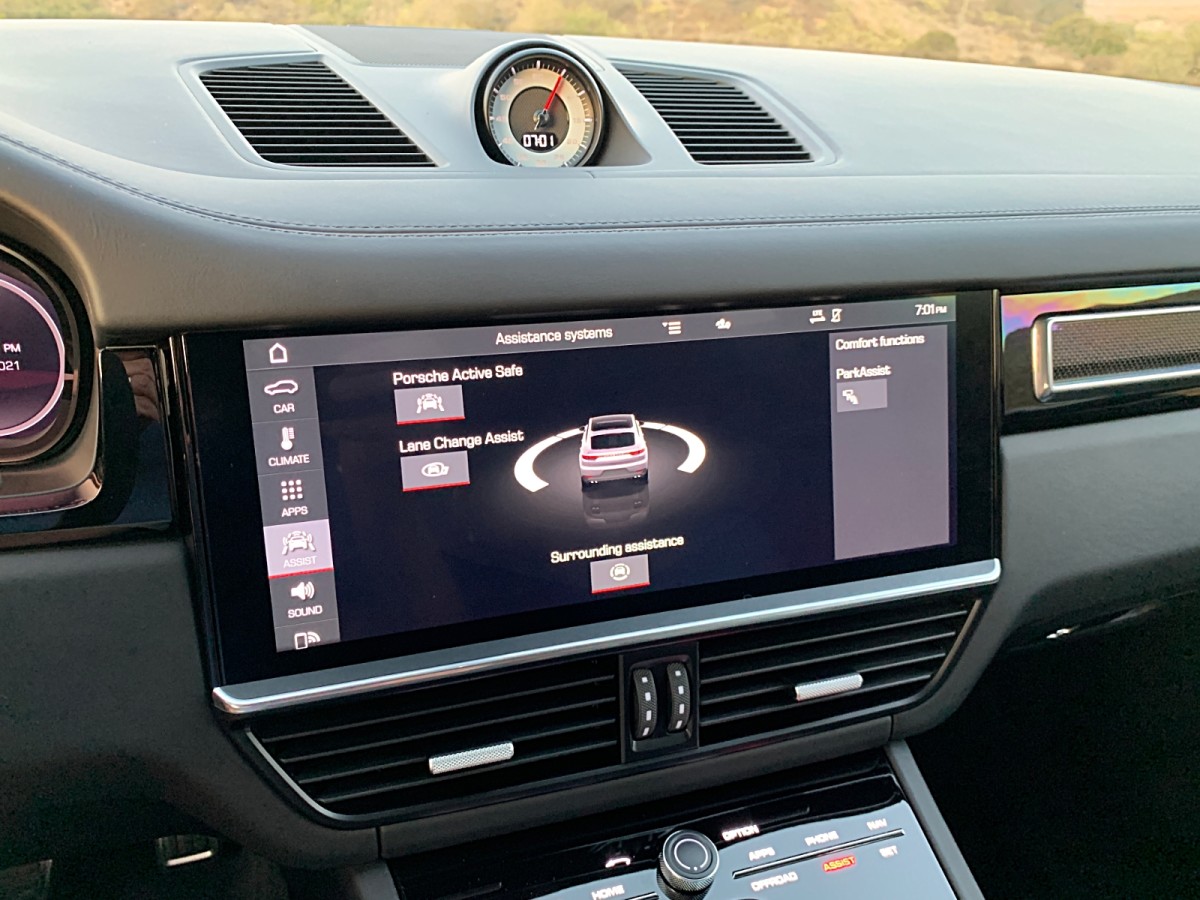
Our Cayenne did have a standard slate of driving aids including forward-collision warning with pedestrian and cyclist detection, automatic emergency braking, lane-departure warning, and lane-keeping assistance. To this, Porsche added lane-change assistance with rear turn assistance and a surround-view camera.
As is true of almost every lane-monitoring technology, the Cayenne’s proved occasionally intrusive or irritating, but not egregiously so. Lane-change assistance helps to prevent drivers from making ill-advised lane changes, and the accompanying turn assistance feature monitors for approaching vehicles or cyclists to the rear of the vehicle when making turns.
Our test vehicle also had an optional surround-view camera. This feature is a necessity, given poor visibility to the rear.
Neither the National Highway Traffic Safety Administration (NHTSA) nor the Insurance Institute for Highway Safety (IIHS) has performed crash tests on the Cayenne.
Cost-effectiveness
There is a difference between price and value. According to Warren Buffett, “Price is what you pay, value is what you get.”
Obviously, when you choose to buy a Porsche, you’re going to pay plenty for it. Seemingly everything is optional, and they’re expensive upgrades at that. But regardless of which kind of Porsche buyer you are, the one who treats a vehicle as fashion or the one who wants maximum performance and pedigree, the value you receive in exchange for your money is going to be worth it.
As for the 2021 Cayenne Coupe, you can rest assured that aside from the loss of a middle rear seating position and pack-to-the-roof maximum cargo capacity, there is no sacrifice in choosing the coupe body style of Porsche’s flagship SUV.
And if you get the new GTS model, you’ll reap the rewards of twin-turbo V8 power combined with standard Weissach wizardry.
What owners say
Trims & specs
Base MSRP $76,500 | Seating 5 |
Engine 3.0L 335 hp V6 | Cargo Capacity 22.0 cu ft |
Combined MPG 21 | Drivetrain AWD |
Base MSRP $89,900 | Seating 5 |
Engine 2.9L 434 hp V6 | Cargo Capacity 22.0 cu ft |
Combined MPG 20 | Drivetrain AWD |
Base MSRP $131,900 | Seating 5 |
Engine 4.0L 541 hp V8 | Cargo Capacity 21.1 cu ft |
Combined MPG 17 | Drivetrain AWD |
Base MSRP $110,500 | Seating 5 |
Engine 4.0L 453 hp V8 | Cargo Capacity 21.1 cu ft |
Combined MPG 17 | Drivetrain AWD |


Pricing trends
MSRP range
$76,500 - $131,900
Current avg. market price
$50,668
Trending down by 0.5% this month
May 2026 - November 2026