2021 Ford Edge Reviews, Pricing & Specs


Pros & cons
What we like
Multiple powertrain options
Comfortable
Spacious
What to consider
Poor handling
Outdated technology
Poor value for money
The CarGurus verdict
Despite its age, the Edge hasn’t dulled.
The Ford Edge proves that trends run in cycles. Launched in the early 2000s, the original Edge was one of the first midsize crossover SUVs, sporting car-like styling that sharply contrasted the more traditional-looking Ford Explorer of the time. However, new-car buyers realized they liked the roominess of three-row SUVs like the Explorer more, and interest in the two-row Edge waned.
Now, however, car shoppers are once again eyeing two-row midsize SUVs, this time as an alternative to sedans. The Edge is now part of a growing market segment that includes the Chevrolet Blazer, Honda Passport, Hyundai Santa Fe, Jeep Grand Cherokee, Nissan Murano, and Volkswagen Atlas Cross Sport.
Yet while market dynamics have changed, the Edge hasn’t. The current second-generation Edge dates back to the 2015 model year, and even a substantial update undertaken for the 2019 model year is quickly receding in the rearview mirror. The Edge now sits between the much newer Explorer and Ford Escape in the automaker's SUV-heavy lineup.
Aside from some new tech features, the 2021 Ford Edge doesn’t get many significant changes, so we can evaluate it based on our experience with previous model years. As with the 2020 model year, trim levels include SE, SEL, ST-Line, Titanium, and ST.
out of 10 expert review
Look & feel
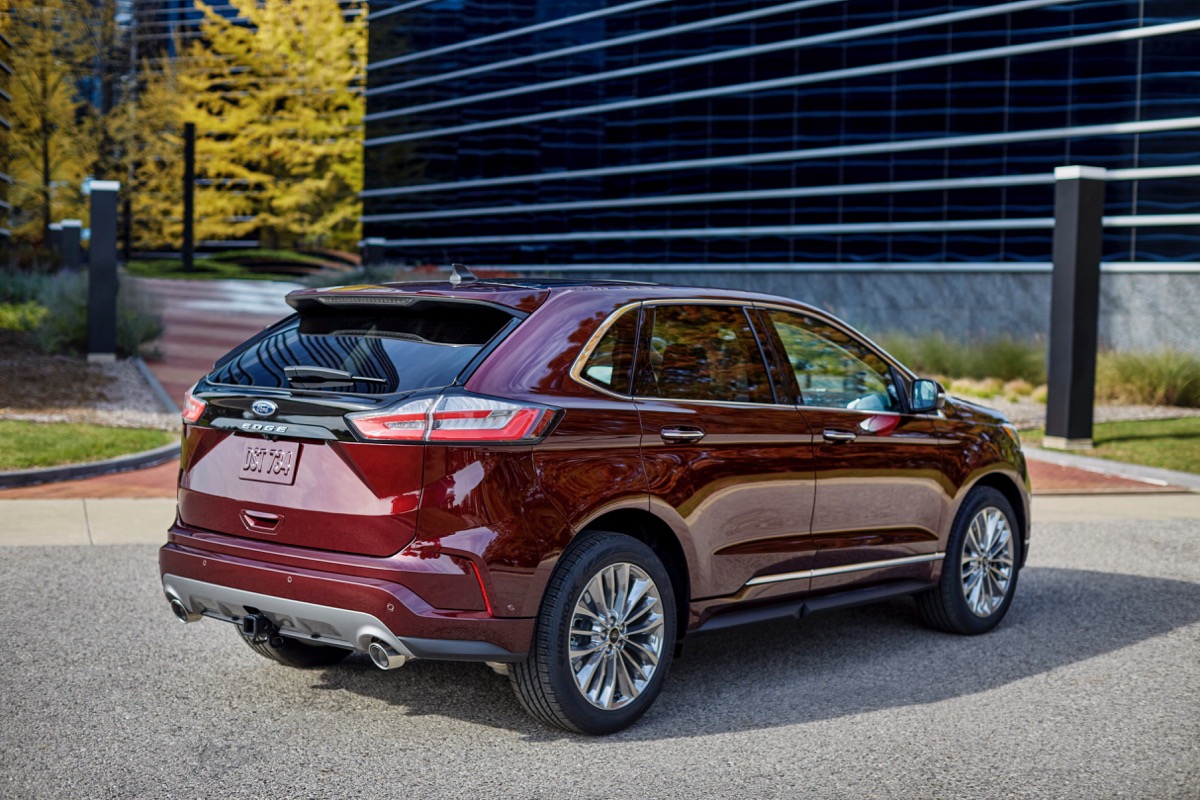
Styling hasn’t changed much since the 2019 model year, when Ford gave the Edge a refresh to bring its exterior in line with more recent designs. That refresh worked surprisingly well, nicely integrating the current Ford look with the carryover Edge body shell. Today, the Edge is a cleaner-looking alternative to the overwrought styling of the Chevy Blazer or Hyundai Santa Fe.
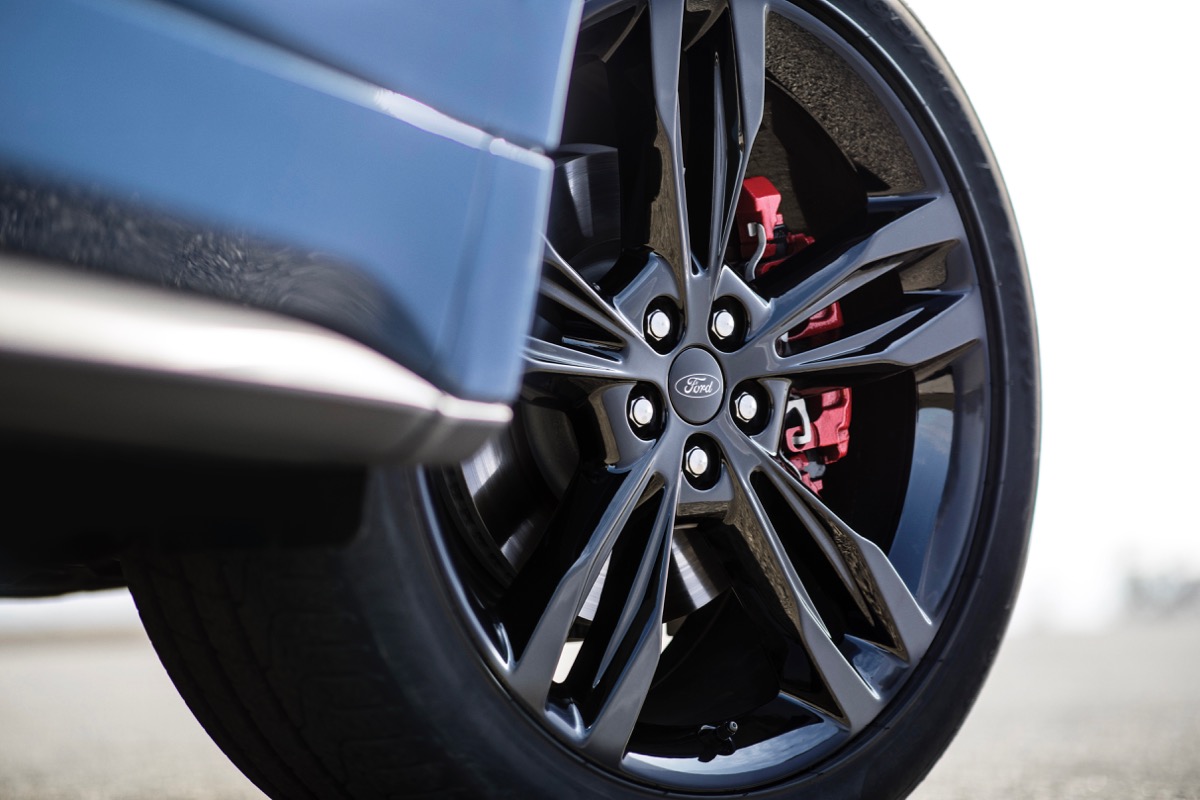
Edge Titanium models get an extra splash for chrome to denote their higher-level status, while the Edge ST trim gets a blacked-out grille, standard 20-inch wheels, and a body kit. Ford also offers the Edge ST-Line, with the same exterior styling features as the ST, but without that model’s performance upgrades and higher price tag.
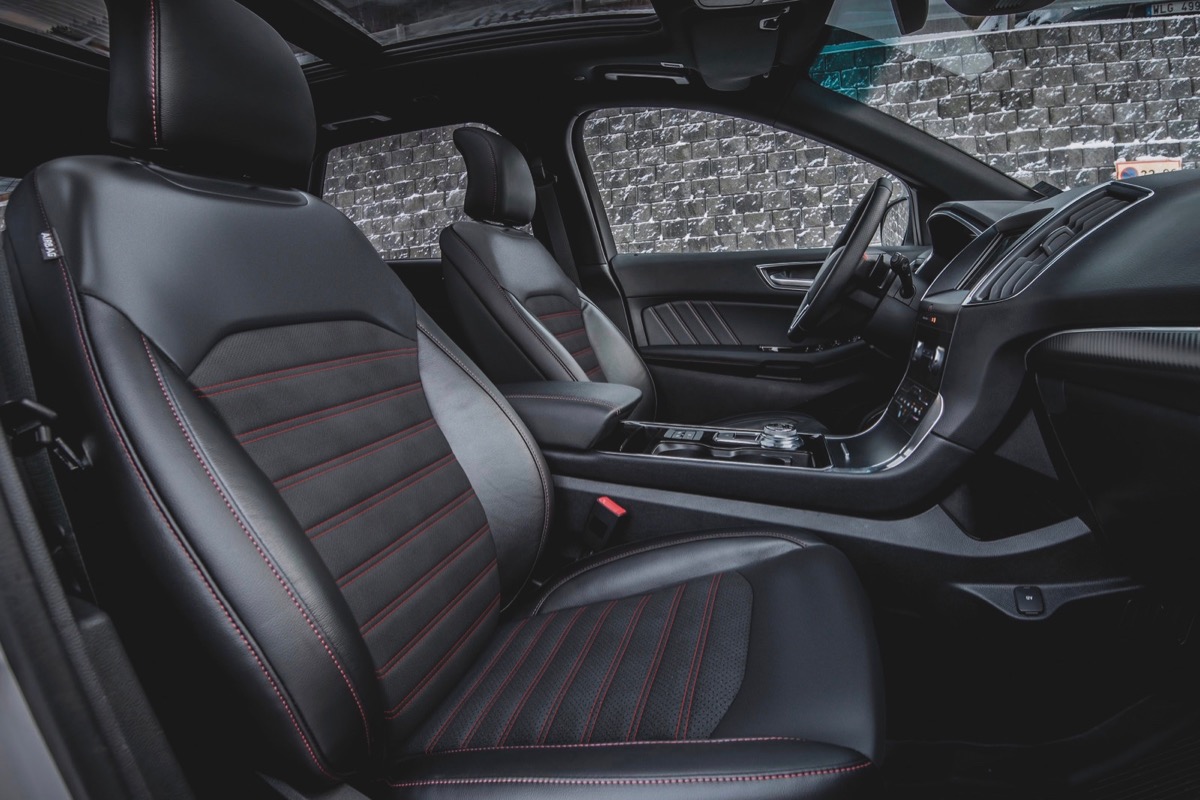
The interior is where the Edge is starting to show its age. The design doesn’t seem as fresh as the exterior, and it’s been awkwardly tweaked over the years to accommodate new features, like a larger touchscreen. Titanium models get leather upholstery, while ST models get sporty front seats with added bolstering and a leather-wrapped steering wheel, both with contrast stitching.
Performance
Most Edge models use a 2.0-liter turbocharged EcoBoost four-cylinder engine, which produces 250 horsepower and 275 pound-feet of torque. This engine is available with only an eight-speed automatic transmission, with standard front-wheel drive (FWD) or optional all-wheel drive (AWD).
Ford also offers the Edge ST performance model, with an EcoBoost twin-turbo 2.7-liter V6 that produces 335 hp and 380 lb-ft of torque on 93-octane fuel. The ST gets standard AWD, an eight-speed automatic transmission, and model-specific suspension tuning. An option package adds upgraded brakes and 21-inch wheels with summer tires.
The Edge ST raised a few eyebrows when it arrived for the 2019 model year. Some car enthusiasts weren’t happy to see the ST badge—previously applied to the Focus ST and Fiesta ST hot hatchbacks—on the liftgate of an SUV. Yet Ford claims the Edge ST isn’t a cynical marketing exercise, saying its engineers benchmarked performance SUVs like the Porsche Macan during development.
Based on previous drives of the ST, we think the Porsche comparison is a bit of a stretch, but this sporty Edge isn’t a bad car to drive, especially considering that none of its competitors emphasize performance. We’ve also found the Edge to be impressively refined for a vehicle based on an aging platform, although past experience showed the turbo-four engine in non-ST models to be a bit sluggish.
Ford quotes maximum towing capacities of 3,958 pounds for the base FWD four-cylinder Edge, 4,122 pounds for four-cylinder AWD models, and 4,525 pounds for the V6-powered Edge ST. Those are respectable numbers, but the Honda Passport and Volkswagen Atlas Cross Sport are both rated to tow 5,000 pounds when equipped with AWD and, in the VW’s case, the optional VR6 engine.
Form & function
The five-seat Edge remains competitive on interior space, boasting the most rear-seat headroom among the current crop of two-row midsize crossovers. Legroom in both the first and second rows is behind only the Hyundai Santa Fe. Dual-zone automatic climate control is standard as well.
At 39.2 cubic feet with the rear seats in place, and 73.4 cubic feet with the rear seats folded, cargo space is behind only the Honda Passport and Volkswagen Atlas Cross Sport. A foot-activated power liftgate is available on higher trim levels.
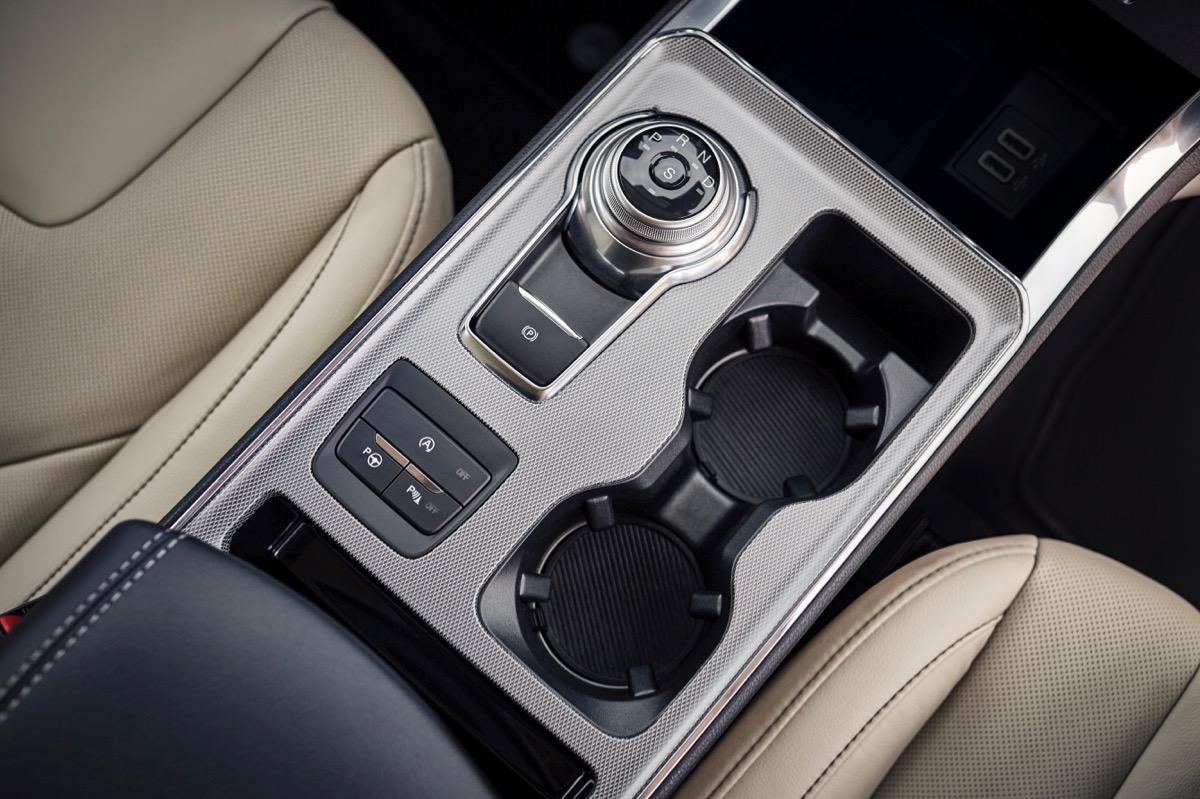
Ford’s ubiquitous rotary shift knob was designed to free up space on the center console, but the narrow width of the console itself means the available space is still only about average. The raised console does leave room for a storage nook below, but it can be difficult to reach, and its out-of-the-way location means items place there will probably be forgotten easily.
Technology
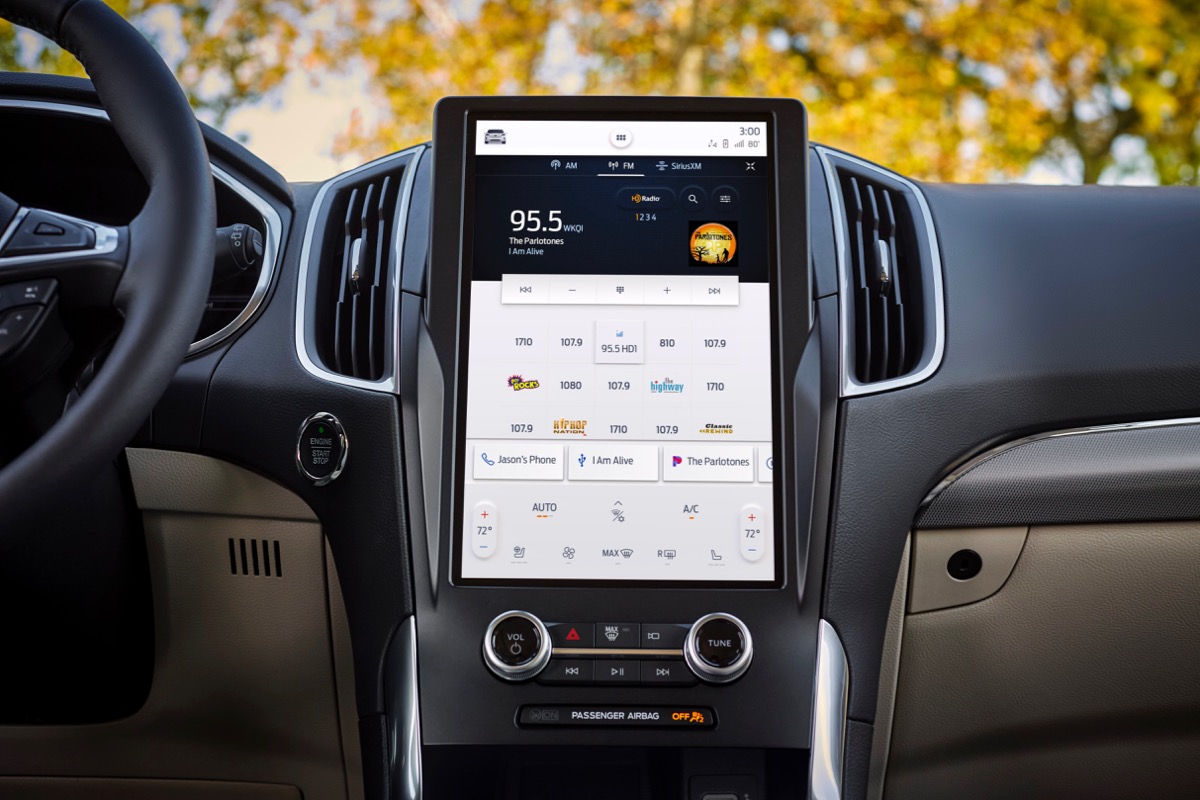
Ford has kept the Edge up to date on tech. For 2021, the crossover gets Ford’s latest Sync 4 infotainment system, with standard wireless Apple CarPlay/Android Auto and a 12-inch touchscreen. Bluetooth, SiriusXM with 360L satellite radio (with a three-month free trial), and a built-in 4G LTE WiFi hotspot are standard as well. Edge ST models also get a 12-speaker Bang & Olufsen audio system.
While the driver doesn’t need to plug in for Apple CarPlay and Android Auto connectivity, the Edge features four USB ports. Two rear USB ports, including one USB-C, were added for the 2021 model year.
We haven’t driven a Sync 4-equipped Edge, but our experiences with Sync 4 in other recent Ford models were positive overall. The simple graphics and straightforward menu layouts should be easy for new users to acclimate to. It’s also worth noting that not all competitors offer wireless Apple CarPlay and Android Auto.
Safety
The 2021 Ford Edge is an Insurance Institute for Highway Safety (IIHS) “Top Safety Pick.” It scored the top “Good” rating in all IIHS crash tests, and the top “Superior” rating for front crash prevention tech in vehicle-to-vehicle situations. However, the Edge got a lower “Advanced” rating for vehicle-to-pedestrian front crash prevention tech, an “Acceptable” rating for LATCH child-seat anchor ease of use, and “Acceptable” and “Poor” headlight ratings (depending on trim level).
The National Highway Traffic Safety Administration (NHTSA) gave the 2021 Edge a five-star overall safety rating, with five stars in frontal and side crash tests, and four stars in rollover crash tests.
The Edge also gets a decent amount of standard safety features under the Ford Co-Pilot360 banner. Standard features include automatic high beams, blind-spot monitoring, lane-keep assist, forward-collision warning, automatic emergency braking (with pedestrian detection), post-collision braking, dynamic brake support, and rear parking sensors.
In addition, adaptive cruise control (with stop-and-go and lane centering) is standard on all but the base Edge SE trim level, along with Evasive Steering Assist. This automatically adds more power assist when swerving to avoid obstacles.
Cost-effectiveness
Four-cylinder Edge models get EPA-rated fuel economy of 24 mpg combined (21 mpg city, 29 mpg highway) with FWD and 23 mpg combined (21 mpg city, 28 mpg highway) with AWD. The V6 AWD Edge ST is rated at 21 mpg combined (19 mpg city, 25 mpg highway).
Ford offers a three-year, 36,000-mile, bumper-to-bumper warranty and a five-year, 60,000-mile, powertrain warranty. That’s pretty standard coverage for a mainstream brand, but Hyundai and Kia offer longer warranty terms.
Pricing for the 2021 Ford Edge starts at $33,995 for a base SE model with FWD (all prices include a mandatory $1,245 destination charge). The SEL starts at $36,435, while the ST-Line and Titanium both start at $40,185. The Edge ST is the most expensive Edge model, with a $44,845 base MSRP.
While the Edge is starting to show its age in some places, it remains a competitive midsize crossover SUV. Ford has kept pace with tech developments, and the Edge keeps up with newer rivals on interior space. So while it may not be the newest vehicle in its competitive set, the Edge is still worth a look.
What owners say
This car wasnt missing anything. It had everything I was looking and more! I couldnt say no to it
October 12, 2026Excellent vehicle. Good size, peppy despite its 4cylinders thanks to the turbos. Great looking. Tons of features.
November 29, 2021I just purchased a 2021 Ford Edge. I like the features it provides, I was not looking for anything fancy in features, just heated seats was my basic request. Still trying to learn all the new gadgets it comes with, however, overall, like it.
July 17, 2022What owners say
This car wasnt missing anything. It had everything I was looking and more! I couldnt say no to it
October 12, 2026Excellent vehicle. Good size, peppy despite its 4cylinders thanks to the turbos. Great looking. Tons of features.
November 29, 2021I just purchased a 2021 Ford Edge. I like the features it provides, I was not looking for anything fancy in features, just heated seats was my basic request. Still trying to learn all the new gadgets it comes with, however, overall, like it.
July 17, 2022Nice car good size just wanted something a little bigger….. but this is a nice car and came in a super super close 2nd
October 28, 2023Trims & specs
Base MSRP $43,600 | Seating 5 |
Engine 2.7L 335 hp V6 | Cargo Capacity 39.2 cu ft |
Combined MPG 22 | Drivetrain AWD |
Base MSRP $40,935 | Seating 5 |
Engine 2.0L 250 hp I4 | Cargo Capacity 39.2 cu ft |
Combined MPG 24 | Drivetrain AWD |
Base MSRP $37,185 | Seating 5 |
Engine 2.0L 250 hp I4 | Cargo Capacity 39.2 cu ft |
Combined MPG 24 | Drivetrain AWD |
Base MSRP $34,745 | Seating 5 |
Engine 2.0L 250 hp I4 | Cargo Capacity 39.2 cu ft |
Combined MPG 24 | Drivetrain AWD |
Base MSRP $32,750 | Seating 5 |
Engine 2.0L 250 hp I4 | Cargo Capacity 39.2 cu ft |
Combined MPG 25 | Drivetrain FWD |
Base MSRP $38,940 | Seating 5 |
Engine 2.0L 250 hp I4 | Cargo Capacity 39.2 cu ft |
Combined MPG 25 | Drivetrain FWD |
Base MSRP $35,190 | Seating 5 |
Engine 2.0L 250 hp I4 | Cargo Capacity 39.2 cu ft |
Combined MPG 25 | Drivetrain FWD |
Base MSRP $40,935 | Seating 5 |
Engine 2.0L 250 hp I4 | Cargo Capacity 39.2 cu ft |
Combined MPG 24 | Drivetrain AWD |
Base MSRP $38,940 | Seating 5 |
Engine 2.0L 250 hp I4 | Cargo Capacity 39.2 cu ft |
Combined MPG 25 | Drivetrain FWD |




Pricing trends
MSRP range
$32,750 - $43,600
Current avg. market price
$18,539
Trending down by 1.7% this month
May 2026 - November 2026


