2021 Ford Bronco Reviews, Pricing & Specs
Write a reviewPros
Excellent off-road capability
Stylish design
Great ride quality
Cons
Poor fuel economy
Noisy
Stereo is lacking
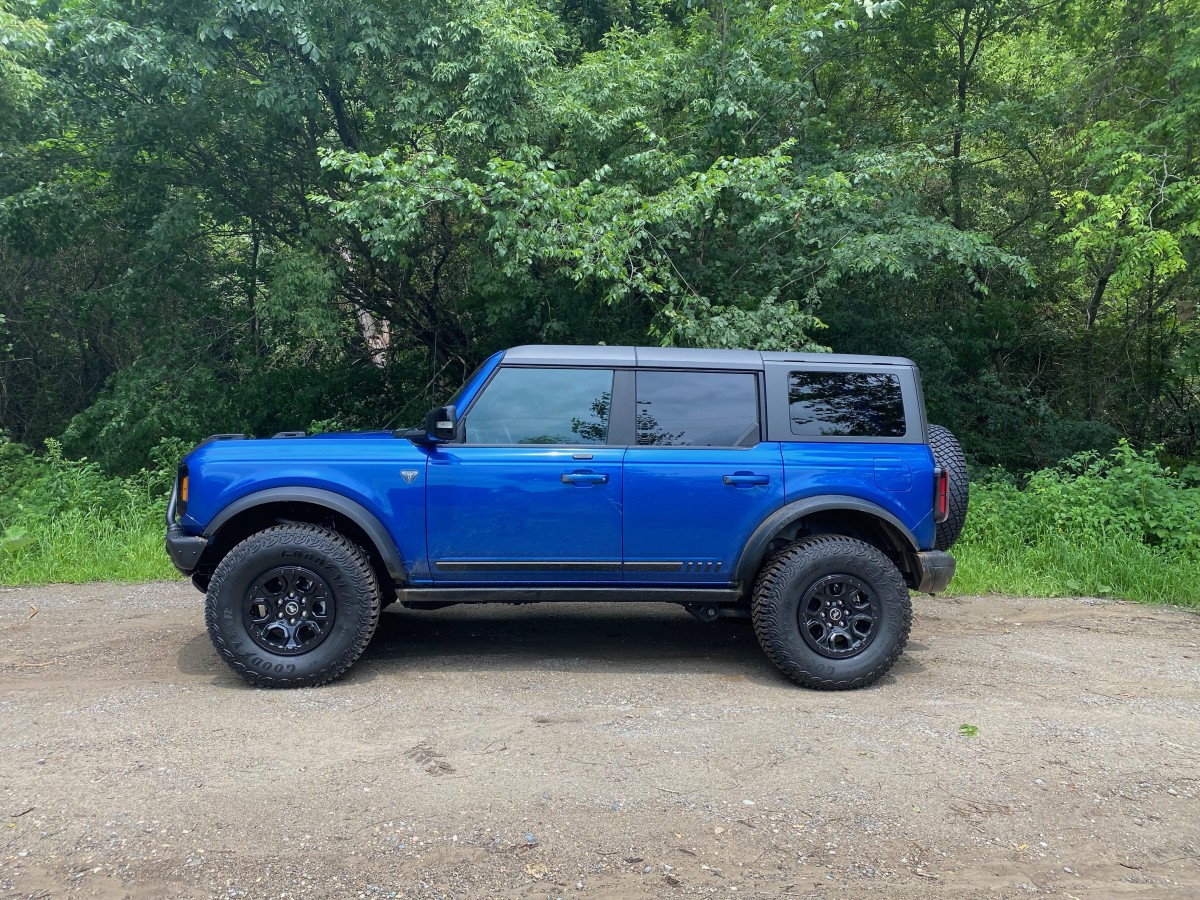
The long-awaited off-roader finally makes its way to showrooms, on the way to challenge the Jeep Wrangler Rubicon as king of the hill.
Ford has been teasing the buying public with the new Bronco since 2004 when unveiling the Bronco Concept vehicle. Passions became even more inflamed with the 2021 Ford Bronco Sport release, a compact crossover SUV riding on the Ford Escape platform, but boosted up with standard all-wheel drive and adventure-friendly styling and details.
The original Ford Bronco debuted as a 1966 model and was produced through five generations ending in 1996. For 30 years of production, the Bronco built a solid reputation for off-road capability and is still a sought-after vehicle as a starting point for customization.
The new Ford Bronco takes inspiration from the original model, much like the current Ford Mustang finds its roots in the classic car. Designers call this “Retrofuturism,” updating a classic (retro) design for current and future tastes and bringing the latest technology, powertrains, materials, and flourishes to bear on the project. It worked with the Mustang; it worked with the Dodge Challenger and Charger; it sort of worked with the Chrysler PT Cruiser, Chevrolet HHR, and Toyota FJ Cruiser, among others.
Retrofuturism works for the Bronco. The original SUV was cool; the new one might be cooler.
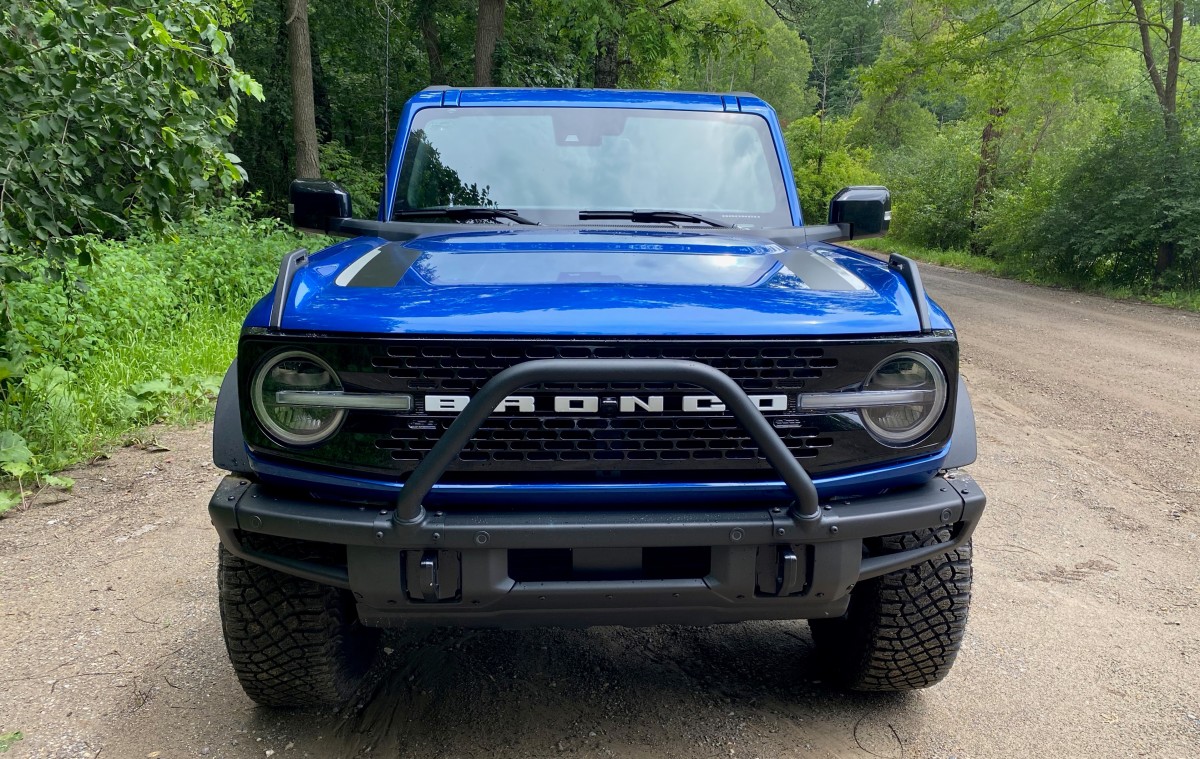
Starting from the front, the Bronco uses a single-piece grille flanked by round headlights linked together by bold B-R-O-N-C-O lettering. The hood bulges modestly and wears removable off-road sights at the corners (more on that later). The body sides are relatively flat and simple, accented with applied fender flares. 32-inch tires are standard; 35-inch tires come with the Sasquatch package, which can be added to any trim level. Wheel choices range from 16-inch steel to 18-inch aluminum, with beadlock-capable wheels available.
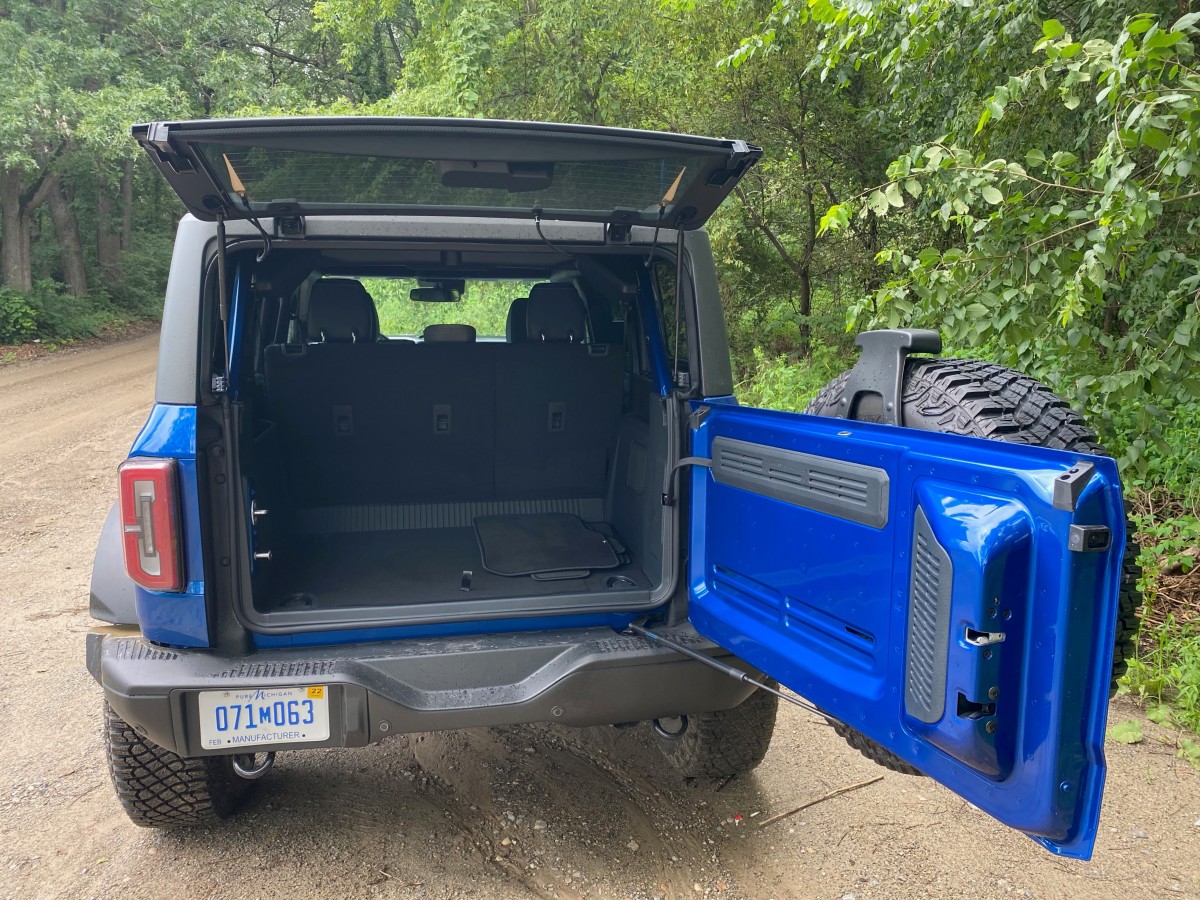
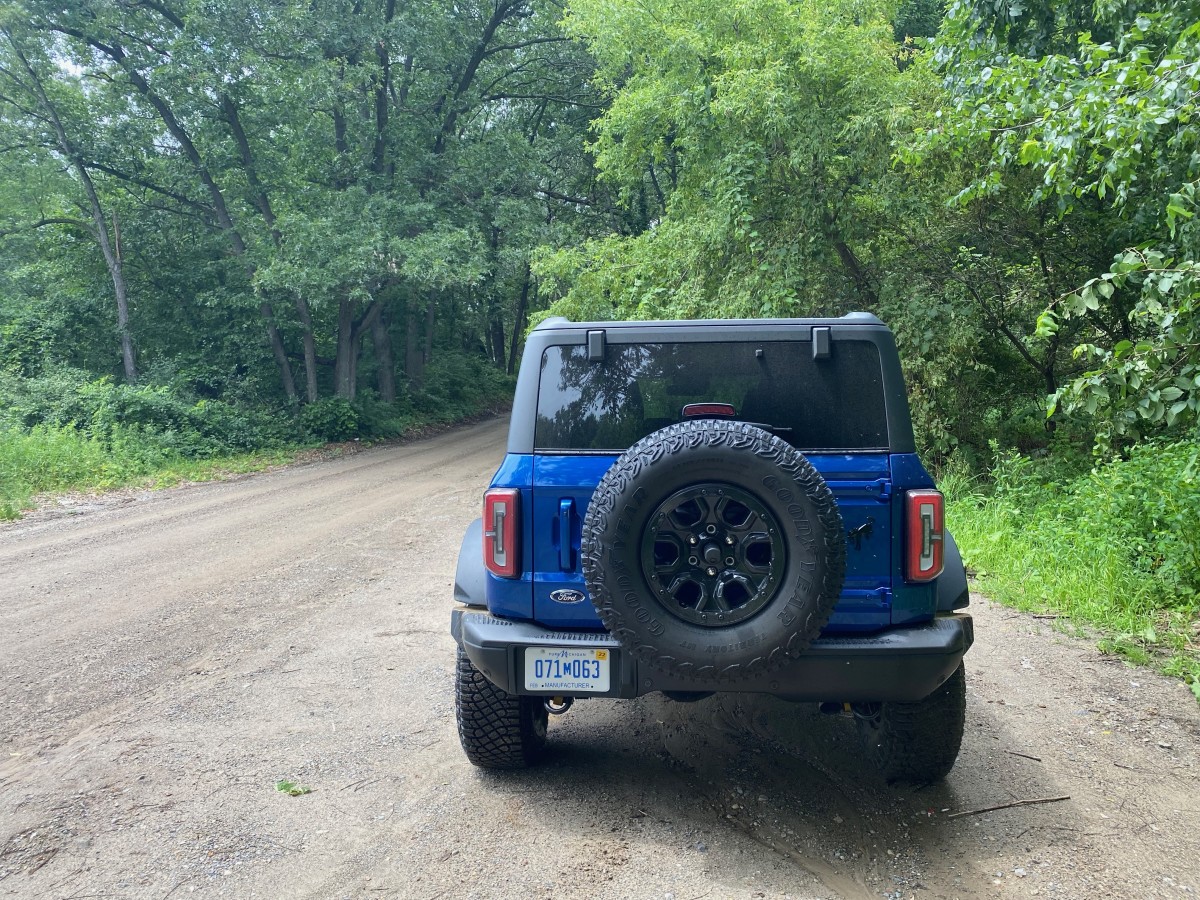
Around the back, the Bronco wears its full-size spare tire and wheel on a rack that swings away for access to the side-hinged half tailgate and flip-up back glass, very old-school and manual. It’s not quite as retro as a fold-down half-tailgate but still creates a place to sit when the gate is open.
The Bronco comes in two-door and four-door configurations. The two-door uses a 100.4-inch wheelbase, while the four-door stretches out to 116.1 inches. This stretch translates to a 15.7 – 15.8-inch difference in overall length (depending on trim level), with the two-door models measuring 173.7 – 174.8 inches. Four-door models start at 189.4 and top out at 190.5 inches. Height ranges from 71.9 – 75.3 inches, again depending on trim level and equipment, and width ranges from 75.9 – 79.3 inches, you guessed it, depending on trim level.
The Bronco comes with either a black soft-top or a modular removable hardtop. Eleven paint colors can adorn the body, with some genuinely eye-popping options like Rapid Red Metallic Tinted Clearcoat, Antimatter Blue, and a greenish-gray called “Area 51” among them.
Inside, the retro feel is more about styling and proportion because the technology housed in the Bronco is way beyond what was around in 1966. Still, Ford designers digitally scanned the original dashboard to unlock its secrets and applied their learnings to the new Bronco.
Befitting a modern SUV, a color touchscreen lives at the center of the dash (8-inch standard/12-inch available), and a digitized cluster replaces the conventional analog gauges above the steering wheel. Vertically oriented HVAC outlets are inset into the dash, with a shape that echoes the geometry of the taillights—a subtle, unifying detail. The dash and interior make a lot of use of plastic but still manage to feel rugged and tough. Like the grab handles integrated into the dash ends, heavy use points are reinforced with metal and lined with grippy rubber, offering a very reassuring solidity. Stretchy mesh door pockets look great and will keep water bottles from rolling around when the road gets gnarly.
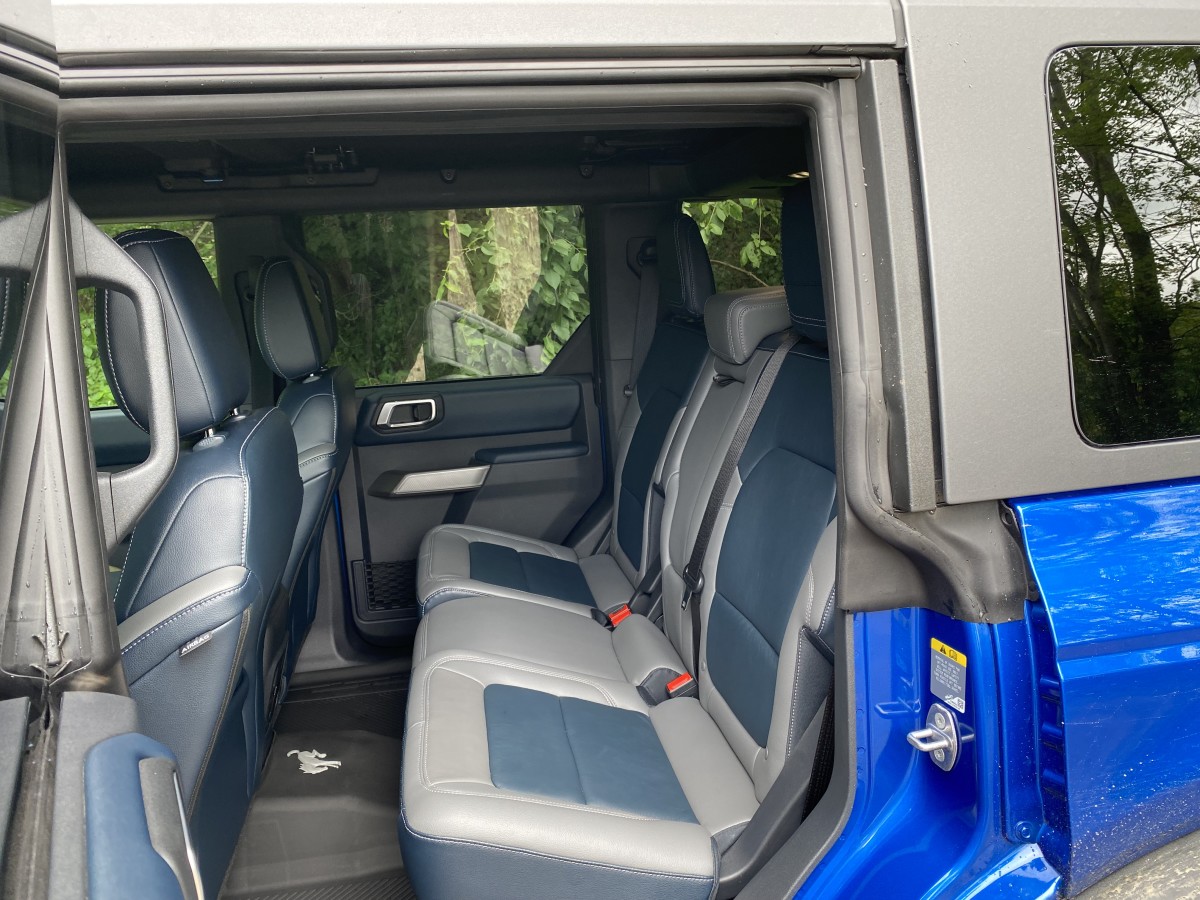
The second row rear seats are comfy in the four-door and predictably a little less-so in the two-door Bronco, but still accessible and appropriate for adults, even three across (if the middle passenger is a small adult or an actual child). Sturdy overhead grab handles await outboard passengers.

Ford has made two engines available for the Bronco at launch: a standard, turbocharged 2.3-liter inline-four-cylinder gasoline engine with direct injection and tuned to produce 270 horsepower and 310 lb-ft of torque; and an optional, twin-turbocharged 2.7-liter inline-four-cylinder engine with port- and direct injection with 310 hp and 400 lb-ft of torque. The 2.3-liter comes with a seven-speed (six gears plus a crawler gear) manual transmission. The 2.7-liter comes with a 10-speed automatic transmission, which is optional on the 2.3-liter. All Bronco models get standard four-wheel drive (4WD).
When you talk about performance in the Bronco, you’ve got to separate everyday on-road behavior from the off-road experience.
Our test drive took place in and around Holly, Michigan, where Ford had plotted an on-road drive route which included pavement and dirt roads, followed by a lead-follow session through an off-road course. Weather conditions were, to put it mildly, awful for ordinary people and perfect for test drivers. It was hot and rainy, with periods of torrential downpour all day long. The pavement portions of the drive offered mildly challenging conditions. In contrast, the off-road drive presented soupy mud, slick rock, slightly treacherous trails on the verge of washing out, and other unplanned obstacles.
On pavement and dirt roads, the Bronco drove like an off-road truck. Our four-door test vehicle, a First Edition trim model, wore the 35-inch tires from the Sasquatch package (we love the name). Ideal for off-roading, 35-inch tires with aggressive tread on 17-inch wheels produce a noisy, somewhat wiggly ride. If you’re planning to drive the Bronco like a normal car every day, you’re going to want to have an alternate set of wheels and all-terrain tires—the standard 32-inch tires that wrap the 17-inch by 7.5-inch wheels on Big Bend, Outer Banks, and Black Diamond trim levels would deliver a much better, quieter ride.
Our First Edition test Bronco came with the 2.7-liter engine and 10-speed automatic transmission, which did a fine job of motivating the big SUV on the streets. The power feels well-matched to the vehicle, and the transmission manages smooth delivery, with an eagerness to kick down a few gears on-demand when it’s time to pass a slowpoke.
We jumped into a short-wheelbase, two-door, base-model Bronco with the optional 2.7-liter twin-turbo engine and 10-speed automatic transmission when the time came for off-roading. This test Bronco had the Sasquatch package, and its 35-inch tires had been aired down to 27 psi (from the on-road normal 32). We’ll discuss the technologies that enabled performance below, but the key takeaway on our hour-plus off-roading was how well the Bronco handled the trail on a variety of terrain conditions. It is very sure-footed, gets the traction to ground, feels balanced, and is great fun to drive. A driver with little off-road experience could get a great drive. A grizzled off-roader will love the articulation, flexible setup, smart electronics, and overall capability of this truck. It has the makings of a great off-roader. A short off-road experience only had us wishing (and planning) for more.
Ford's Bronco designers and engineers made excellent use of the marketplace as a research tool when putting together the new SUV. They looked at the competition; they looked at the aftermarket; they looked at what owners of classic Bronco trucks had done to and with their vehicles. And they took some great ideas, improved some good ideas, and, perhaps most importantly, avoided some bad ideas in their execution.
One area where form and function really meet in the Bronco to the great benefit of the eventual buyer is modularity. Recognizing owners' delight in removable doors, a popular feature for off-road vehicles, Bronco’s designers didn’t just make the doors removable and frameless, they designed dedicated protective storage bags for the doors. The doors have integrated grip handles to help move them around. And they engineered storage space in the Bronco’s cargo hold for the doors in their bags. Going further, the electrical connection to the doors (which have power windows and locks) is a simple plug, and the hardware to remove the door takes one simple tool. Not only that, each dedicated door-storage bag is clearly labeled for its specific door and has a QR code that leads to video instructions on door removal and replacement. The video can be displayed on the owner’s smartphone, or on the Bronco’s infotainment screen. This is a far cry from leaning the doors against the side of the garage, a popular option for some other vehicle doors.
Ford expects Bronco owners to do some bashing in their SUVs. Thinking ahead, there’s standard protection under the chassis and more robust accessory skid plates available. The fenders are all removable, front and back, for easy repair and replacement. So are the bumpers. The one-piece front grille is easy to remove and replace or upgrade. A knock or scrape is inevitable on the trail; with easy to replace modular parts, a minor crunch doesn’t necessitate an expensive shop visit.
On the hood, there’s another clever feature: the trail sights at each forward outboard edge. Doing dual duty, the hard plastic sights bolt onto the hood and have a tie-down hole at the front to help manage the lines for roof-mounted cargo (like a kayak). What a great, simple feature, and since they’re easy to remove, the sights will be a target for aftermarket upgrades and other smart functionality. Action-camera mount, anyone?
Inside, a similar level of research, thought, and creative problem-solving has been applied. Two sets of switches shine a light on this process. On the top of the center stack, a row of buttons with simple pictographs and LED indicator lights provides access to the differential, sway-bar, and other suspension settings (different ones in various trim levels). The driver will be able to see, reach, and operate these controls while engaged in challenging off-road situations without taking their eyes off the trail for more than a second. That’s smart. In the center overhead console, but still in front of the driver, there’s a row of beefy toggle switches ready to be connected to auxiliary equipment, much of which already has onboard wiring. So, when owners decide to install roof lights, or a winch, or any other tool to make off-roading better, they won’t have to tear up their interior to get a clean, reliable connection.
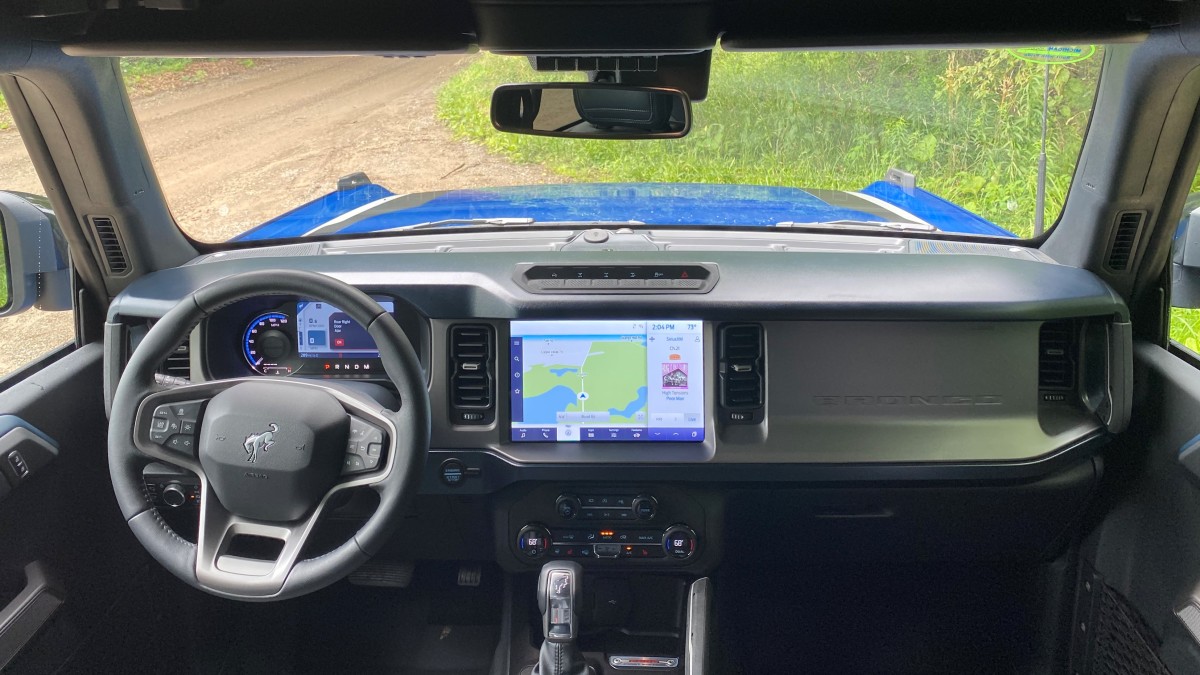
The center console between the front leg wells has the gear selector lever and a big rotary control for off-road traction functions. Ford calls it the G.O.A.T. system, for “Go Over Any Terrain.” Base models come with five G.O.A.T. modes, while up to seven drive modes are available as you go up the trim ladder. The clever name covers a familiar, effective terrain control system that’s easy to operate and understand, and won't leave you stranded, whether you're rock crawling, driving across sand, or tackling mud and ruts—it's perfectly suited to the Bronco.
The Bronco uses the latest version of Ford’s infotainment interface, SYNC 4 with enhanced voice recognition. The 8-inch standard touchscreen is mounted at the top of the center stack. An upgrade to a 12-inch touchscreen comes with the High Package. An upgrade to a 10-speaker B&O sound system, voice-activated touchscreen navigation, and a wireless device charging pad comes with the Lux Package.
Push-button start is standard, upgradeable to a proximity key entry system with the Mid Package and above. A rear-view camera with backup assist lines comes with the Mid Package, too, as do auto high-beam headlamps.
Position-sensitive Bilstein shock absorbers are part of the Sasquatch Package (which you should order just for the logo), increasing off-road travel and capability.
Ford has packaged safety features on the Bronco, which means you get more access to safety features as you step up to higher trim levels. The Base vehicle gets a base level of safety features, including airbags. The Big Bend trim and Black Diamond trim can add the Mid Package of options, which includes a reverse sensing system, Ford Co-Pilot 360 including pre-collision assist with automatic emergency braking, blind-spot information system with cross-traffic alert, lane-keeping system, auto high-beam headlamps, and rear-view camera with backup assist grid lines. The High Package, which you can add to the Outer Banks, Wildtrak, and Badlands trims, adds a 360-degree camera, a forward-sensing system, and side-view mirror LED approach lamps.
Any vehicle with removable doors has to get a safety knock, but the Bronco includes side curtain airbags that work in concert with sensors on the vehicle to deploy appropriately in off-roading situations, measuring not only lean angle for rollover, but the speed of the roll, too. There are situations off-road where a vehicle might wind up on its side or top without incurring much damage or any injury to its occupants, only to be manipulated back onto its wheels to continue traveling. If the side curtain airbags deploy, your day is over. If they don’t deploy, you can keep on rolling.
Neither the National Highway Traffic Administration (NHTSA) nor the Insurance Institute for Highway Safety (IIHS) has released crash-test ratings for the 2021 Bronco yet.
The 2021 Ford Bronco Base two-door starts at and MSRP of $28,500; $33,200 for the four-door Bronco. Six additional trim levels will be released at launch, each available in two-door or four-door: Big Bend ($33,385/$35,880); Black Diamond ($36,050/$38,545); Outer Banks ($38,955/$41,450); Badlands ($42,980/$44,590); Wildtrak ($46,980/$49,475); and First Edition ($56,915/$61,110). Adding the Mid Package runs $1,495; High Package costs $1,295; and Lux Package adds another $3,590. Off-roaders will want to add the $4,200 Sasquatch Package, as we discussed above.
The Bronco’s pricing must be compared to its most direct competitor, the Jeep Wrangler, which has starting prices from $28,900 up to $73,745. Price will probably not be the determining factor for Bronco and Wrangler buyers—they’re going to compare function, style, and community. Jeep has a healthy head start on Ford here, with a long history of Jeep Jamborees, tours, excursions, clubs, and other social entities. Ford’s launching Off-Roadeo and Bronco owners club events, hoping to capture the authentic, organic community vibe by fabricating it themselves. Time will tell.
Other competitors include the Land Rover Discovery (starting at $53,900) and Land Rover Defender (starting at $46,100), along with the Toyota 4Runner (starting at $36,795).
Twenty-five years is a long time to wait for a new vehicle. So far, it looks like the 2021 Ford Bronco rewards patient off-roaders with a cool, competent, complex new SUV.


