2017 Nissan Pathfinder Reviews, Pricing & Specs






Expert review
Nissan's Pathfinder bridges the gap between minivans and more rugged 4x4s, doing family-hauling duty and offering all-wheel-drive capability when needed.
There was a time when SUVs like the Ford Explorer and Nissan Pathfinder were truck-based machines. They got through EPA loopholes for fuel economy and provided families added space as well as a 4-wheel-drive power train that could handle a variety of road and driving conditions.
The Explorer, Pathfinder, and others have moved to car-based platforms, and that’s not necessarily a bad thing. The new Pathfinder isn’t as rugged as it was in the past, but it can do everything that’s asked of a family hauler.
The Pathfinder is in its fourth generation after debuting in 1985 as a 2-door SUV that was very nearly a pickup with a hardtop. The first-gen eventually picked up a second set of doors, but never added more interior comfort. A second-generation model was introduced in 1995 as a far more refined vehicle, with 4 full doors. The third-generation model was introduced for the 2005 model year and was as rugged as it was comfortable, sharing a platform with the Frontier pickup truck.
In 2013, the Pathfinder got completely redesigned, using a platform shared with the Altima, Quest, Maxima, and others. That allowed Nissan to maximize the space provided by the platform, making for tons of cargo and passenger room.
out of 10 expert review
Look & feel
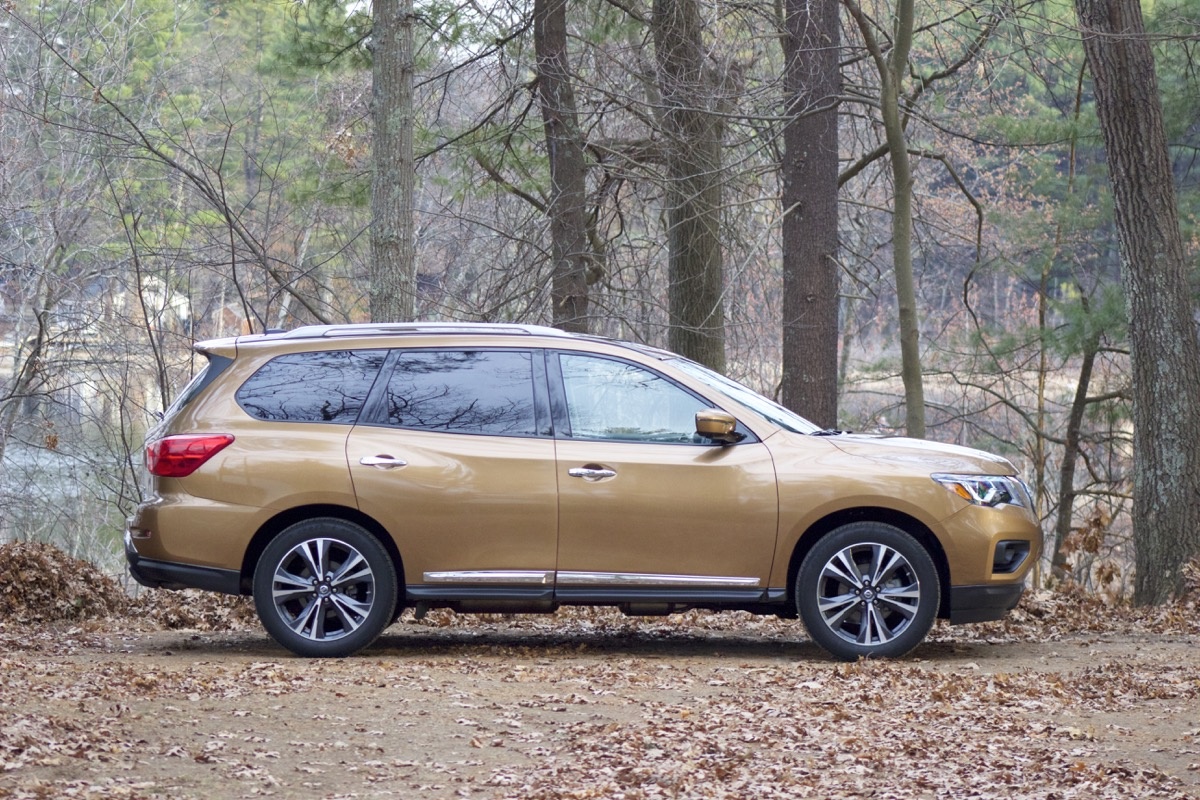
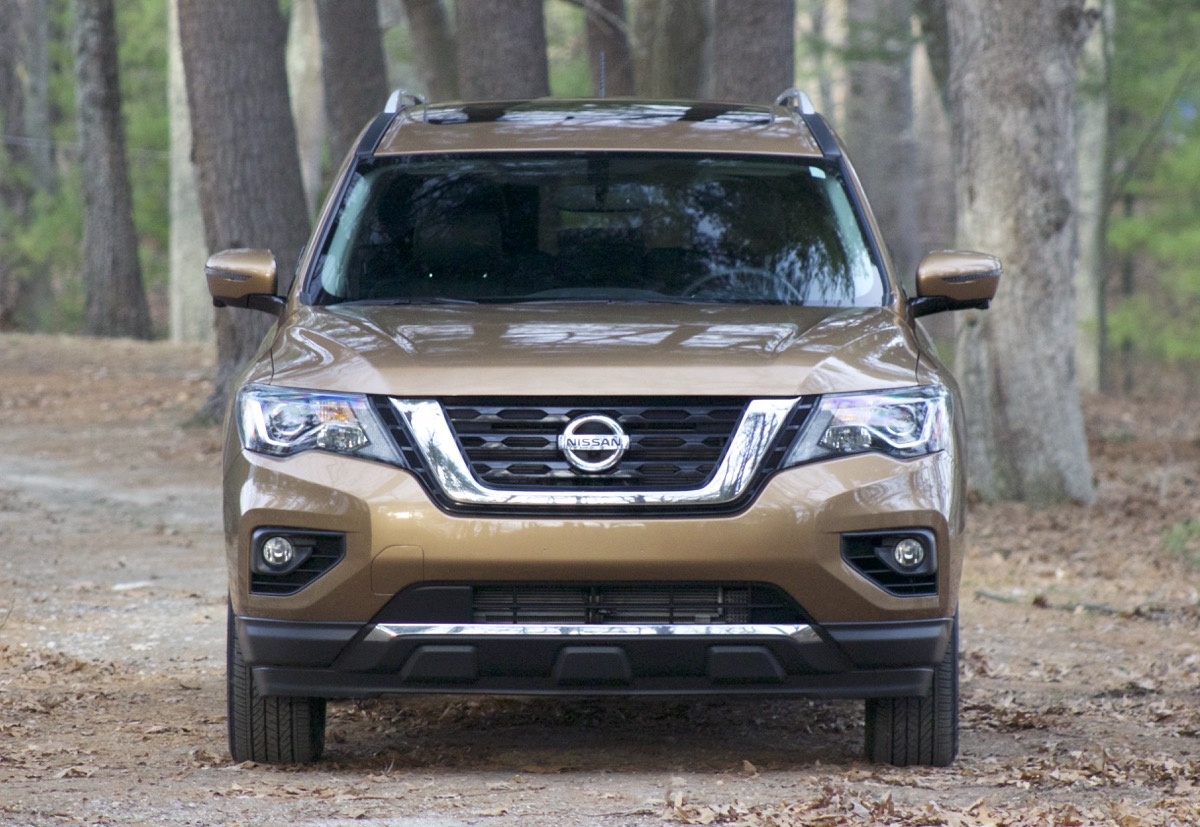
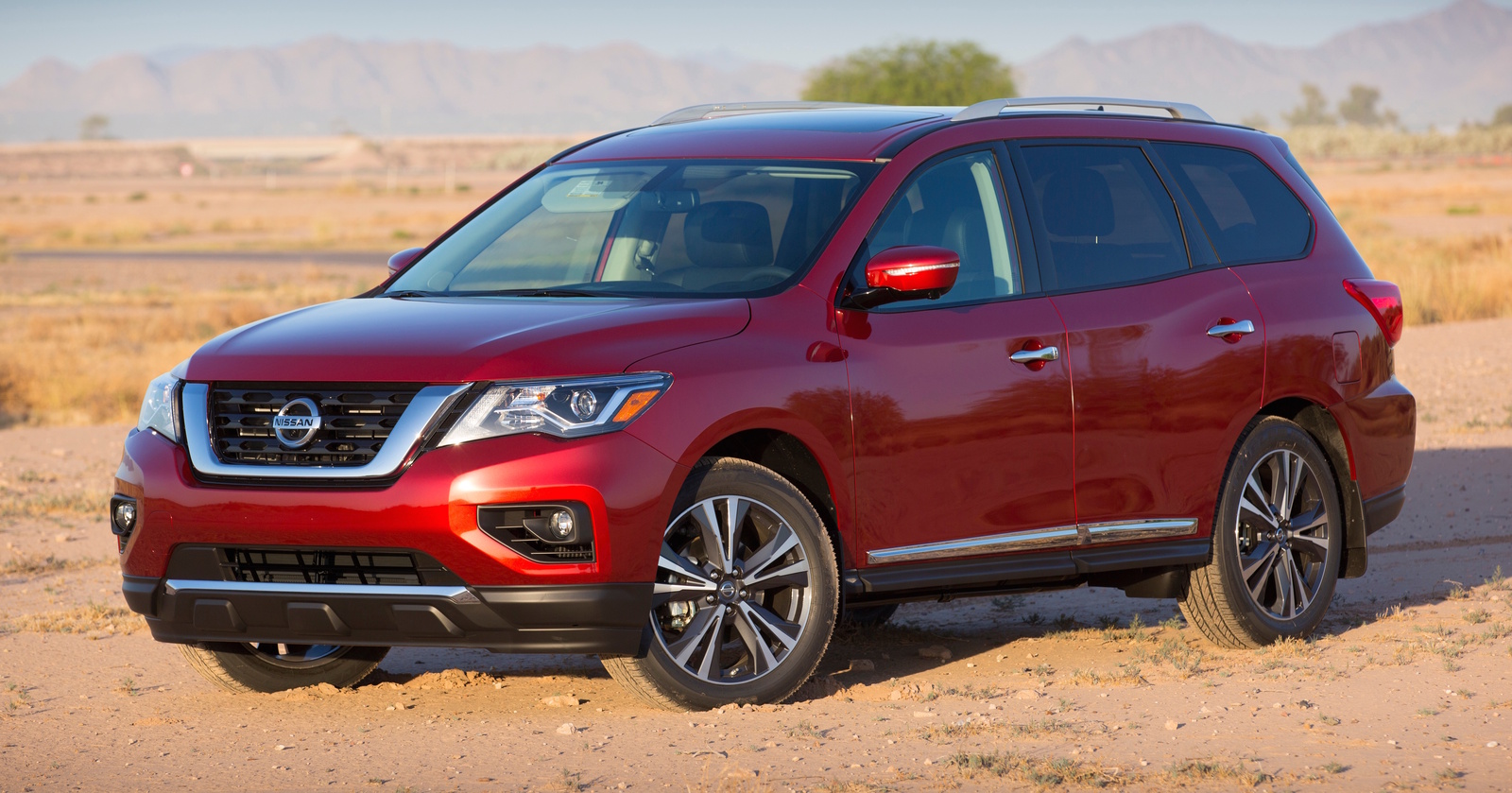
For 2017, Nissan has updated the Pathfinder again. The new vehicle tightens up the headlight design and adds a more aggressive grille, all of which falls in line with the look introduced by the eighth-generation Nissan Maxima, which arrived for the 2016 model year. The new look also features redesigned taillights, which are not very noticeable, but look sharp nonetheless.
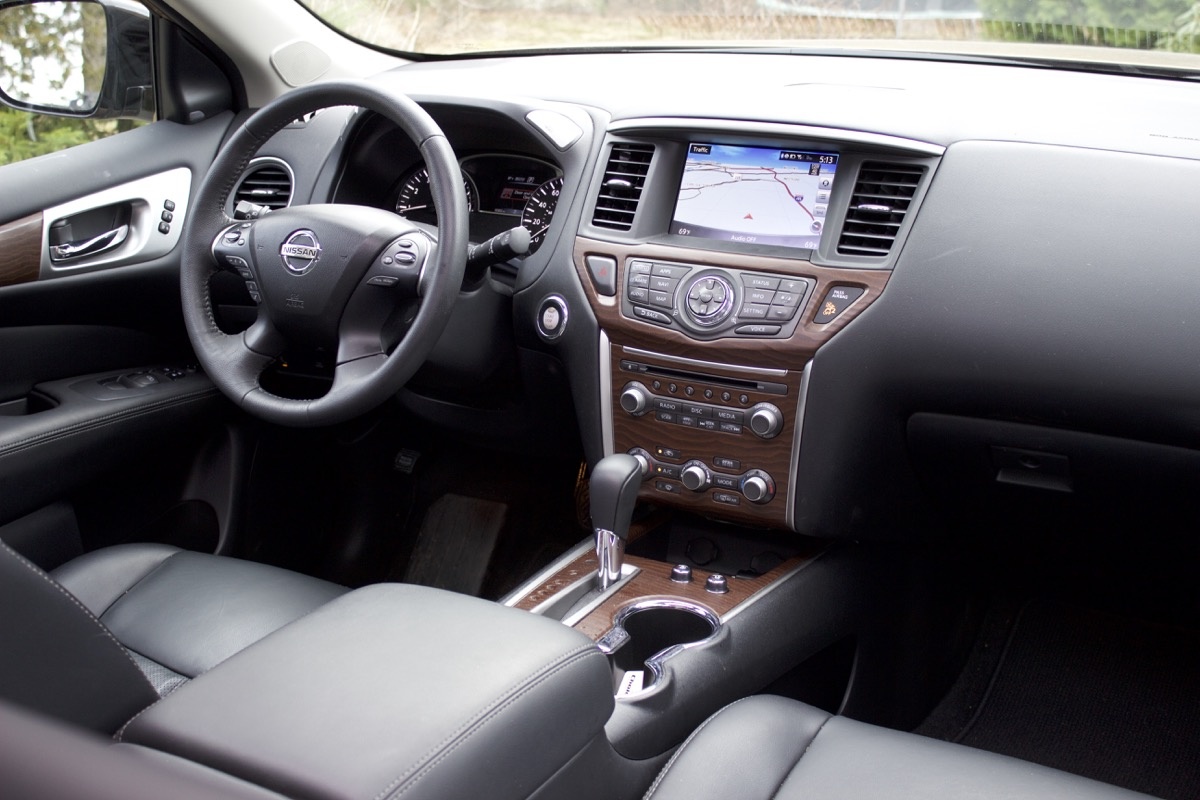
Inside, things look very much the same as the 2016 model. One of the only changes is this added space between the cupholders. And it’s fine that little has changed here, because the Pathfinder has a great interior layout.
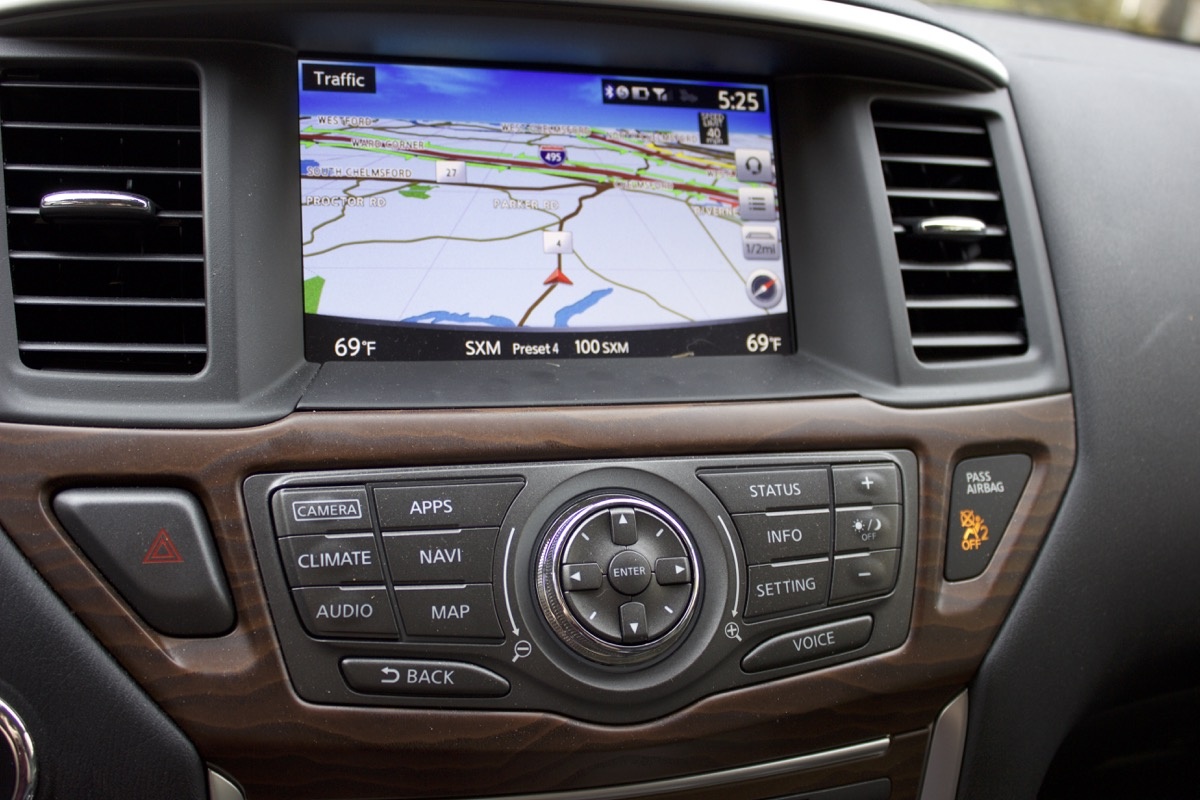
While automakers have been pushing form over function for cabin controls, Nissan doesn’t try to push any styling boundaries on the Pathfinder’s controls. They feature a traditional layout, with a familiar position for dials for the climate and audio controls. Above them is the 8-inch touchscreen that’s standard across all trims. In its base form, it operates the radio and other basic functions, but it can be outfitted with Navigation in more expensive versions.
Trims for the Pathfinder are S, SV, SL, and Platinum. The base S features the aforementioned touchscreen, 18-inch aluminum alloy wheels, LED daytime running lights, roof rails, dual power outside mirrors with integrated LED cornering signals, push-button start, remote keyless entry, a reversing camera, Bluetooth hands-free calling, and three-zone automatic climate control.
Move up to the SV and you get smart auto-on headlights, fog lights, remote start, HomeLink universal transceiver, auto-dimming rear-view mirror, leather-wrapped steering wheel and shift-knob, and reversing backup sensors.
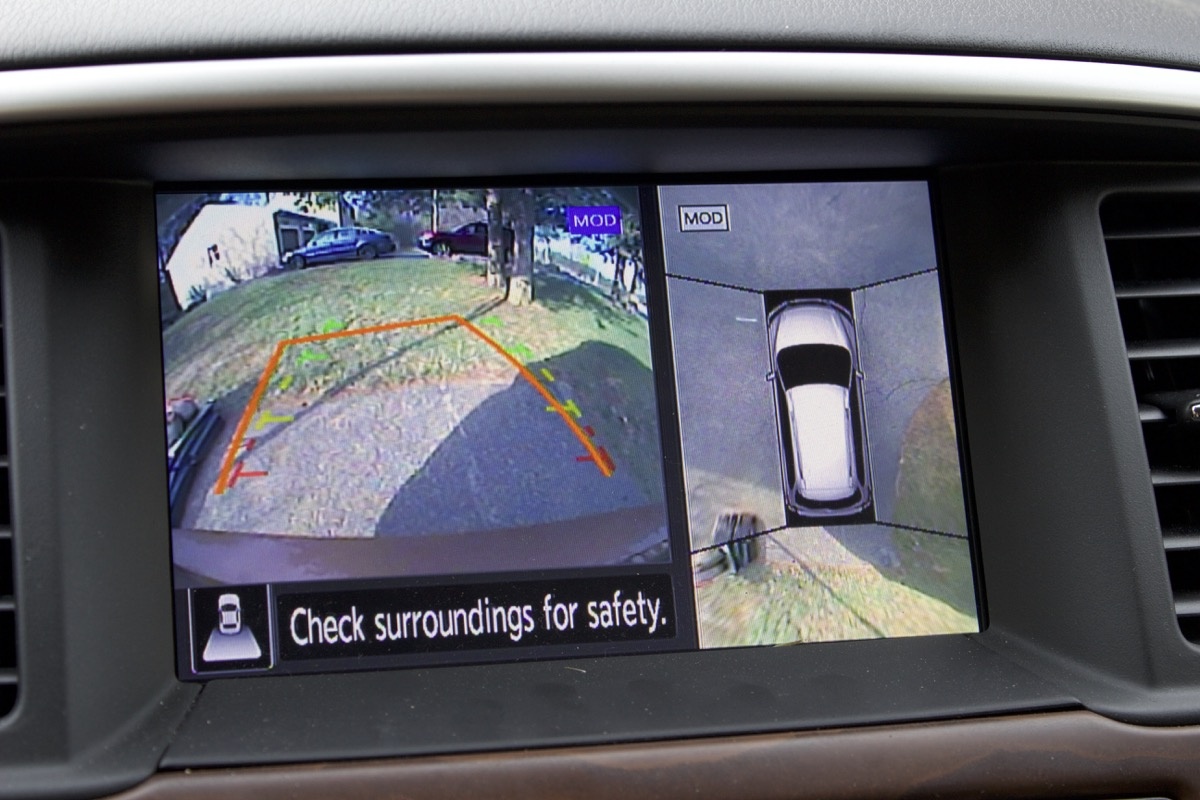
The SL trim adds a 360-degree camera system, dual power outside mirrors with reverse tilt-down feature, digital compass, “welcome lighting,” leather seating and door trim, 120-volt wall-style power outlet, heated front seats, heated rear seats, and a blind-spot warning system. The SL also gets a motion-activated liftgate that lets you just kick your foot under the rear bumper to open the power hatch.
We’re driving the range-topping Platinum trim. It adds 20-inch aluminum-alloy wheels, upgraded LED projector headlights, chrome body side moldings, a dual-panel panoramic moonroof, navigation system with XM real-time traffic updates, power tilt-telescoping steering column, heated and cooled front seats, wood-tone interior trim, a forward-collision-avoidance system, and adaptive cruise control.
Performance
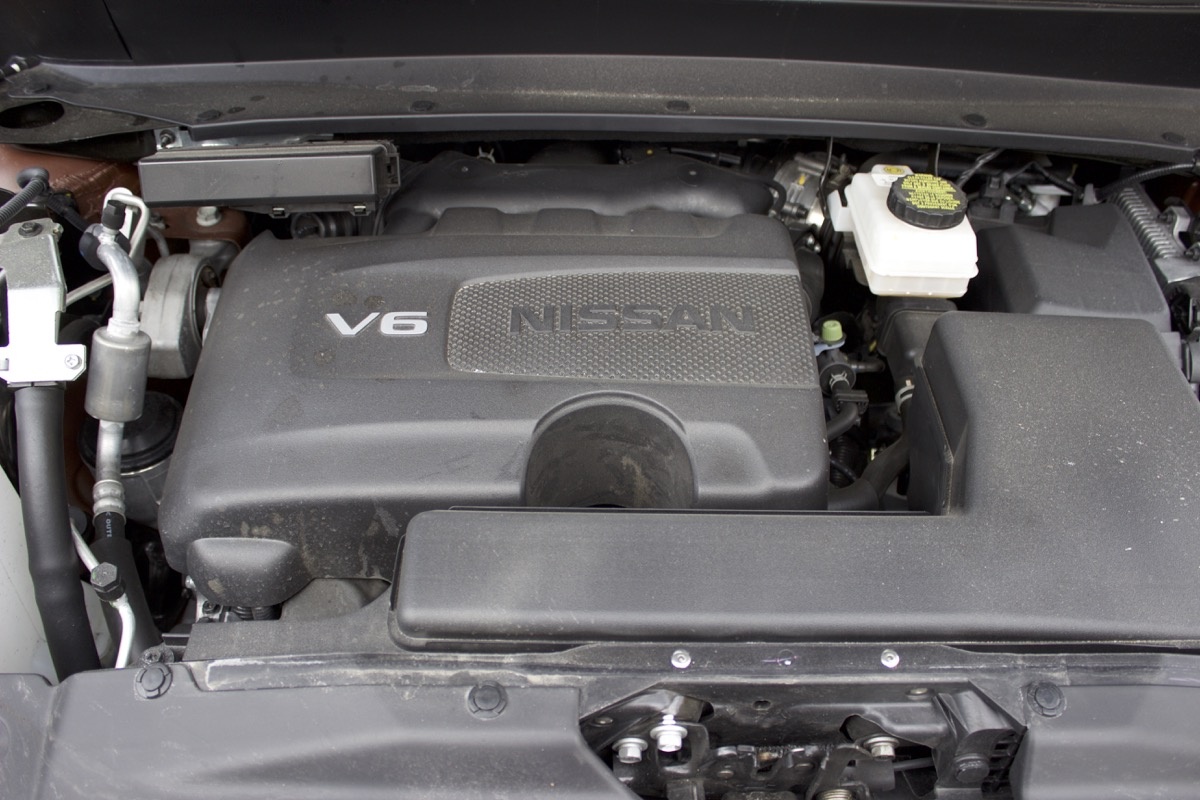
The Pathfinder gets a 3.5-liter V6, which has been updated for 2017. It should be noted that some SUVs in the class, such as the Toyota Highlander, come with an inline 4-cylinder (I4) as the base engine. But unless you’re talking about a turbocharged 4-cylinder, like the one powering the new Mazda CX-9, an I4 will be underwhelming for a vehicle this size—the V6 is close to necessary.
The updated 3.5-liter V6 makes 284 horsepower—up from 260. This is a noticeable bump in power, and not just on paper. Lay your foot into the accelerator, and the V6 provides some serious acceleration. Whether it's pulling away from a stop light, getting up to highway speeds, or even making a pass at highway speeds, that added power is noticeable, and it also means a larger 6,000-pound towing capacity. It’s not quite the 7,400-pound capacity of a V8 Durango, but it’s a thousand pounds more than the Pilot and the Highlander can manage.
Power gets sent through a continuously variable transmission (CVT) to the front wheels or available all-wheel drive, as found on our test car. Nissan calls it 4x4-i, but it isn’t the transfer-case/low-range setup you might find in a truck—it’s a full-time 4-wheel-drive (4WD) system that’s really an all-wheel-drive (AWD) setup, but it does have a dial that allows the driver to select a drive mode.
One can switch the Pathfinder into 2-wheel drive for better fuel economy, leave it in Auto, or lock it into 4WD for getting off the beaten path. It also has also hill-start assist and a hill-descent-control button, which will maintain the Pathfinder’s speed using the brakes and throttle with your feet completely off the pedals, allowing you to focus on the trail.
How much use this system will receive is entirely up to you—maybe the head of the bike trail or the launching spot for your kayaks is down a remote road. If anything, leaving the system in Auto will ensure great traction when the weather gets rough.
As for driving the rest of the time, the Pathfinder isn’t that special. It’s not bad, per se, but its handling and cornering are vague. On the plus side, it has little body roll through corners, and most shoppers should find its ride relatively comfortable.
Form & function
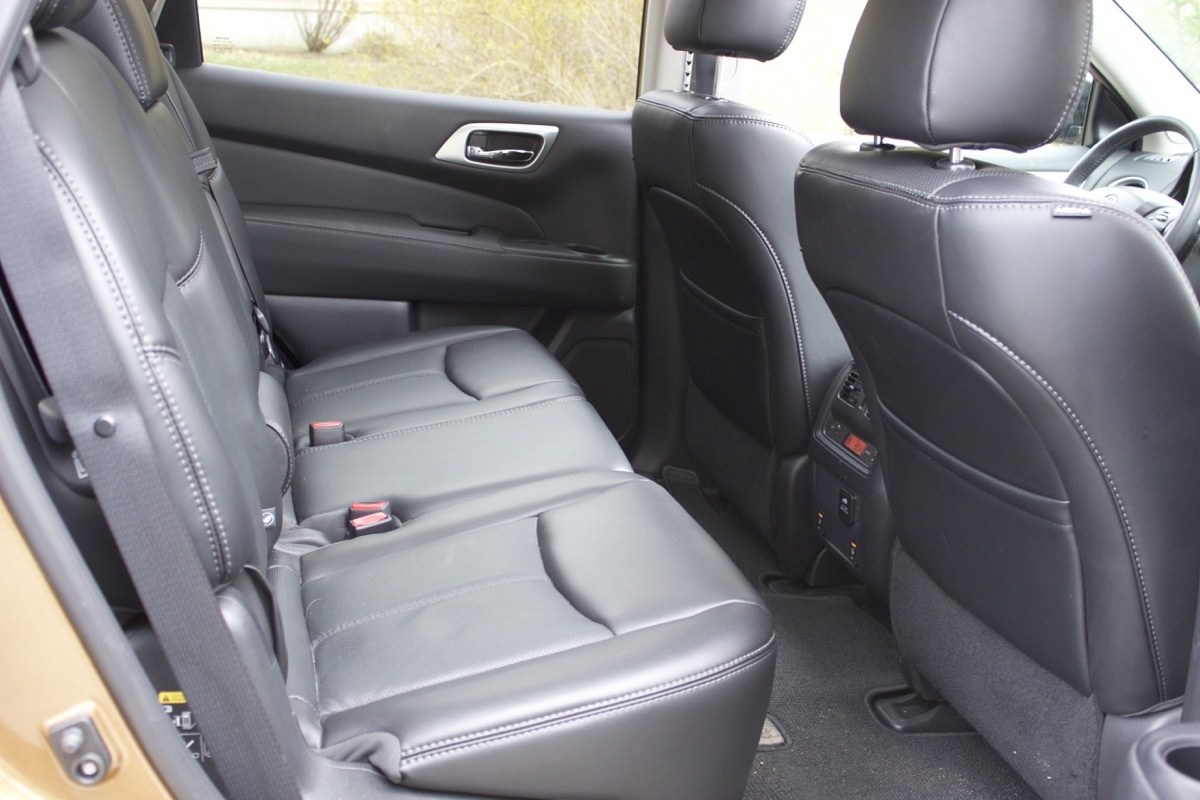
The Pathfinder provides 8 cup holders and 6 bottle holders, as well as plenty of cubbies and compartments for all your stuff. And no matter which trim you choose, you get 7-passenger seating with a middle bench and a 50/50-split third row. Drop the second and third rows and you get 79.8 cubic feet of cargo space. That’s less than the Toyota Highlander and Honda Pilot, but only slightly. If you like the Pathfinder, that marginal drop in cargo space won’t be a deal breaker.
The same cannot be said of all three rows of seating. Access to the third row is easy enough, though as third rows go, it’s middle of the pack. The Highlander has a more cramped third row, and the Honda Pilot is one of the few vehicles in this class with a third row that fits adults. But if you’re mainly hauling kids around, that shouldn’t be a huge deal, either.
Technology
As stated already, the Pathfinder has an 8-inch touchscreen as standard equipment, and moving up to the Platinum trim adds navigation with real-time traffic and weather. One great thing about Nissan products is their redundant controls. You can use the touchscreen or the many buttons down below, including a large dial in the middle to zoom in and out of the map.
A tray for your smartphone displays the ambient light below the center stack. You can plug your phone into one of the pair of USB ports located on the center console. Pairing a smartphone for Bluetooth hands-free calling is easy enough, and you can click through to your phone’s music simply by pressing Media. It is a straightforward layout, though it lacks Apple CarPlay and Android Auto. They might be available in the future, but not on the 2017 model. That’s more than we can say for the Toyota Highlander, which has no plans to get those systems.
Safety
The Pathfinder comes standard with a full array of front and side impact airbags, Vehicle Dynamics Control with traction control, front and rear crumple zones, and the LATCH child-seat anchoring system. The Pathfinder also comes standard with a tire pressure monitoring system and Easy-Fill Tire Alert. When you fill the tires with air, the car automatically honks the horn when you’ve reached the ideal tire pressure. This is a great system to keep tire pressures normal, as most folks don’t typically carry a tire-pressure gauge.
A crossover like this often has to carry plenty of kids and their gear, and the Pathfinder delivers peace of mind via its strong safety scores. It earns 5 stars in National Highway Traffic Safety Administration (NHTSA) crash testing, and it’s a Top Safety Pick from the Insurance Institute for Highway Safety (IIHS). Optional safety tech, like forward-collision warning, blind-spot warning, and rear cross-traffic alert are also considered Superior by the IIHS.
Cost-effectiveness
Base MSRP for the 2017 Nissan Pathfinder is $30,290 for the S trim. The SV starts at $32,980, and the SL starts at $36,100. A Platinum trim starts at $42,070, and our Platinum 4WD test model clocks in at $44,685.
The Nissan Pathfinder comes with a 3-year, 36,000-mile basic warranty and a 5-year, 60,000-mile powertrain warranty. These figures are in line with its biggest competitors, the Honda Pilot and Toyota Highlander.
The Pathfinder breaks with the Pilot and Highlander to offer a compelling third option in this group of family-hauler SUVs. It doesn’t excel at any one thing, but instead is a very well-rounded vehicle. I have no problem calling the Pathfinder a smart choice as an all-around family-friendly vehicle.

What owners say
"Overall, owners of the 2017 Nissan Pathfinder express a strong liking for its comfort, features, and spaciousness, particularly for families. Many appreciate the smooth performance and good gas mileage. However, some concerns were raised about steering issues and tire wear."
I love this car! Very comfortable, lots of great features.
December 4, 2020AMAZING CAR! Has great features for a 2017! Awesome deal and runs so smoothly! Have back up camera, Bluetooth, great ac, very roomy for my 4 kids! Trunk is medium sized not too big so if Im doing a big grocery day I’ll have to let seats down but overall I’m in love !!
March 25, 2022Roomy but not engulfing, handles nicely, all around sharp looking vehicle!
May 28, 2021What owners say
I love this car! Very comfortable, lots of great features.
December 4, 2020AMAZING CAR! Has great features for a 2017! Awesome deal and runs so smoothly! Have back up camera, Bluetooth, great ac, very roomy for my 4 kids! Trunk is medium sized not too big so if Im doing a big grocery day I’ll have to let seats down but overall I’m in love !!
March 25, 2022Roomy but not engulfing, handles nicely, all around sharp looking vehicle!
May 28, 2021Very well equipped SUV. I love the fact that it has third row seating (that actually seems quite comfortable for short trips). The gas mileage on this is great for an older full-size SUV (25 mpg avg according to tripometer). The SL and Platinum both had leather interior, which is really nice and the seats were very comfortable. A great car for traveling!
May 22, 2023Steering wheel wobbled while driving. Tire were worn out.
February 9, 2020Trims & specs
Base MSRP $43,760 | Seating 7 |
Engine 3.5L 284 hp V6 | Cargo Capacity 16.0 cu ft |
Combined MPG 22 | Drivetrain 4X4 |
Base MSRP $42,070 | Seating 7 |
Engine 3.5L 284 hp V6 | Cargo Capacity 16.0 cu ft |
Combined MPG 23 | Drivetrain FWD |
Base MSRP $34,670 | Seating 7 |
Engine 3.5L 284 hp V6 | Cargo Capacity 16.0 cu ft |
Combined MPG 22 | Drivetrain 4X4 |
Base MSRP $32,980 | Seating 7 |
Engine 3.5L 284 hp V6 | Cargo Capacity 16.0 cu ft |
Combined MPG 23 | Drivetrain FWD |
Base MSRP $31,980 | Seating 7 |
Engine 3.5L 284 hp V6 | Cargo Capacity 16.0 cu ft |
Combined MPG 22 | Drivetrain 4X4 |
Base MSRP $30,290 | Seating 7 |
Engine 3.5L 284 hp V6 | Cargo Capacity 16.0 cu ft |
Combined MPG 23 | Drivetrain FWD |
Base MSRP $37,790 | Seating 7 |
Engine 3.5L 284 hp V6 | Cargo Capacity 16.0 cu ft |
Combined MPG 22 | Drivetrain 4X4 |
Base MSRP $36,100 | Seating 7 |
Engine 3.5L 284 hp V6 | Cargo Capacity 16.0 cu ft |
Combined MPG 23 | Drivetrain FWD |


Pricing trends
MSRP range
$30,290 - $43,760
Current avg. market price
$10,324
Trending down by 3.1% this month
May 2026 - October 2026


