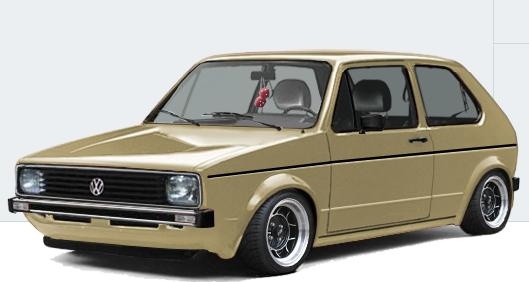
1975 Volkswagen Rabbit Reviews, Pricing & Specs

Write a review

--

Original MSRP

--

expert review

2.3

avg user rating

(3 reviews)
1975 Volkswagen Rabbit Preview summaryImage

In 1975, Volkswagen launched what it hoped would be a successful successor to the Beetle, whose popularity had started to wane by the mid-1960s. Called the Golf in the rest of the world, the new vehicle was dubbed the Rabbit for the U.S. market. Sporting an angular appearance, thanks to a design by famed Italian automotive designer Giorgetto Giugiaro, the Rabbit was distinctively different than the Beetle, and it would prove the success VW needed.

In its first year of production, the Rabbit was available as a either a two- or four-door hatchback. It was a front-wheel-drive vehice powered by a 1.5-liter. water-cooled four-cylinder engine that generated 70 horsepower. Top speed was 93 miles per hour, according to Volkswagen. A four-speed automatic was standard, while a three-speed automatic was available as an option.

With a length of 13 feet, the Rabbit was actually 5 inches shorter than the Beetle. But because VW turned the Rabbit's front-positioned engine sideways, there was plenty of interior space. Among the Rabbit's features were a driver's seat that adjusted to 18 different positions, padded sunvisors, four-wheel independent suspension, and rack and pinion steering. Options included air conditioning, a roof rack, bumber guards, a rear window defogger, and a wood-panel dashboard.

Despite its lackluster engine, at least by today's standards, the '74 Rabbit was still highly rated when compared to its competitors, with reviewers citing its balance, handling, ride, and quickness as positive points.

CarGurus Editorial Team
Published Aug 9, 2022 by CarGurus Editorial Team
While we highlight specific author bylines where possible, sometimes our content results from the combined efforts of several members of the CarGurus editorial team. As with all our editorial content, you can expect high levels of automotive insight and expertise delivered in a style that is approachable and free from jargon.

User reviews for 1975 Volkswagen Rabbit

Write a review
User rating:
by Phillip B
Jan 29, 2009
cold air intake and performance suspencion and performance exaust and performance brakes and engine good and its in good shape i paid 500 and i put 2500 in the engine and 5000 in the apperance and when i got it it was stripped it had no light and no engine and no windows.Jan 29, 2009
by Larry L
Jun 05, 2008
average car with no extrasJun 05, 2008
by Anonymous
Apr 01, 2007
I had fallen for my girlfriend's baby blue '71 VW Beetle and, after nearly three years and 27,000 miles of making excuses for daring to drive faster than 50 miles per hour in my chocolate brown '72 Vega 2300 Notchback sedan, I was ready to buy a shiny new '75 metallic green VW Le Grande Bug with all the trimmings. This was a very nicely equipped car and was the last of VW's attempts to market the super beetle in an increasingly competitive environment of vehicles from the orient. I liked what I saw and approached the dealer's lot with money in hand when my path was blocked by a Rabbit owner who explained the virtues of his new vehicle. He seemed especially pleased that the car appeared to be designed to be very easy to service. I had done some reading and was aware that the Rabbit was a radical departure from contemporary products. It was a new lightweight front wheel drive design and a bit of future shock in its day but innovation didn't scare me. GM's engine driveability problems scared me. I had taken a test drive in a new but slightly rusting '75 Nova LN with a small V8 engine that had stalled several times as the salesman hung a left turn into oncoming traffic. That afternoon, I decided to gladly trade my Vega for a shiny new, African Red '75 Rabbit with straight stick and an AM/FM radio. The car was nicely painted and the white vinyl seats were comfortable but as soon as I sat down in my 2-door Rabbit Custom, I was disappointed to discover that the seats were not designed to recline fully as they did in the Rabbit Deluxe, which I had not purchased. There were other differences that I accepted as I discovered them. The fan ran at one very high noisy speed and the fan was not integrated with the dashboard registers. So, unless you were underway, there was no way to force fresh air into the car. Okay. I could always roll down a window. I was ready to get moving but I had some difficulting getting the seat belt to unwind from the holster beside the driver's seat. When I turned to ask the salesman for help, he had disappeared into the building. Eventually, I discovered the trick to carefully coaxing the belt from the temperamental spring-loaded retractor mechanism. It was the beginning of my education with this car. Once I was underway, the new engine was responsive and peppy. The 4 speed stick shifted easily into most of the gears. When I arrived home (in Erie, Pa) from taking delivery at the dealer (in Meadville, Pa) I opened the driver's door, stepped out, and closed the door. There was a funny little noise. The little black popup button that operates the door lock had disengaged itself from the control linkage so that the door could not be locked without a key. No problem. I quickly popped the inside door panel off the door frame and reinserted the metal rod that had undone. My first repair. I felt a splash of pride: I had fixed my new car without any fuss. Over the years, I became an expert at this repair. A few weeks later, my girlfriend and I were zipping down route 79 intent on spending the day in Pittsburgh when, suddenly, there was a very loud wheezing noise from the engine compartment. If I released my foot from the accelerator, the engine died. It would restart but would not continue running unless I floored the accelerator pedal. I pulled off the highway to the shoulder. I opened the hood. I looked for something that looked broken but I couldn't find anything. I got some grease on the cuff of my blue polyester suit. Suddenly, a highway patrolman pulled alongside us. He asked if the car could be driven and encouraged me to get it off the highway. Luckily, we were a short distance from Meadville and we were able to drop the car with the dealer. We hoofed it to the bus station for a ride back home. Three days later, the car was fixed. A plug had fallen out of the carburetor. A few weeks later, the low-hanging oil pan struck the curb as we gently rolled into a head-in parking space. I applied hard-setting permatex to fix the ensuing oil leak. Did I mention the self-destructing little rubber donuts that held a shield to the exhaust pipe? I learned to keep a supply of these in the car. I always knew when it was time to crawl under the car and replace one: there was an annoying metallic vibration every time the engine came out of gear. My car was equipped with a zenith carburetor. The exhaust gas recirculation system was designed to allow condensing water vapor to collect on the choke flap in the carburetor. During the warm months of the year, everything worked fine. But, when the temperature dropped below freezing, the choke flap was stuck in the fully open position disabling the engine at startup because the choke could not close the flap. VW eventually put out a bulletin on how to fix this problem. They added a brass pipe to route the condensation directly into the carburetor intake throat without contacting the choke linkage. I became a regular pal with the technicians at the VW shop in Cleveland, where we also discovered that the radio antenna wire was allowing rainwater to drip onto the electrical fuseblock, disabling the brakelights. Later, when the catalytic converter began to clog with debris from the combustion process, the car would resist all attempts to accelerate any faster than, say, 25 mph. The VW techs retuned the jets and eventually, emptied out the converter. So much for clean air. I only kept the car for 72,000 miles but somehow, every 90 days I was told that I needed new brakes. I fell for this nonsense a couple of times before I reminded the service writer (at a store in Garden City, Long Island) that his shop had replaced the brakes 3 months earlier. This was the same writer who told me that two of my taillights were blown and had to be replaced before the car would pass inspection. This was a big surprise because I had checked the lights before bringing the car in for inspection. After I made a big fuss in front of a long line of Rabbit owners, he dropped the bullsh't story and returned my car. In the second year of ownership, I paid to replace a defective battery, a defective distributor, and a bad alternator, among other small electrical relays and devices hidden away under the hood. One day, I noticed I was being trailed by a small cloud of blue smoke especially on long downgrades. Without my permission, the car had acquired a taste for motor oil. First, it was a manageable quart every third or fourth fillup. After a few months it was a quart every other fillup. The next year, it became a quart of oil when I filled up with gas. In the final year of ownership, it became intolerable. I was pulling into gas stations requesting that the attendant "fill it up and check the gas." Finally, one day in '79, the fuel gauge suddenly swung up toward the full mark and remained stuck there. Now, I had no idea when to fill the engine with oil and the tank with gas. Quickly, I realized that I could simply stop every 200 miles and replenish all of the fluids. I grabbed a pencil and kept a notation of the mileage when I filled the tank. I did this for several months until one day, while I was cruising along dragging a blue cloud behind me, when the speedometer needle suddenly dropped to zero and stayed there while the car continued to chug along at very nearly the speed limit. Now, I felt a chill run through my entire body. I no longer knew how far I was traveling. Nor did I know how much gas remained in the tank. It was time to dump this critter. The next week, I traded it for an '80 Monte Carlo and I have never regretted that decision. BTW, I still have the Monte. It has 240,000 miles on it and runs like a top. Apr 01, 2007

1975 Volkswagen Rabbit Pricing

Original MSRP
N/A
Price range
N/A
Average price on CG
N/A
YoY price change
N/A

Trims & specs

No trims were found for this car.