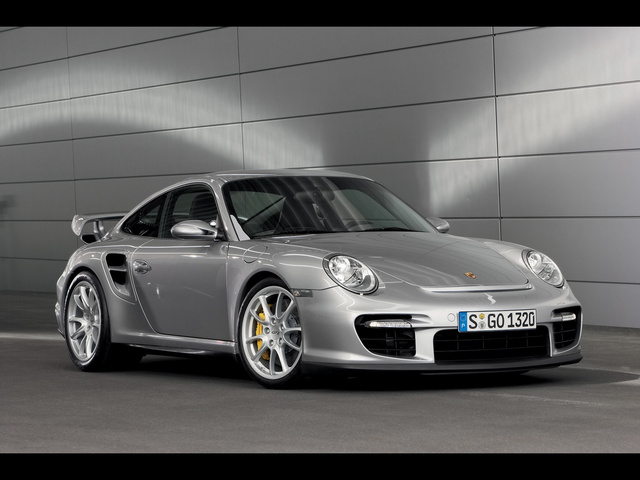
The 2008 GT2 represents the performance peak of the forty-four-year-old production Porsche 911. First unleashed for the 993-generation 911 (which debuted in '93), the GT2 was powered by an air-cooled, twin-turbocharged boxer six that produced 430 hp. Car and Driver labeled it "the Darth Vader of the world club-racing scene." The next-generation GT2, introduced in 2002, boosted horsepower to 456. Discontinued for the last two years, Porsche engineers were busily developing the 997-generation version. For this latest version of the GT2, Porsche engineers crossbred the fabulous 911 Turbo with the all-out track GT3 and then added some of their engineering "magic" to refine the ultimate production 911.
Based on the 911 Turbo's 3.6-liter all-alloy boxer six, the GT2 engine also has dry-sump lubrication with nine separate oil pumps, VarioCamPlus variable intake valve timing, and Nikasil-coated aluminum cylinder liners that feature individual oil-spray cooling. The GT2, however, adds the latest Borg-Warner water-cooled, variable-turbine geometry (VTG) turbochargers, which are capable of 20.3 psi of boost. VTG technology uses the engine-management system to control the turbine's guide vanes, allowing higher turbine speed at lower engine rpm. This helps make turbo-lag spin away, while extending the engine's torque range. Other GT2-specific engine innovations include the new expansion intake manifold, which forces cooler air into the engine, and the new titanium exhaust system that is 20 pounds lighter than the standard 911's and provides the GT2's unique "voice."
The result is an engineering tour de force: 530 hp with 505 ft-lbs of torque from 2,200 to 4,500 rpm. The engineering, however, didn't stop with the engine. To produce even more outstanding performance, Porsche put the GT2 on a diet. The rear seats and sound-deadening were deleted, while carbon-fiber front bucket seats firmly hold the driver and a lucky passenger. Standard equipment also includes massive Porsche Ceramic Composite Brakes (PCCB) - they reduce weight by 20 pounds per wheel and enable the GT2 to get from 0 to 186 mph back to a stop in 40 seconds! The svelte GT2, minus all-wheel drive, weighs more than 300 pounds less than its 911 Turbo sibling.
Thus, while the GT2 ties the manual-transmission 911 Turbo across the 0-60 jump at 3.7 seconds (but not the Tiptronic S 911 Turbo, which does it in a phenomenal 3.4 seconds), it soon leaves the "chubby one" behind, reaching 99 mph in 7.4 seconds, a second faster than the manual 911 Turbo and half a second faster than the automatic. The GT2 can get up to 124 mph in 11.2 seconds from a standing start, while the 911 Turbo takes a second longer. At the top end - are you ready for this? - the Turbo maxes out at 193 mph, while the GT2 continues to pull away to a "top track speed," as Porsche puts it, of 204 mph. Reviewers all seem to have had their top-speed Autobahn ride on the same rainy day in Germany, but their top speeds varied from a "low" of 195 mph to Car and Driver's incredible speedometer-indicated 331 km/h or 205 mph!
Reviewers all agree that the 911 Turbo is easier to control at such high speeds, but the rear-wheel-drive GT2 is a much more thrilling ride - it's basically a race car in road "clothing." Porsche has finessed the car's aerodynamics - the rear spoiler has ram-air ducts in its lower half and behind the rear wheels, and air extractors ventilate the intercoolers and engine compartment - and lowered the GT2 by an inch. Enlarged front grills with an air extractor for the radiator on the edge of the nose make the visual point that this car has been built for serious speed.
How serious? Serious enough that Walter Rohrl, legendary rally racer and Porsche test driver, set a Nurburgring Nordschleife record of 7 minutes, 32 seconds in a GT2 - matching the times of the 605-hp Carrera GT! Even more amazing, the GT2 comes equipped with Porsche Active Suspension Management (PASM), an electronic control system that adjusts shock damping according to road conditions and driver input. The driver can select "Normal" for maximum comfort or "Sport" for maximum-performance handling. Rohrl used the "Normal" setting for his record run. Car and Driver pointed out that the GT2's "Normal" setting is firmer than that of the Turbo, and even Rohrl wondered why "Sport" was necessary.
Yet reviewers had some mixed impressions of the GT2's handling. Car and Driver praised its "gorgeous steering, razor sharp and crystal clear" and its "rock solid chassis...solid unflappable high-speed perfection." But Edmunds, while praising its overall performance, felt that "even the smallest of surface imperfections makes it feel nervous."
Everyone, however, thoroughly enjoyed the GT2 Launch Assistant system - a first for Porsche - which practically guarantees perfect drag-strip launches. Put the clutch pedal and gas pedal to the floor, and slip the gear shifter into first. The engine revs to 5,000 rpm (not its redline), and your foot slips off the clutch. Don't forget to shift into second and you have 0-60 in roughly 3.7 seconds! Reviewers, however, unanimously complained about the clutch pedal's heavy action.
Walter Rohrl summed up the GT2 by saying, "This is the best 911 ever: Race car, street car - the best." But then he can handle it. The GT2 should probably come with a warning on its leather-stitched dashboard: Don't try this at home.